What Does Quantum Mechanics Have To Do With A Cat?
What Is Quantum Mechanics?
Quantum mechanics is a branch of science that studies the tiniest things in the universe—things like atoms, electrons, and photons. These particles are so small that the usual rules of physics don’t apply to them. Scientists noticed that particles can act like both waves and solid objects at the same time. That sounds confusing, doesn’t it? But it’s true! In the quantum world, particles can even be in two places at once or spin in opposite directions at the same time. This is very different from what we see in our everyday lives. Because of this, quantum mechanics helps explain things like how the sun shines and how atoms stick together.
Meet Schrödinger’s Cat
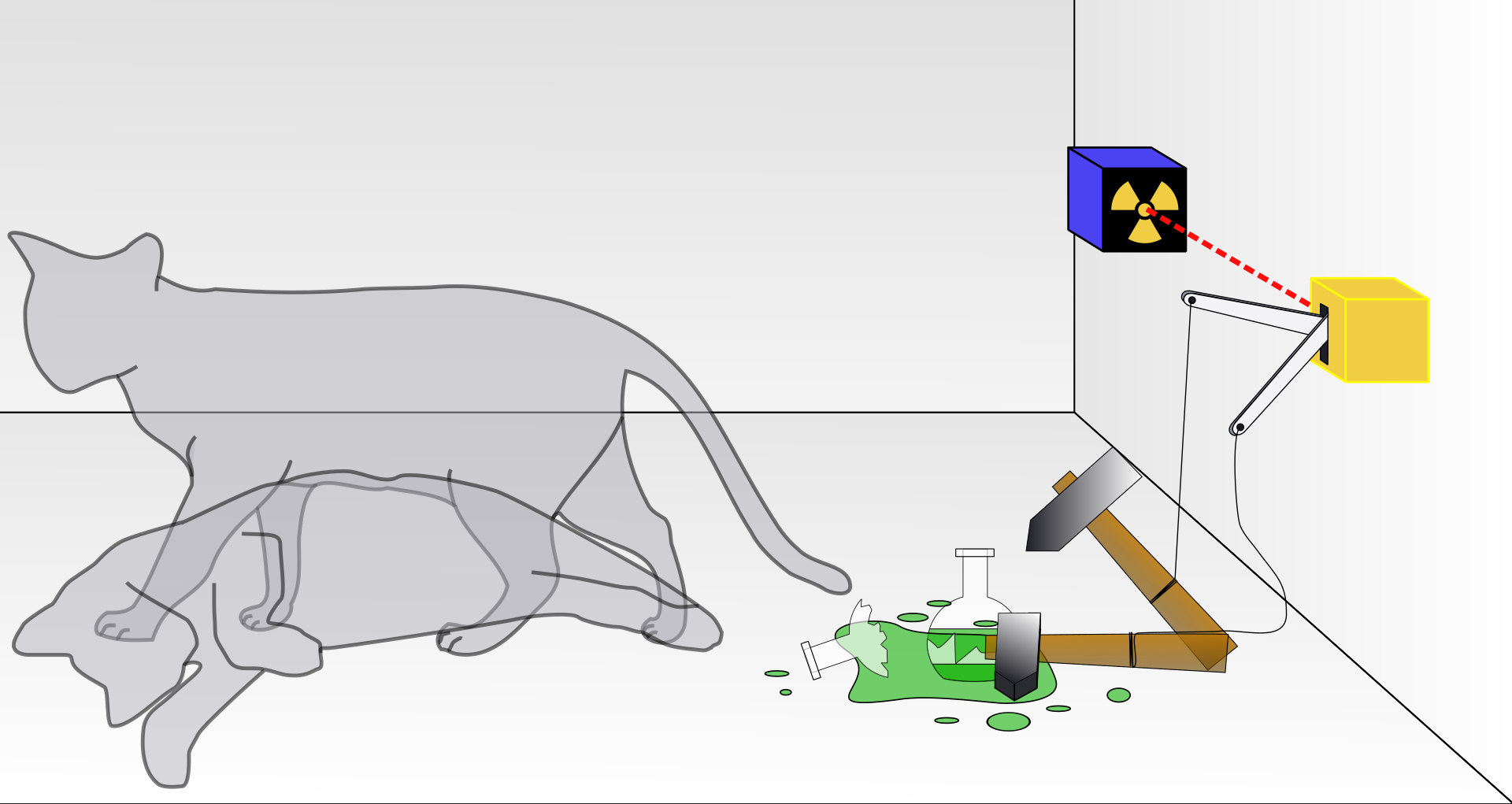
Now, let’s bring in the cat! In 1935, an Austrian scientist named Erwin Schrödinger came up with a weird idea to explain a problem in quantum mechanics. He imagined a cat inside a sealed box with a strange gadget. This gadget had a tiny bit of radioactive material and a poison that would be released if an atom decayed. But here’s the thing: in quantum mechanics, that atom is both decayed and not decayed until someone checks. So the cat, weirdly enough, is both alive and dead until the box is opened. Schrödinger didn’t want anyone to hurt a cat—he was using this as a thought experiment to show how bizarre quantum rules can be.
How Can a Cat Be Both Alive and Dead?
This idea sounds like something from a science fiction movie, but it’s actually meant to make you think. Schrödinger’s cat isn’t really about the cat at all. It’s about how observing something in quantum mechanics changes what it is. Until you look inside the box, the cat is in a mix of states—both alive and dead. Once you open the box, the cat is either alive or dead, but not both. The idea is that the act of measuring or observing something affects what’s really happening. This is one of the strangest and most fascinating parts of quantum physics.
Superposition: A Fancy Word for Being in Two States
One of the big ideas in quantum mechanics is called superposition. Superposition means a particle can be in more than one state at the same time. Imagine flipping a coin. In the real world, it lands on heads or tails. But in the quantum world, it could be both heads and tails until someone looks! This is what’s happening with Schrödinger’s cat. The cat’s life or death depends on a tiny particle that’s in superposition. Once someone looks, the superposition collapses, and we see just one outcome.
Why This Matters in Real Life
You might be wondering, “Why should I care about this strange science stuff?” Well, quantum mechanics isn’t just for scientists in labs. It helps make the modern world work! Things like computers, mobile phones, and even GPS use quantum rules. Lasers, microwaves, and solar panels rely on quantum ideas. In fact, without quantum physics, the internet wouldn’t exist. So even though it seems weird, it has a big impact on your everyday life.
What Are Quantum Particles Like?
Quantum particles are nothing like footballs or marbles. They don’t follow the normal rules of motion or gravity. Instead, they can disappear and reappear, go through walls, or even link up with other particles far away. These tiny things are unpredictable and hard to measure. Scientists use very clever machines and experiments to try and catch them in action. Even then, they can only predict what might happen, not what will happen for sure. This makes quantum mechanics both tricky and exciting.
The Role of Observation
In quantum physics, observing something isn’t just about seeing—it actually changes what you’re looking at! This is called the “observer effect”. If you try to measure a particle’s location, you can’t also measure its speed exactly, and vice versa. This is part of something called the Heisenberg Uncertainty Principle. It means we can never know everything about a particle at once. It’s as if the universe has its own secrets it won’t share too easily!
Is Schrödinger’s Cat Real?
No, there was never a real cat in a box, and no animals were harmed. Schrödinger’s cat is just an idea—a way to show how strange and confusing quantum rules are. It’s meant to make people think and question how the universe works. Scientists don’t actually believe a cat can be alive and dead at the same time in real life. But they do use the cat example to explain quantum ideas in a way people can understand.
Quantum Mechanics vs. Classical Physics
Classical physics is the science of big things—cars, planets, rockets, and so on. It works great for things we can see and touch. But when things get super tiny, classical physics doesn’t work anymore. That’s when we need quantum mechanics. It’s like the universe has two sets of rules: one for big stuff and another for tiny particles. Understanding both helps scientists build better technology and solve mysteries of the universe.
Quantum Computers: The Future Is Now
One amazing thing that comes from quantum mechanics is the idea of quantum computers. These are super powerful machines that can do things normal computers can’t. They use quantum bits, or qubits, which can be both 1 and 0 at the same time. This lets them solve problems much faster. One day, quantum computers might help find new medicines, crack secret codes, or even design smarter robots.
Teleportation and Entanglement
Have you heard of teleportation? Quantum mechanics makes it kind of real! Scientists can “teleport” information between particles using something called entanglement. When two particles are entangled, whatever happens to one instantly affects the other—even if they’re far apart. It’s like magic, but it’s been proven in real experiments. This could help build super-fast internet or super-safe communication in the future.
The World of Possibilities
Quantum mechanics opens up a world of possibilities that we’re only just beginning to explore. Scientists are using it to understand black holes, dark matter, and the beginning of the universe. They’re building machines that can see inside atoms and make materials that act in strange new ways. Every day, new discoveries are being made, and the science of the tiny keeps changing what we know.
Can We Ever Understand It All?
Even experts admit that quantum mechanics is confusing. Albert Einstein once said, “God does not play dice with the universe,” because he didn’t like how random it all seemed. But the more we study it, the more we realise the universe is full of surprises. Some things we may never fully understand—but that’s what makes science exciting. There’s always more to learn!
Why It’s Fun to Learn About Strange Things
Even if quantum mechanics sounds weird or hard, it’s still fun to explore. The idea that a cat could be alive and dead at the same time grabs your attention, doesn’t it? Learning about strange ideas helps your brain grow and your imagination shine. You don’t have to be a genius to be curious. Who knows—you might be the next great scientist who solves a big mystery!
So, What Does Quantum Mechanics Have To Do With A Cat?
Now you know! The famous Schrödinger’s cat thought experiment helps explain one of the weirdest ideas in quantum mechanics—superposition. While it’s just a pretend cat in a pretend box, it teaches us how particles behave in the quantum world. The cat might not be real, but the science behind it definitely is. And it’s helping shape the future in ways we’re just starting to discover.
What Do You Remember?
-
What does quantum mechanics study?
-
Why did Schrödinger imagine a cat in a box?
-
What is superposition?
-
How does observing something change it in quantum mechanics?
-
What is one real-life technology that uses quantum science?
Related Topics
If you enjoyed learning about Schrödinger’s cat and the odd world of quantum mechanics, you might want to explore more about atoms, energy, and the universe itself. Learning how science explains things we can’t see is like having a superpower of knowledge! You could look into how black holes work, or how computers are getting smarter with quantum rules.
Learn more
https://en.wikipedia.org/wiki/Quantum_mechanics
https://en.wikipedia.org/wiki/Schr%C3%B6dinger%27s_cat