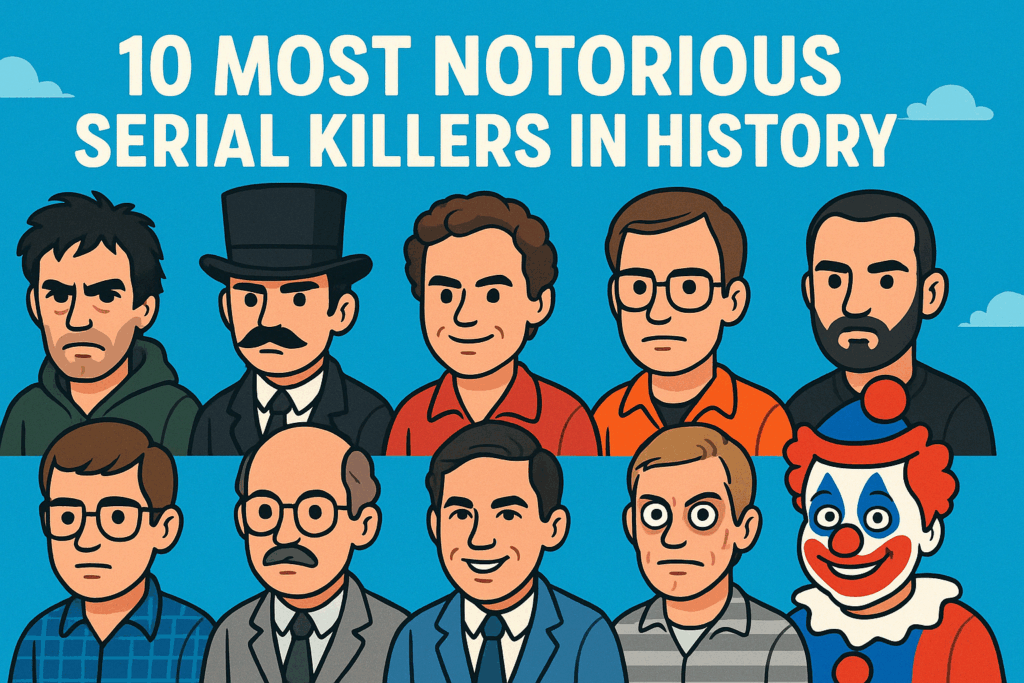
10 Most Notorious Serial Killers in History
Serial killers have fascinated and horrified people for generations. These notorious serial killers didn’t just break the law — they broke our sense of safety. From ancient history to modern times, these infamous criminals left chilling legacies that still echo today. In this article, we’re digging into who they were and why they’re remembered.
We’ll look at famous murderers like Jack the Ripper, as well as modern serial homicide cases that still shock investigators. Each case tells a different story — some killers acted alone, others worked in pairs. Some were caught quickly, while others evaded justice for years. All left deep marks on society and criminal history.
But what makes someone become a serial killer? Is it something they’re born with — or shaped by life? We’ll explore the psychology behind these crimes and look at how detectives work to catch history’s worst killers. And along the way, you’ll start spotting the patterns that connect these cases across time.
So if you’re curious, disturbed, or just want to understand how investigators tackle evil — you’re in the right place. Let’s dive into the dark and complex world of the most notorious serial killers in history.
This topic is part of our Info Zone collection. You can read the full topic, once logged in, here: 10 Most Notorious Serial Killers in History
You’ll also find a full Lesson Plan and a handy Parent Q & A sheet, for this topic, ready to use..
What Makes a Serial Killer?
To be classed as a serial killer, a person must murder at least three people in separate incidents. These killings usually follow a pattern and are often committed over weeks, months, or even years. The motivation is rarely money or revenge. Instead, it might be power, obsession, or deep psychological issues.
Most notorious serial killers plan their crimes in detail. They often have a preferred method — like strangling, poisoning, or stabbing. Some even leave behind strange clues or symbols. Many killers also choose victims who fit a certain type — by age, gender, or other traits.
What’s frightening is how “normal” some of these people seemed. Many held jobs, had families, and blended into society. But behind the scenes, they were leading double lives. This ability to hide in plain sight makes serial homicide cases especially hard to crack.
Psychologists have tried to understand what drives these individuals. Some had troubled childhoods. Others suffered brain injuries. And a few were driven by twisted beliefs or urges they couldn’t control. While there’s no single “serial killer personality,” there are warning signs — and patterns.
Understanding what makes a serial killer is the first step in stopping them. That’s why profiling and forensic psychology have become crucial tools in modern law enforcement.
Jack the Ripper: History’s First Media Sensation
Jack the Ripper is one of the most famous murderers in history — even though we still don’t know who he was. In 1888, he killed at least five women in London’s Whitechapel district. The victims were poor and vulnerable, and the crimes shocked Victorian society.
What made Jack the Ripper different was how he played with the media. He sent letters to newspapers, mocking police. Some letters included gruesome details that only the killer would know. This turned the case into an early example of media-fuelled fear.
The murders stopped suddenly. Despite dozens of suspects and endless theories, the killer was never caught. Some think he was a surgeon. Others believe he left the country. The mystery keeps the case alive to this day.
Jack the Ripper taught police an important lesson: serial killers often enjoy attention. This makes their behaviour unpredictable — and dangerous.
Even now, detectives study the Ripper case to understand how serial homicide cases unfold, especially when the killer wants to control the story.
Ted Bundy: The Charming Killer
Ted Bundy is often remembered for one strange fact — he didn’t *look* like a killer. He was educated, attractive, and confident. But behind the charm was a cold, calculating murderer. Bundy confessed to killing more than 30 women across several US states in the 1970s.
He lured his victims by pretending to be injured or needing help. Once they let their guard down, he attacked. His crimes were brutal, and he often revisited the crime scenes. Bundy escaped police twice and even acted as his own lawyer in court.
Bundy’s case changed how people viewed serial killers. It showed that evil doesn’t always look scary. Sometimes, it looks friendly — even trustworthy.
His trial was one of the first to be broadcast on national television. It gave the public a chilling look into the mind of an infamous criminal who never truly showed remorse.
Ted Bundy remains a key case in criminal psychology. He’s often studied in law and psychology courses today — not because of fame, but because of what he revealed about how killers think.
John Wayne Gacy: The Killer Clown
John Wayne Gacy lived a double life. By day, he ran a business and entertained children as “Pogo the Clown.” By night, he tortured and murdered young men. Gacy killed at least 33 victims in the 1970s, burying many of them under his house.
The idea of a killer clown horrified the public. How could someone who seemed so cheerful and helpful be so evil? Gacy used his charm and costumes to lower people’s defences — especially his young victims.
When police discovered the bodies, the nation was stunned. His case led to major changes in how police track missing people, especially teenagers. It also led to increased psychological testing for people working with children.
Gacy never showed regret. He was eventually executed, but his case continues to be used in law enforcement training. It’s a reminder that appearances can be deceiving — and predators don’t always look like villains.
Today, “killer clown” is a term that instantly triggers fear, largely because of this one man.
Harold Shipman: Doctor Death
Unlike other serial killers, Harold Shipman didn’t stalk the streets. He worked as a GP in the UK — and used his position to kill. Between 1975 and 1998, he murdered over 200 of his patients, making him one of the deadliest known killers in history.
Shipman targeted mostly elderly women, often using lethal doses of painkillers. Many families trusted him, which gave him the freedom to work without suspicion. For years, his crimes went unnoticed.
What finally caught him was a mistake with a forged will. A family questioned why their mother left everything to Shipman. An autopsy revealed she’d been given a fatal dose of morphine.
His case shocked the UK. It led to major reforms in how doctors are monitored and how deaths are certified. It also highlighted the dangers of blind trust in authority.
Shipman’s crimes are a chilling example of how power can be abused — and how easily it can go unchecked if no one speaks up.
Aileen Wuornos: A Life of Violence
Aileen Wuornos is one of the few female serial killers to become widely known. She killed seven men in Florida in 1989 and 1990, claiming they tried to harm her. Her case raised tough questions about justice, trauma, and the treatment of women in the legal system.
Wuornos had a deeply troubled past. She was abused, homeless, and turned to sex work to survive. Her killings were brutal, but some argued she acted in self-defence. Others saw her as manipulative and dangerous.
She was eventually caught, tried, and executed in 2002. Her life has since been the subject of films, books, and debates.
Wuornos challenges the typical image of a serial killer. She showed that women can be just as violent — and that trauma doesn’t always lead to healing. Sometimes, it creates more harm.
Her case continues to spark conversations about mental illness, abuse, and the criminal justice system’s role in protecting or punishing.
The Psychology of Infamous Criminals
What makes people commit such horrific acts? The study of criminal psychology looks for patterns in thinking, behaviour, and history. Many serial killers share traits like lack of empathy, need for control, or extreme narcissism.
Some also show signs of psychopathy — a condition marked by charm, manipulation, and no guilt. But not all psychopaths are violent. In fact, most don’t become criminals.
Serial killers often follow routines. This is known as a “signature” — something they do not out of necessity, but compulsion. Think of it like a fingerprint. It helps investigators link crimes and build profiles.
Understanding these minds helps police predict what a killer might do next. It also helps courts decide whether someone is mentally responsible for their actions.
This field is still growing. But it’s already saved lives by helping police identify patterns early — before the killing continues.
How Serial Killers Are Caught
Finding a serial killer is one of the toughest jobs in law enforcement. It takes time, teamwork, and advanced science. Detectives rely on witness reports, crime scene evidence, and criminal profiling.
One key tool is DNA evidence. Even a single hair or skin cell can link someone to a crime. Another is behavioural analysis — looking at how the killer acts before, during, and after each crime.
Technology also helps. CCTV, mobile phone tracking, and computer forensics allow police to build timelines and track suspects.
Sometimes, a simple mistake by the killer is what solves the case. Dropping a receipt. Using a victim’s bank card. Talking too much. These slip-ups can break open a case.
But the real heroes are often the analysts and lab workers behind the scenes — piecing together tiny clues to catch history’s worst killers.
Why We’re Fascinated by Serial Killers
It might seem strange, but people are often drawn to stories of serial killers. Why? Partly because they force us to face our deepest fears. They make us question how well we know others — even ourselves.
Books, films, and documentaries explore these cases in chilling detail. While some sensationalise the violence, others aim to understand it. There’s a fine line between curiosity and glorification.
True crime content can be educational — if it focuses on justice, prevention, and truth. But it’s important not to forget the victims. Every case was someone’s worst nightmare.
Our interest also comes from wanting to protect ourselves. By studying these stories, we learn what warning signs to look for — and how to stay safe.
In the end, serial killers reveal the darkest corners of the human mind. But understanding them might just help us stop the next one.
Can Serial Killers Be Stopped?
Stopping serial killers before they act is incredibly hard — but not impossible. Mental health support, early intervention, and education play a big role. Spotting risky behaviour early can save lives.
Community awareness matters too. When people feel safe reporting concerns, police can respond faster. Sharing information between departments and countries also helps catch cross-border killers.
Laws and systems must evolve. For example, databases like ViCAP in the US help police connect related crimes across regions.
Education is key. The more people know about how serial killers operate, the better we can protect each other. Schools, families, and communities all have a part to play.
While we may never stop every killer, each case we solve teaches us more — and brings justice to victims.
A Final Thought
Notorious serial killers shock us — but they also teach us. By studying their patterns, we gain tools to prevent future tragedies and protect each other.
Quick Quiz
- What qualifies someone as a serial killer?
- Who was Jack the Ripper and why is his case still famous?
- How did DNA evidence help solve modern serial homicide cases?
- What made Ted Bundy’s trial unique at the time?
- Why is understanding criminal psychology so important?
Write your answers in the comment section below.
Related Wikipedia Links
To explore more about the history and psychology of serial killers, check out these pages:
What Do You Think?
Do you think serial killers are born or made? And can understanding their minds really prevent future crimes?