The Nature of Light: Waves and Particles (Q&A)
Q & A - The Nature of Light: Waves and Particles
Light is something we all experience every day, but it’s not always easy to explain. This light particles parent Q&A page is here to help you support your child as they explore the strange and fascinating ways light behaves. It acts like a wave, it acts like a particle—and sometimes, it seems to do both at once. That’s why scientists talk about the dual nature of light.
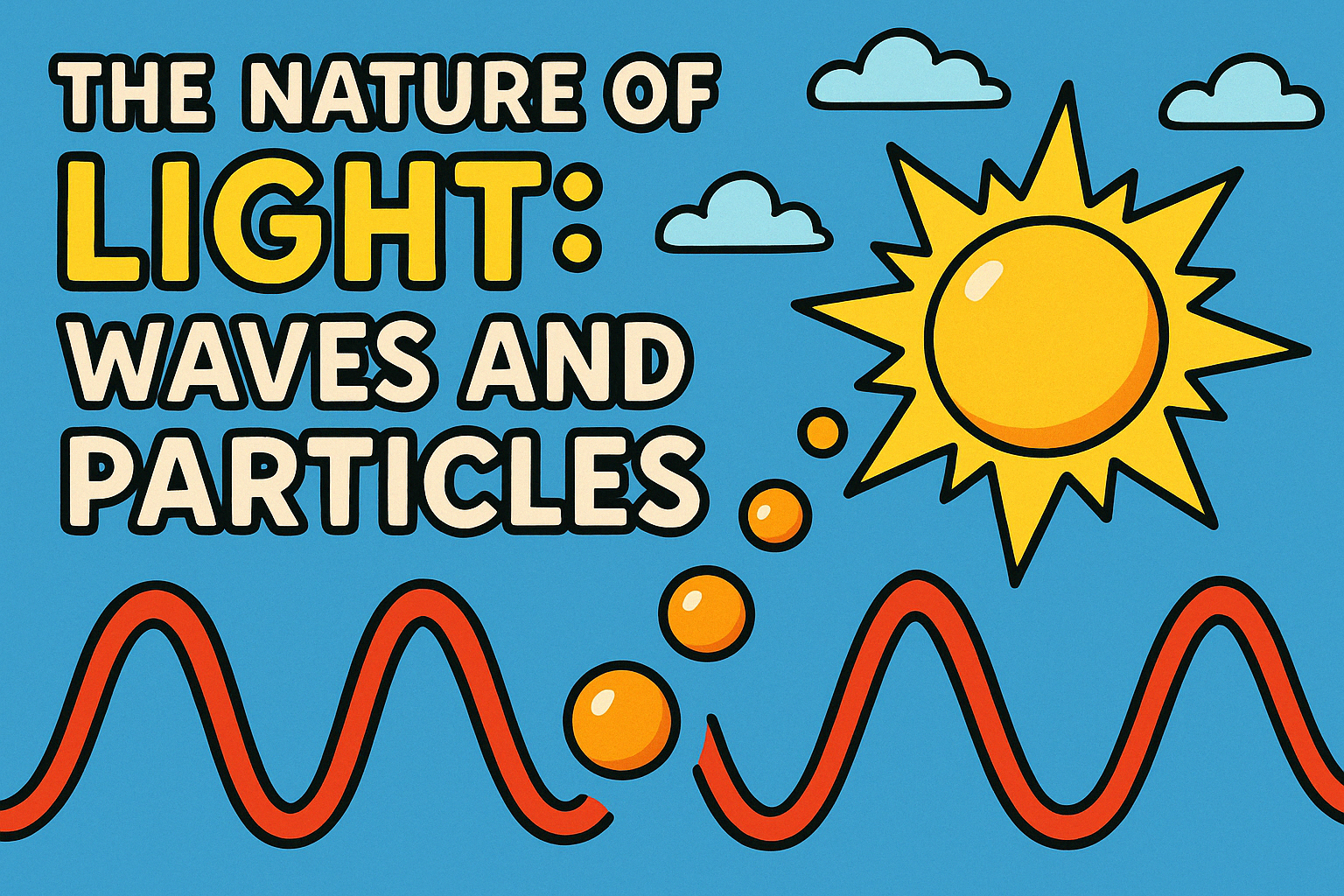
You don’t need to be a science expert to guide this conversation at home. This Parent Q&A page gives you practical, plain-English answers to the most common questions children ask on this topic. You’ll also find real-life examples, relatable explanations, and tips to spark deeper thinking. If you’re looking for a more structured approach, we also offer a lesson plan based on this same topic.
Whether your child is curious about rainbows, laser beams, or how light travels through space, this topic connects directly to things they already notice in everyday life. It’s not just about science—it’s about helping them ask questions, explore ideas, and think like a problem solver. The goal isn’t to memorise facts. It’s to help your child understand how the universe works—and that starts with light.
This topic is part of our Info Zone collection. You can read the full topic, once logged in, here: The Nature of Light: Waves and Particles
You’ll also find a full Lesson Plan and a handy Parent Q & A sheet, for this topic, ready to use..
[cl_logged_in]
[br][br]
Tip for Parents: Don’t worry if you’re not sure how to explain everything perfectly. These answers are here to guide you step by step, and it’s completely okay to learn alongside your child.
[br][br]
What does it mean that light is both a wave and a particle?
This is known as wave–particle duality. It means that light sometimes behaves like a wave (spreading out and creating patterns), and sometimes like a particle (hitting things in single bursts called photons). Which one we see depends on how we observe it.
[br][br]
What’s a photon?
A photon is a tiny particle of light. It has no mass but carries energy. You can think of it like a small packet of light energy that can travel through space and interact with matter.
[br][br]
Is light made of particles or waves?
Light is both—it behaves like a wave in some experiments and like a particle in others. This idea is central to quantum physics and is one of the key points explored in this light particles parent Q&A page.
[br][br]
Can we see photons?
No, we can’t see individual photons. But when many photons hit your eye at once, they trigger the sensation of light. In very dark conditions, the human eye can detect surprisingly small numbers of photons.
[br][br]
How do we know light is a wave?
Light bends around corners, reflects, and creates interference patterns (light and dark bands) when passed through slits. These are behaviours typical of waves, not particles.
[br][br]
How do we know light is a particle?
When light hits certain materials, it can knock electrons free. This is called the photoelectric effect, and it only works if light arrives in small energy packets—photons. That’s particle behaviour.
[br][br]
What is wave–particle duality in simple terms?
It’s the idea that light doesn’t behave in just one way. Sometimes it spreads out like a wave, and sometimes it acts like a particle. It’s not a mistake—it’s just how light really works.
[br][br]
Why do scientists still study light?
Because we don’t fully understand everything about it yet. Light is involved in everything from photosynthesis to fibre-optic internet. Studying it helps us understand the universe—and develop new technology too.
[br][br]
How fast does light travel?
In a vacuum, light travels at about 300,000 kilometres per second. That’s fast enough to go around Earth more than seven times in one second.
[br][br]
Why does light slow down in glass or water?
Light interacts with particles in materials like glass or water, which causes it to slow down and change direction. This bending is called refraction, and it’s why lenses work.
[br][br]
Do other things have wave–particle duality too?
Yes. Electrons and even whole atoms can show both wave and particle behaviour. It’s a feature of the quantum world—not just light. But light was the first place we discovered it.
[br][br]
Is this topic too hard for younger learners?
Not at all. You don’t need to explain everything at once. Simple ideas like “light travels” or “light can bounce and bend” are great starting points. This light particles parent Q&A offers layered answers to suit different ages.
[br][br]
How can I show wave behaviour at home?
Use a bowl of water and drop two small stones in close together. Watch how the ripples overlap. That’s similar to how light waves can interfere. You can also use a CD to reflect colourful patterns from a torch.
[br][br]
Where do we see photon behaviour in real life?
Solar panels work by capturing photons and using their energy to move electrons. Lasers and remote controls also rely on photons. Even your eyes respond to photons when they detect light.
[br][br]
What does “quantum” mean in this context?
Quantum means dealing with very small things—like atoms and particles of light. Quantum physics looks at how these things behave, and light’s dual nature is a key example.
[br][br]
What’s the double-slit experiment?
It’s a famous test where light is passed through two narrow slits. Instead of making two bright lines, it creates a pattern of many lines, like ripples. That only happens if light is acting like a wave—even if it’s sent through one photon at a time.
[br][br]
Can my child understand quantum ideas?
Absolutely. They don’t need to know all the maths, but they can think deeply. This light particles parent Q&A includes examples and questions that make it easier to explore at different levels.
[br][br]
What if I get stuck or don’t know the answer?
That’s okay! Just say, “Let’s find out together.” Curiosity is more important than knowing everything. These answers are here to support both of you.
[br][br]
Where can I learn more?
You can explore the full topic here: The Nature of Light: Waves and Particles. There’s also a lesson plan available if you’d like to go further.
[br][br]
[/cl_logged_in]
[cl_logged_out]
Members Only
You need to be registered and logged in to access this Q and A sheet and all other learning resources, games and quizzes.
[/cl_logged_out]

