Hello Alan Lloyd - Your Scores - Logout

The Doppler Effect: Parent Q&A

The Doppler Effect: Parent Q&A

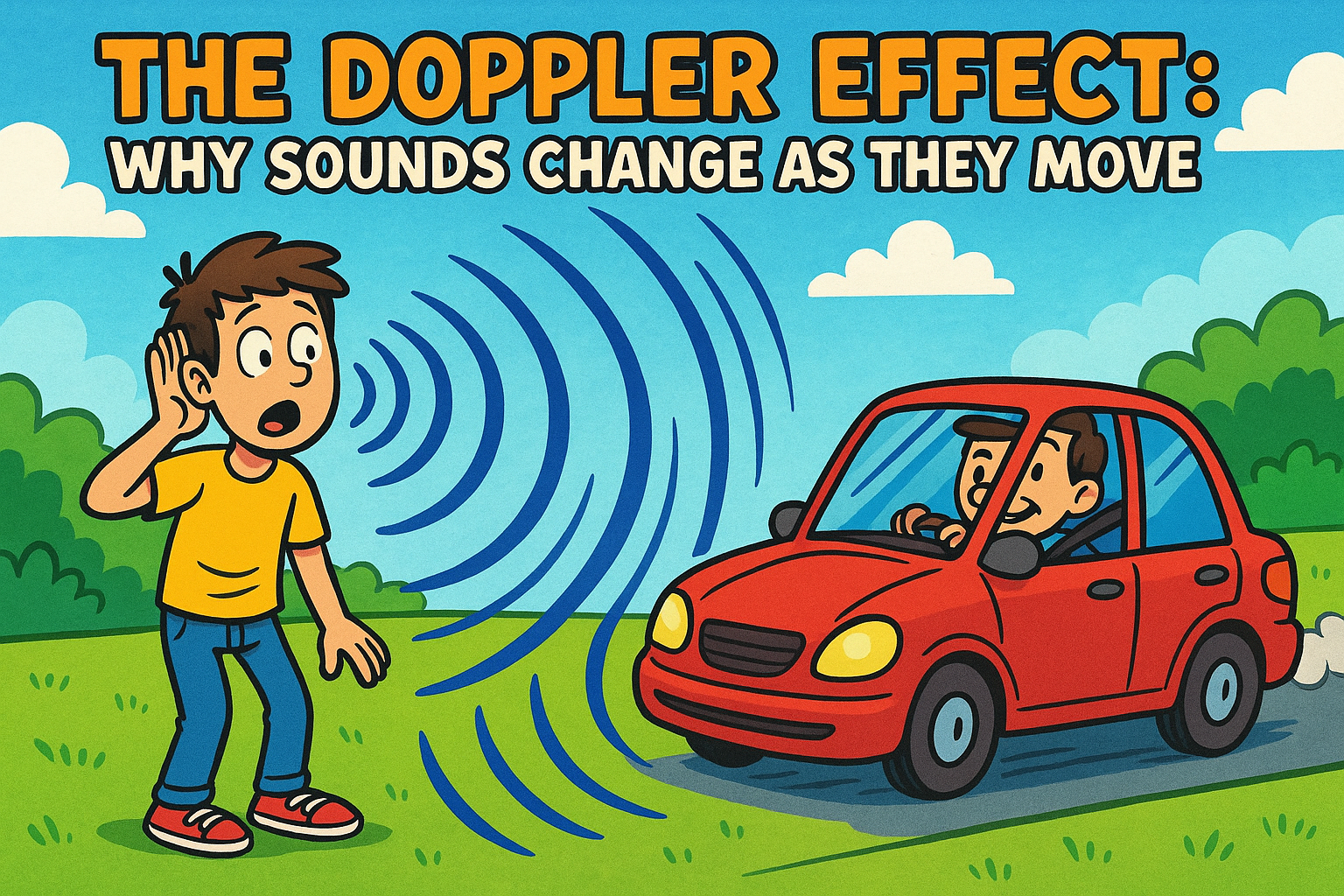
Have you ever wondered why an ambulance siren sounds different as it passes by? This doppler effect parent Q&A page is here to help you explain exactly that to your child. The Doppler effect is a physics concept that describes how sound and light waves change when something moves. It’s simple to observe in daily life, yet surprisingly powerful in science—used in everything from weather radars to astronomy.

The Doppler Effect: Why Sounds Change as They Move
By Alan Lloyd

This Parent Q&A page is designed to help you answer your child’s questions clearly and confidently, using plain language, relatable examples, and step-by-step thinking. It’s written especially for home educators like you, whether or not you’ve studied physics before. You don’t need to know it all in advance—just follow along, and explore it together.

If you’d like a full lesson plan as well, we offer that separately. But this page can stand alone as a guide to learning through conversation. You’ll find answers to common questions, tips on how to explain abstract ideas like wave compression, and examples of how the Doppler effect links to real life. Whether you’re exploring sound waves or stretching your learner’s thinking, this is a great place to start.

This topic is part of our Info Zone collection. You can read the full topic, once logged in, here: The Doppler Effect: Why Sounds Change as They Move

You’ll also find a full Lesson Plan and a handy Parent Q & A sheet, for this topic, ready to use..

Printable Parent Q&A


The Doppler Effect: Parent Q&A


Tip for Parents: Don’t worry about getting every detail perfect. Use these answers to guide conversations and encourage questions. Curiosity is the goal.


What is the Doppler effect?

The Doppler effect is a change in the pitch or frequency of a sound when either the source or the listener is moving. When something making a sound moves towards you, the pitch sounds higher. As it moves away, the pitch drops. It’s caused by sound waves being squashed or stretched.


Why does a siren sound different as it passes?

As the siren comes closer, the sound waves get compressed—this makes the pitch higher. Once it passes and moves away, the waves are spread out, so the pitch drops. That sudden change is exactly what the Doppler effect describes.


Does the sound itself change?

No, the sound being produced by the siren doesn’t change. What changes is how often the sound waves reach your ears. When the source moves, it alters how the waves are spaced, which changes the pitch you hear.


What are sound waves?

Sound waves are vibrations that travel through air (or other materials). They move in patterns of compression and expansion. The frequency (how many waves reach you per second) affects how high or low the pitch sounds.


What is frequency in sound?

Frequency is the number of sound wave cycles per second. It’s measured in hertz (Hz). Higher frequencies mean higher-pitched sounds. Lower frequencies mean lower pitches.


What is pitch shift?

Pitch shift is the change in pitch that happens because of the Doppler effect. It doesn’t mean the source changes sound—it’s just how our ears interpret the compressed or stretched sound waves when there’s movement.


Can the listener be the one moving?

Yes! If you’re moving towards a sound, the waves hit you more frequently—so you hear a higher pitch. If you move away, you receive fewer waves per second and the pitch sounds lower. The effect depends on relative motion.


What’s a real-life example besides sirens?

Trains, racing cars, planes, and fireworks all show this effect. As they pass by, the pitch of their sound changes. It’s most noticeable when something is moving quickly and making a constant sound.


How does the Doppler effect help police?

Radar guns use the Doppler effect with radio waves. They bounce signals off moving cars. If the waves come back at a higher frequency, the vehicle is approaching. The difference in frequency tells the radar how fast it’s going.


Does the Doppler effect only apply to sound?

No. It applies to all types of waves, including light. In astronomy, scientists observe redshift and blueshift in light from stars and galaxies. That helps them understand how things in space are moving.


What is redshift?

Redshift is when light from a star or galaxy shifts to longer wavelengths because it’s moving away. It’s the light equivalent of a falling pitch. It tells scientists the object is getting farther from us.


What about blueshift?

Blueshift is the opposite. It happens when a light source is moving towards us. The waves are squeezed together, shifting the light to shorter wavelengths—the blue end of the spectrum.


Why does the Doppler effect matter?

It helps us measure speed and motion without touching anything. It’s used in medicine, astronomy, weather tracking, and traffic systems. It also helps us understand how waves behave when objects move.


How does the Doppler effect work in medicine?

Doctors use Doppler ultrasound to check blood flow. The machine sends sound waves into the body. Changes in the returning wave frequencies help measure the speed and direction of blood movement.


What doesn’t change in the Doppler effect?

The speed of sound (or light) in a medium doesn’t change. The wave source also doesn’t change its frequency. What changes is how often the waves reach the observer—because of movement.


Is this related to echoes?

Not exactly. An echo is a reflection of a sound wave bouncing off a surface. The Doppler effect is about motion, not reflection. But both involve wave behaviour and timing, so they’re linked in wave science.


Can we simulate the Doppler effect at home?

Yes! Make a steady sound (like humming) while walking past someone. They should hear a pitch change. You can also use a speaker playing a tone and swing it on a string—just safely and gently!


What if nothing is moving?

If the source and listener are both still, there’s no Doppler effect. The pitch stays constant because the wave spacing doesn’t change. The effect only happens when there’s movement between the two.


Where can I learn more?

You can visit the learning resource here: The Doppler Effect: Why Sounds Change as They Move. You can also try our full lesson plan if you’d like structured activities to go along with it.


Leave a comment

'; // Add header content for print html += '

Lenara Learning

Get more learning resources at www.lenara.uk

'; // Insert the worksheet content html += '
' + content + '
'; html += ''; printWindow.document.write(html); printWindow.document.close(); printWindow.focus(); // Trigger printing and auto-close the popup printWindow.print(); printWindow.onafterprint = function() { printWindow.close(); }; setTimeout(function() { printWindow.close(); }, 1500); }