Hello Alan Lloyd - Your Scores - Logout

Brilliant Brits: British Inventors Who Changed the World

Brilliant Brits: British Inventors Who Changed the World

British inventors have made some of the most important creations in history. From steam engines to the World Wide Web, these clever minds have changed how we travel, communicate, and live. This article will introduce you to the amazing inventions and the brilliant Brits behind them.
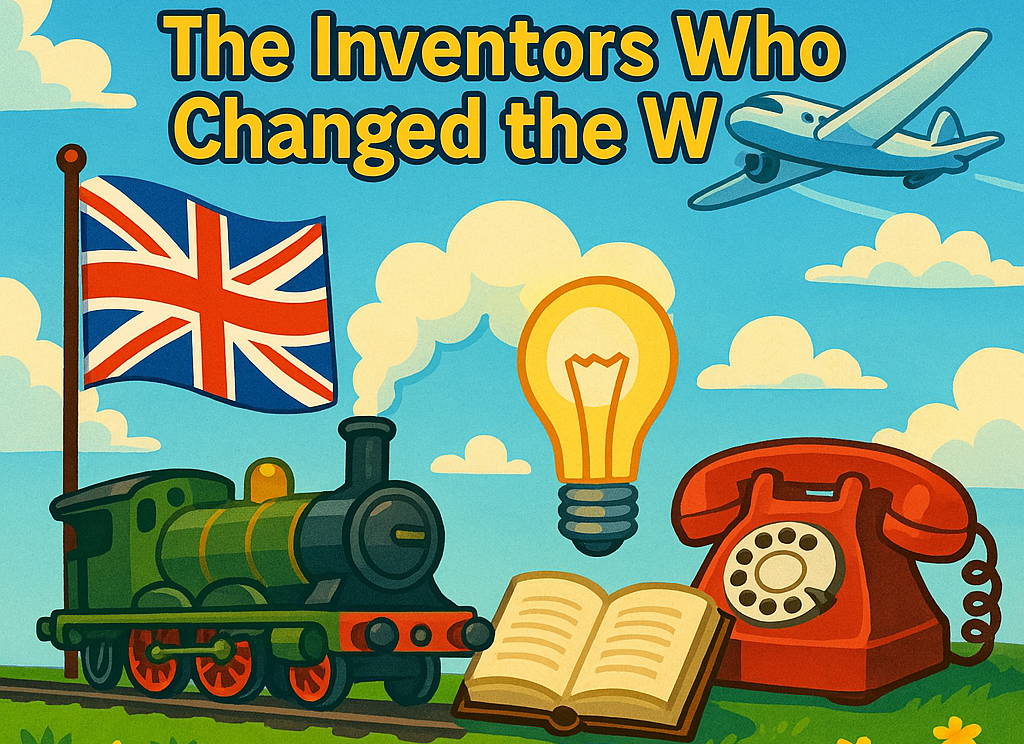
Brilliant Brits: The Inventors Who Changed the World
By Alan Lloyd


This topic is part of our Info Zone collection. You can read the full topic, once logged in, here: Brilliant Brits: The Inventors Who Changed the World

You’ll also find a full Lesson Plan and a handy Parent Q & A sheet, for this topic, ready to use..

The Inventors Who Changed the World

Britain has long been known as a land full of inventors and innovators. Some of the world’s most life-changing creations came from British brains, helping people around the globe. From machines that powered factories to inventions that connect us online, these British inventions have left their mark.

In this article, we’ll explore some of the most famous inventions from Britain and the inventors who made them. You’ll discover how these brilliant ideas were thought up and how they continue to shape our world today. Get ready to meet steam engines, light bulbs, televisions, and even the internet!

These inventors weren’t always famous when they started. Some were even laughed at, but they kept going and changed the world. Let’s dive into the fascinating world of British inventors and their incredible creations.


The Power of Steam: James Watt and the Steam Engine

James Watt didn’t invent the steam engine, but he made it much better. Before his improvements, steam engines were weak and wasteful. Watt’s clever upgrades turned them into powerful machines that could do real work.

His new steam engine powered factories, mines, and even trains. This invention helped start the Industrial Revolution, a time when Britain became full of machines, factories, and cities. It changed how people worked and lived.

James Watt’s name lives on today. The unit of power, the “watt,” is named after him. Every time you switch on a lightbulb, you are using watts!


George Stephenson: Father of the Railways

George Stephenson is often called the “Father of the Railways.” He invented the first successful steam-powered locomotive, named “The Rocket,” in 1829. Before trains, people had to travel slowly on horses or carriages.

Stephenson’s invention changed transportation forever. Trains made it possible to travel faster and carry more goods across long distances. This made everyday items cheaper because they could be moved around more easily.

Today, trains are still one of the most important ways people and goods move around the world. Stephenson’s work paved the way for modern transport.


Michael Faraday and the Magic of Electricity

Michael Faraday was a scientist who made important discoveries about electricity and magnetism. He invented the electric motor and the dynamo, which helped people turn energy into electricity for the first time.

Faraday’s work helped bring electricity into homes, factories, and cities. Without him, we might not have lights, computers, or electric cars today. His experiments showed the world that electricity could be useful and not just a strange science trick.

Faraday’s discoveries are still used today in electric motors and generators around the world. He helped light up the world, quite literally!


Alexander Graham Bell and the Telephone

Alexander Graham Bell, born in Scotland, was fascinated by sound. He invented the telephone in 1876. Before this, people could only send messages by letters or telegraphs, which took time and weren’t very personal.

The telephone changed everything. Now people could talk to each other, even if they were miles apart. It made the world feel smaller and brought friends and families closer.

Bell’s invention is the reason we have mobile phones today. The technology may have changed, but the idea of hearing someone’s voice across a distance started with Bell.


Joseph Swan and the Light Bulb

Many people think Thomas Edison invented the light bulb, but a Brit named Joseph Swan was actually the first to create a working version. In 1878, Swan showed off his electric light bulb to the world.

Soon, homes, streets, and buildings were glowing with light. This invention meant people could stay up later, work more safely at night, and enjoy life after dark without gas lamps or candles.

Joseph Swan worked with Edison later to bring electric lighting to more people. Today, every time you flick a switch, you’re continuing Swan’s bright idea.


John Logie Baird and the Television

Can you imagine life without TV? John Logie Baird, a Scottish inventor, gave the world its first working television. In 1926, he showed off his invention, and people were amazed.

At first, the pictures were black and white and a little fuzzy, but it didn’t matter — the world was hooked. TV soon became a part of everyday life, showing news, stories, and entertainment to millions of people.

Baird even made the first colour TV, making television even more exciting. Without Baird, we might still be stuck reading books for fun — not that books are bad!


Alan Turing: The Code Breaker Who Saved Lives

Alan Turing was a mathematical genius who helped Britain during World War II. He built machines that could break secret German codes, saving thousands of lives by helping end the war more quickly.

Turing’s code-breaking work helped create the first computers. Without him, computers, video games, and the internet might not even exist today.

Today, Alan Turing is remembered as one of the most important minds of the 20th century. His work not only helped win a war but also shaped the digital world we live in.


Tim Berners-Lee and the World Wide Web

If you’ve ever surfed the internet, you have Tim Berners-Lee to thank. In 1989, this British computer scientist invented the World Wide Web while working at CERN, a science lab.

His invention made it possible to share information across the world using the internet. Websites, emails, videos, and even this article are all thanks to Berners-Lee.

Today, the internet connects billions of people, allowing them to learn, share, and create. Tim Berners-Lee truly changed the world without even leaving his office.


Other Brilliant British Inventions

There are even more amazing British inventions. Edward Jenner discovered the smallpox vaccine, saving millions of lives. Sir Frank Whittle invented the jet engine, which helps planes fly faster and higher.

Alexander Fleming discovered penicillin, the first antibiotic, which has cured countless infections. Sir Isaac Newton developed the laws of motion and gravity, which we still use today to understand how the world works.

These inventors didn’t just change Britain—they changed the world forever. Their inventions are still making a difference today.


What Makes a Great Inventor?

What did all these inventors have in common? They were curious. They loved asking questions and solving problems. Most importantly, they didn’t give up, even when things went wrong.

Inventions don’t usually work perfectly the first time. Many inventors had to try again and again. Their determination paid off, creating things we still use today.

If you love building, solving puzzles, or thinking of new ideas, you could be the next great inventor! Who knows what you might create?


What Do You Remember?

  • Who improved the steam engine and helped start the Industrial Revolution?
  • What invention is George Stephenson famous for?
  • What did Alan Turing help invent while working on breaking codes?
  • Who created the World Wide Web?
  • Name two other British inventors mentioned in this article and their inventions.

Write your answers in the comment section below.


Related Topics

Want to learn more about inventors and discoveries? You could explore topics like the Industrial Revolution, the history of electricity, or how computers and the internet work today.


What Do You Think?

If you found this to be an interesting topic, why not have your say. Or if you can think of ways we could improve it. We would love to know what you learned and more importantly, what you think. So now is your chance, use the comments section below to let us know your thoughts.


Leave a comment

'; // Add header content for print html += '

Lenara Learning

Get more learning resources at www.lenara.uk

'; // Insert the worksheet content html += '
' + content + '
'; html += ''; printWindow.document.write(html); printWindow.document.close(); printWindow.focus(); // Trigger printing and auto-close the popup printWindow.print(); printWindow.onafterprint = function() { printWindow.close(); }; setTimeout(function() { printWindow.close(); }, 1500); }