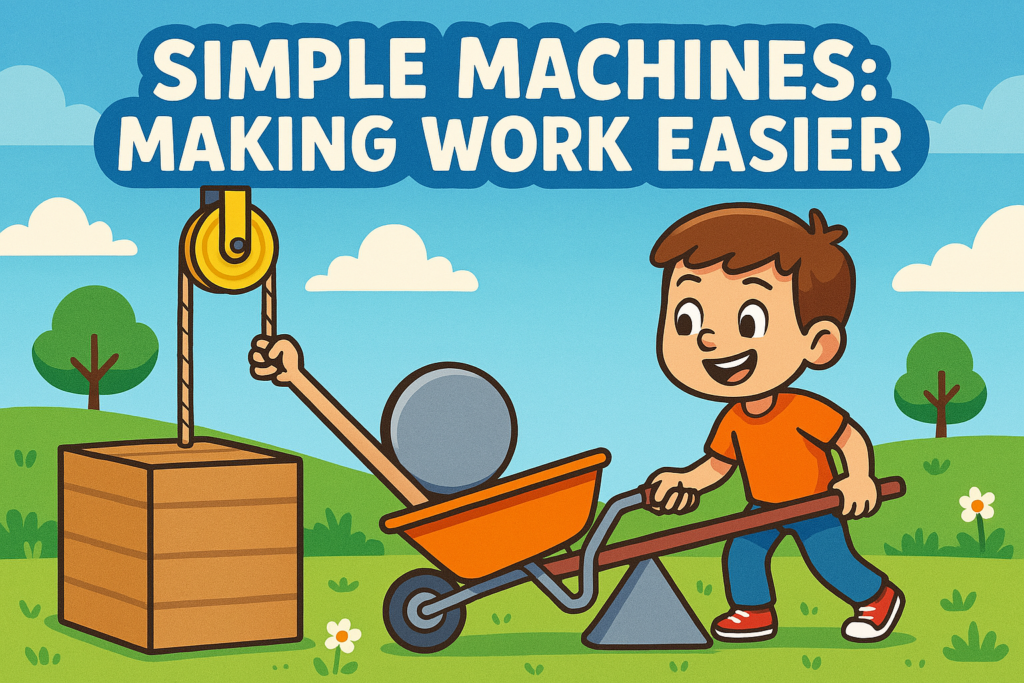
Work Smarter, Not Harder: The Science of Simple Machines Explained
Have you ever wondered how ancient people built huge pyramids or lifted giant stones without modern machines? The answer lies in something called simple machines. These clever tools help us use less effort to do the same amount of work. Instead of lifting something heavy with your arms, you can use a lever, a pulley, or a wheel to make it easier.
In this topic, we’ll explore how simple machines work and why they’re still important today. You’ll discover the different types of simple machines, find out where they appear in everyday life, and understand how they help us “work smarter, not harder.” Even if physics sounds tricky, don’t worry – we’ll explain everything clearly using real-life examples. So get ready to see the world through a whole new lens of practical science!
This topic is part of our Info Zone collection. You can read the full topic, once logged in, here: Work Smarter, Not Harder: The Science of Simple Machines Explained
You’ll also find a full Lesson Plan and a handy Parent Q & A sheet, for this topic, ready to use..
What Is a Simple Machine?
A simple machine is a basic device that changes the direction or strength of a force. This makes tasks much easier to carry out. Instead of relying on electricity or engines, simple machines use clever mechanical design. People have used them for thousands of years to move heavy objects, build structures, and solve tricky problems.
The six main types of simple machines are the lever, pulley, wheel and axle, inclined plane, wedge, and screw. Each one works in a slightly different way but shares the same goal – to reduce effort and make jobs more manageable. You can spot them in toys, household tools, playgrounds, and even in your own body.
Every simple machine helps us apply force more effectively. When you push or pull something, you use force. These machines allow us to spread out, change, or multiply that force to get work done more easily.
For instance, a ramp (which is an inclined plane) lets you roll a heavy box up slowly rather than lift it all at once. This doesn’t reduce the work done, but it spreads it out to make it feel easier. In physics, that’s what it means to “work smarter, not harder.”
Understanding simple machines is the first step to understanding how people have shaped tools, technology, and their environment throughout history.
[br][br]Levers: Lifting the Smart Way
A lever is a solid bar that rotates around a fixed point called a fulcrum. By pushing one end, you can lift a load on the other. It’s just like a seesaw at the playground – but used for serious lifting!
Levers come in three classes. Class 1 levers have the fulcrum in the centre, like scissors. Class 2 levers place the load in the middle, like a wheelbarrow. Class 3 puts the effort in the middle, like tweezers or your arm.
Levers are incredibly useful. You’ll find them in bottle openers, crowbars, nutcrackers, and even your own limbs. For example, your elbow is the fulcrum, your hand carries the load, and your muscles provide the effort.
By adjusting the position of the fulcrum and the lengths of the lever arms, you can multiply your force. This means you can lift or move something much heavier than you normally could. The longer the lever, the less effort you need.
Levers prove that using the right tool is often better than using brute strength. They are brilliant examples of mechanical advantage in everyday life.
[br][br]Pulleys: Ropes That Lift Like Magic
A pulley is a wheel with a groove around its edge, which holds a rope or cable. When you pull on one side of the rope, the pulley helps lift or move a load in another direction. This allows you to lift things without needing to be as strong.
There are two main types of pulleys: fixed and movable. A fixed pulley changes the direction of the force but doesn’t reduce the effort. A movable pulley, on the other hand, cuts the force needed in half. When you combine them in a pulley system, they become even more powerful.
Builders and engineers use pulleys in cranes, lifts, and rescue systems. You’ll also find them in sailing boats and flagpoles. Without pulleys, we’d struggle to lift or move many heavy objects.
Let’s say you’re hoisting a flag up a pole. The pulley at the top lets you pull the rope down while the flag goes up. This means you don’t need to climb the pole – much easier and safer!
Because pulleys redirect and reduce effort, they are one of the smartest inventions for handling heavy loads efficiently.
[br][br]Inclined Planes: Ramps That Help You Rise
An inclined plane is simply a sloped surface that connects a lower point to a higher one. Instead of lifting something straight up, you push or roll it up the ramp. This spreads the work over a longer distance and makes it feel easier.
Wheelchair ramps, playground slides, and loading ramps on lorries all use inclined planes. They let people or heavy objects move smoothly from one level to another without as much strain.
The longer and gentler the slope, the less effort is needed to move something up. Of course, this means the object travels a greater distance – but that’s often a fair trade for less effort.
Ancient builders used huge ramps to help construct pyramids and temples. They couldn’t lift the stones directly, so they rolled them up inclined planes instead.
Inclined planes are proof that a simple idea can solve a big problem. They remain essential in building, transport, and accessibility today.
[br][br]Wheels and Axles: Roll, Don’t Drag
The wheel and axle is one of the most important inventions in human history. It works by attaching a wheel to a central rod (the axle). When the wheel turns, the axle turns too, reducing friction and making movement smoother.
This simple machine makes it far easier to move heavy objects across the ground. Try dragging a suitcase without wheels – now try it with wheels. The difference is clear!
You’ll find wheels and axles in bikes, skateboards, cars, trolleys, doorknobs, and more. They’re also used in rolling pins, steering wheels, and many other household tools.
By turning a large wheel, you can make the axle turn with more force. This helps power machines, open doors, and move vehicles.
Because they make movement so efficient, wheels and axles are vital to transport, machinery, and everyday convenience.
[br][br]Wedges: Cutting Through Work
A wedge is made of two inclined planes joined together in a sharp point. It helps push things apart or cut through them. Wedges work by concentrating force into a small area, which increases pressure and makes splitting or cutting easier.
Knives, axes, nails, chisels, and even your teeth are all examples of wedges. When you bite into an apple, your teeth act like little wedges that cut into the skin and pulp.
Sharp wedges require less effort but can be fragile. Thick wedges are stronger but need more force to drive them in. That’s why you choose different wedge shapes for different jobs.
In addition to cutting, wedges can hold things in place. For example, doorstops are wedge-shaped so they stay put and keep doors open.
Wedges are clever, multi-use tools that make cutting, slicing, and securing objects much more manageable.
[br][br]Screws: Twisting to Win
A screw is really an inclined plane wrapped around a rod. When you twist a screw, it moves into or out of a material. This converts a turning force into a straight movement – very useful!
Screws are used to hold things together tightly. You’ll see them in jars, bolts, lightbulbs, and many types of machinery. They keep things secure and are easy to insert and remove with the right tool.
The more threads (spirals) a screw has, the more turns it takes to drive it in – but the stronger the grip. This is perfect for materials that need a tight connection.
Some ancient water pumps used huge screws to lift water from rivers. Today, we still rely on screws in construction, furniture, and electronics.
Screws may look small, but they are essential for precision, strength, and security in countless devices.
[br][br]Compound Machines: When Two Is Better Than One
When you combine two or more simple machines, you create a compound machine. These machines can perform complex tasks more efficiently by using the strengths of multiple parts.
Scissors use levers and wedges. A wheelbarrow combines a wheel and axle with a lever. Even a bicycle includes wheels, levers, screws, and gears working together.
Compound machines appear everywhere in modern life – from can openers to cranes. They’re what make cars, planes, and even blenders possible.
Each part of a compound machine does a small job. Together, they achieve big results with less effort from the user.
Learning about compound machines helps you see how everyday tools rely on physics to solve practical problems more easily.
[br][br]Why Simple Machines Matter
Simple machines might look basic, but they have huge value. They save time, reduce injuries, and help people of all ages do more with less effort. From ancient times to modern factories, they’ve made work smarter.
Knowing how they function can help you understand tools, fix things, or even invent something new. It builds useful problem-solving skills and encourages creative thinking.
Every time you open a tin with a can opener, ride a bike, or use a screwdriver, you’re using simple machines. They’re so common, we often forget how brilliant they really are.
Because they make life easier and safer, simple machines are a huge part of science, engineering, and daily living.
So next time you complete a task easily, ask yourself – which simple machine helped you do it?
[br][br]A Final Thought
Simple machines have helped people for thousands of years. Even in a world full of robots and computers, the clever designs behind levers, pulleys, and wedges are still in use today. They show that smart thinking beats hard pushing – every time!
[br][br]What Do You Remember?
- What are the six main types of simple machines?
- How does a lever reduce the effort needed to lift something?
- Why is a pulley helpful for lifting loads?
- Which simple machine is made of a sloped surface?
- What simple machines are combined in a wheelbarrow?
Write your answers in the comment section below
[br][br]Related Wikipedia Links
If you’d like to explore further, these links will help:
[br][br]What Do You Think?
Which simple machine do you think is the most useful or clever? Let us know in the comments – we’d love to hear your thoughts!
[br][br] [/cl_logged_in][cl_logged_out]
Members Only
You need to be registered and logged in to access this learning resource and other member only content. It only costs £1.99
[/cl_logged_out]