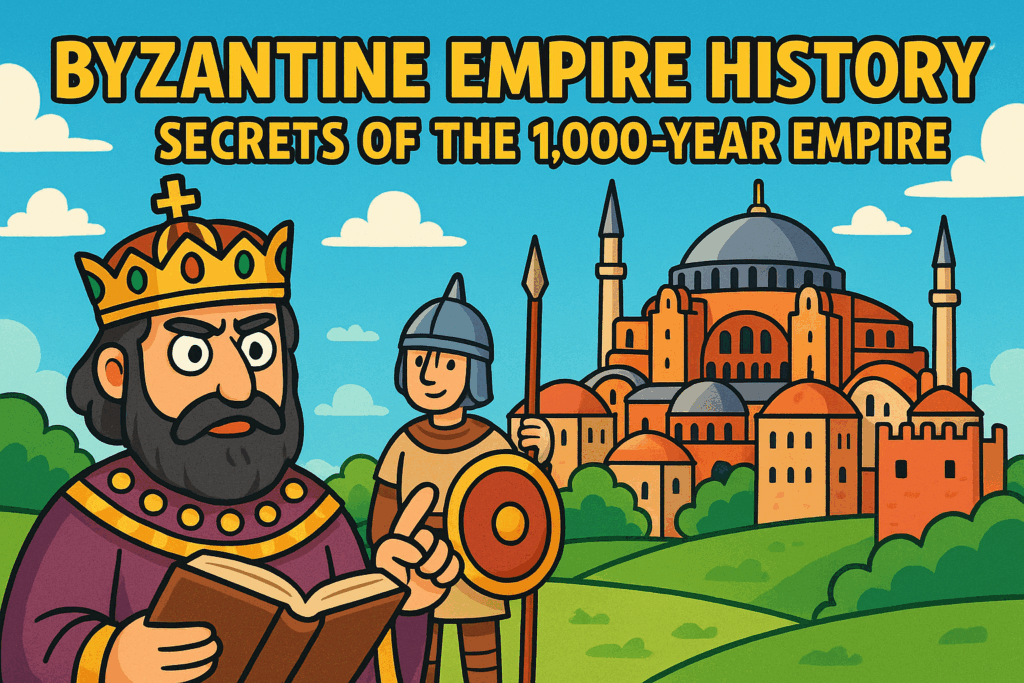
Byzantine Empire History: Secrets of the 1,000-Year Empire
The Byzantine Empire history spans over a thousand years of incredible change, power, and influence. This long-lasting empire, often called the Eastern Roman Empire, began when the Roman Empire split in two. At its heart stood Constantinople, a city filled with culture, trade, and political power. Even though it’s gone today, its legacy shaped Europe and the Middle East in huge ways.
Understanding the history of Byzantium means diving into wars, religion, emperors, art, and science. The empire acted as a bridge between the ancient world and the Middle Ages. It preserved Roman traditions, added Greek culture, and defended Christianity for centuries. But it wasn’t always peaceful — far from it.
This powerful Byzantine civilisation faced constant invasions, fierce politics, and major religious disputes. Still, it held strong for over 1,100 years. That’s longer than most empires in history! So how did it survive so long, and what secrets did it hold?
Let’s explore the Byzantine Empire history and find out what made it so unique — and why it still matters today.
This topic is part of our Info Zone collection. You can read the full topic, once logged in, here: Byzantine Empire History: Secrets of the 1,000-Year Empire
You’ll also find a full Lesson Plan and a handy Parent Q & A sheet, for this topic, ready to use..
What Was the Byzantine Empire?
The Byzantine Empire was the eastern half of the Roman Empire that continued after the fall of Rome in AD 476. Its capital, Constantinople (modern-day Istanbul), became one of the richest and most powerful cities in the world. While the western Roman Empire collapsed under pressure from invasions and internal problems, Byzantium lasted nearly 1,000 years longer. It became a mix of Roman law, Greek culture, and Christian faith.
This empire controlled much of southeastern Europe, western Asia, and northern Africa at its height. It had a strong army, complex government, and rich culture. People spoke Greek, not Latin, and the empire was deeply shaped by Orthodox Christianity. The emperor was seen as God’s chosen ruler, giving the leader both political and religious power.
Unlike the Roman Empire, which faded quickly, Byzantium slowly transformed over time. It kept Roman traditions alive while becoming something new. That’s why historians often call it the *Eastern Roman Empire*. Even its enemies saw it as the continuation of Rome.
So when we study the *Byzantine Empire history*, we’re really looking at a bridge between ancient Rome and modern Europe. It kept ancient knowledge safe, built great cities, and shaped the world around it.
The Founding of Constantinople
In AD 330, Emperor Constantine officially moved the capital of the Roman Empire to Byzantium, a city on the edge of Europe and Asia. He renamed it Constantinople, which means “City of Constantine.” This location was chosen for its strong defences and easy access to trade routes. It sat between Europe and the Middle East, controlling important roads and seas.
Constantinople became the heart of the *Constantinople empire*, growing quickly into a bustling capital filled with palaces, churches, and marketplaces. Its massive walls made it one of the most well-defended cities in history. Even during long sieges, it often held out when other cities would’ve fallen.
The city also became a centre of learning, faith, and wealth. The Hagia Sophia, a huge cathedral, stood as a symbol of both imperial power and religious faith. For centuries, Constantinople was the largest and richest city in Europe.
Thanks to its location, the city connected East and West, helping ideas, goods, and people travel. It was truly the crown jewel of the *Byzantine civilisation*.
Emperors and Power Struggles
The emperors of Byzantium had incredible power — sometimes too much. They ruled as absolute monarchs, often claiming divine authority. Some were brilliant leaders, like Justinian I, while others were weak or cruel. This led to many palace plots, assassinations, and rebellions.
Justinian I (ruled AD 527–565) is one of the most famous Byzantine emperors. He tried to rebuild the old Roman Empire by retaking lands in Italy and North Africa. He also created the “Justinian Code,” a legal system that influenced European law for centuries.
But not all rulers were so successful. Some lost wars, raised taxes too high, or fought with church leaders. This constant struggle for power weakened the empire over time. Still, Byzantium had enough strength and wealth to recover again and again.
The story of the *Eastern Roman Empire* is filled with dramatic rises and sudden downfalls. That’s part of what makes it so fascinating to study.
The Role of Religion in Byzantine Life
Religion was at the centre of life in Byzantium. The empire became officially Christian under Constantine, and the church was deeply connected to the government. In fact, the emperor often acted like the head of the church too. This close tie between faith and rule shaped every part of society.
The most common form of Christianity was Eastern Orthodox, which focused on rituals, icons (religious images), and tradition. Churches were decorated with gold, mosaics, and domed roofs. Religious debates were common — sometimes leading to riots or even wars.
One major conflict was the “Iconoclasm” — a period when emperors banned religious images, saying they were like idols. This caused a huge split among people and weakened the empire’s unity. Eventually, icons were brought back, but the damage was done.
Byzantine Christianity also broke away from the Pope in Rome, leading to a lasting divide between Eastern Orthodox and Roman Catholic churches. Even today, that split still exists.
So, in the *history of Byzantium*, religion wasn’t just personal — it was political and powerful.
War, Invasion, and Defence
For over a thousand years, the Byzantine Empire faced constant threats. From Persians to Arabs, Slavs to Turks, enemies always pressed in from all sides. But the empire’s strong army and clever tactics helped it survive much longer than expected.
Byzantine generals used strategy, not just strength. One famous weapon was “Greek Fire” — a fiery liquid sprayed from ships that could burn even on water. Its recipe was a tightly guarded secret, and it gave the empire a major edge in naval battles.
The empire also relied on a strong system of walls, forts, and alliances. Constantinople’s walls were nearly impossible to breach until the very end. Even when surrounded, the city could hold out for years.
But every empire has limits. Over time, the cost of constant war drained the treasury and wore down the army. Still, their military legacy is a key part of *Byzantine Empire history*.
Art, Culture, and Learning
Byzantium wasn’t just about war and politics — it was also a centre of art, music, writing, and education. The empire preserved and copied many ancient Greek and Roman texts, which later helped fuel the Renaissance in Western Europe. Its scholars studied history, philosophy, science, and more.
Byzantine art is famous for mosaics — pictures made from tiny pieces of coloured stone or glass. These often showed religious scenes, saints, and emperors. Gold backgrounds made them shine in candlelight, giving churches a heavenly glow.
The Hagia Sophia, built under Justinian, was both a church and an architectural wonder. Its massive dome seemed to float in the air — a symbol of both faith and engineering skill.
Even fashion, music, and literature reflected a blend of ancient and Christian influences. In many ways, this rich culture helped define the *Byzantine civilisation* and spread its values far beyond its borders.
The Fall of Constantinople
By the 1400s, the empire was a shadow of its former self. It had lost most of its land, wealth, and allies. The final blow came in 1453, when the Ottoman Turks captured Constantinople after a long siege. Their leader, Sultan Mehmed II, used massive cannons to smash through the city’s ancient walls.
This event marked the end of the *Eastern Roman Empire* and the start of the Ottoman Empire. It shocked Europe and led to changes in trade, politics, and religion. Many scholars fled west, carrying ancient books and ideas that helped spark new thinking.
Though the city fell, the Byzantine spirit didn’t completely vanish. It lived on in the Orthodox Church, in Russian traditions, and in the stories passed down through history.
The fall of Constantinople is one of the most dramatic endings in world history — a real turning point that reshaped the world map.
Legacy of the Byzantine Empire
Even though it’s gone, the Byzantine Empire still influences us today. Its legal systems, religious traditions, and art styles spread across Europe and beyond. It helped shape the modern world in ways people often don’t realise.
Orthodox Christianity, practised in places like Greece and Russia, is one of its most visible legacies. So is the idea of a powerful ruler linked to religion — something seen in later European monarchies.
By preserving Roman and Greek ideas, Byzantium helped Europe rediscover science, law, and philosophy during the Renaissance. The printing of these ideas sparked revolutions in thought and culture.
So when you hear the phrase *Byzantine Empire history*, remember — it’s not just about the past. It’s about how that past still shapes our world today.
A Final Thought
The Byzantine Empire wasn’t just a leftover piece of Rome — it was a powerful civilisation in its own right. Its history holds lessons, warnings, and inspiration for anyone who looks closely enough.
Quick Quiz
- What was the original name of Constantinople?
- Who was Justinian I and what did he do?
- What role did religion play in Byzantine society?
- Why was Greek Fire important?
- What happened in 1453 that changed world history?
Write your answers in the comment section below.
Related Wikipedia Links
Here are some helpful pages to explore more about the Byzantine Empire:
What Do You Think?
What do you find most surprising about the Byzantine Empire? Do you think it gets the attention it deserves in history lessons?