
Byzantine Empire History: Secrets of the 1,000-Year Empire (Lesson Plan)
Lesson Plan - Byzantine Empire History: Secrets of the 1,000-Year Empire
Understanding Byzantine Empire history gives learners a unique window into more than 1,000 years of global influence. From powerful emperors and grand architecture to major religious changes and political drama, the Eastern Roman Empire was anything but boring. This home education lesson plan helps you guide your child through key ideas in a simple, engaging, and structured way. It covers not just facts and timelines, but also critical thinking about why this ancient empire still matters.
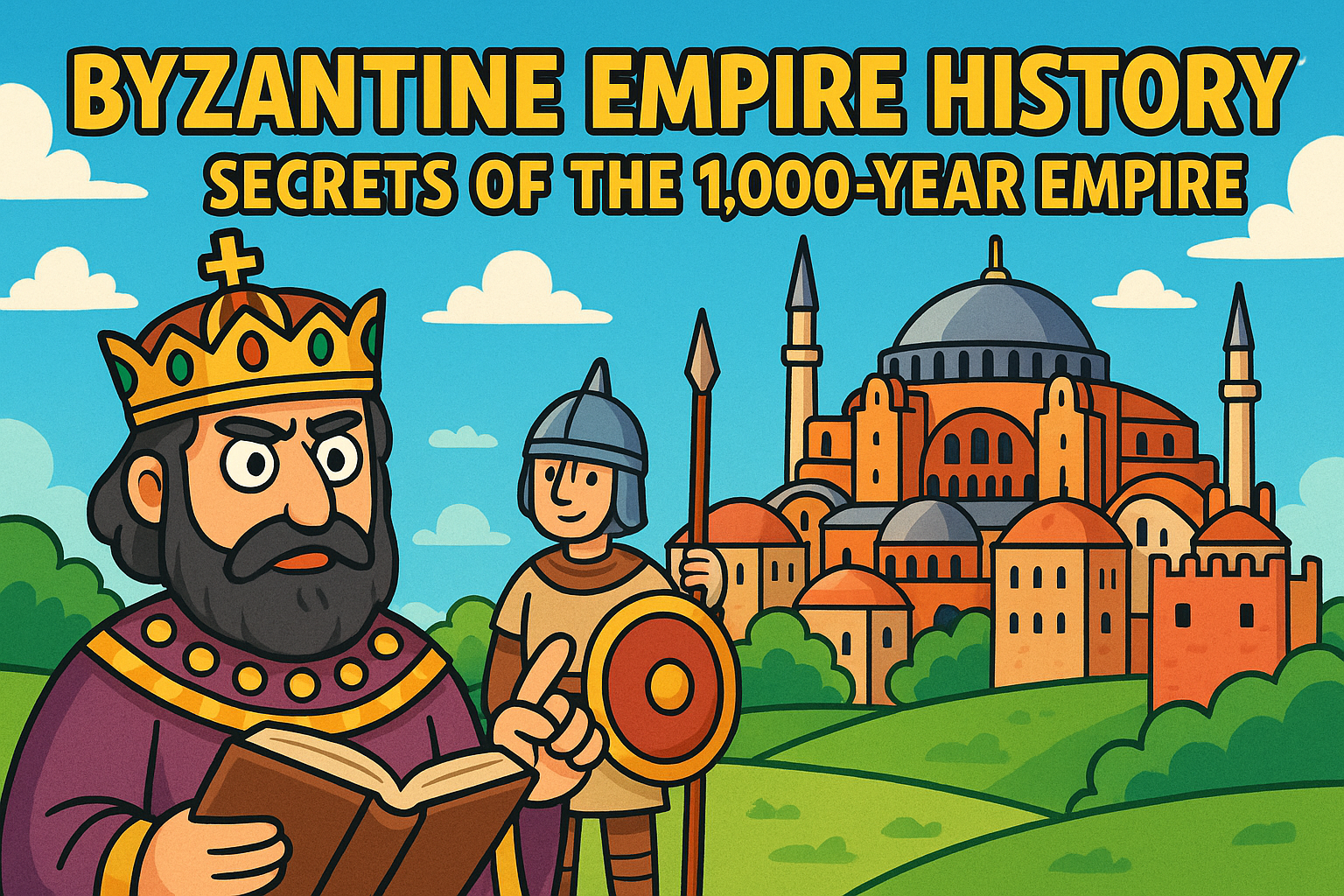
You don’t need to be a historian to use this Byzantine Empire history lesson plan. Everything is broken into manageable parts, with age-flexible tasks and guided questions for discussion. It helps you explore the rich culture of the Byzantine world, including Constantinople’s importance, how religion shaped politics, and what made this civilisation last for so long. There’s also a quiz and an optional follow-up task to stretch learning further.
By using this plan, you’re not just helping your child remember dates or emperors. You’re showing them how past civilisations helped shape the world we live in today. That deeper connection makes history more meaningful, memorable, and fun to explore together.
This topic is part of our Info Zone collection. You can read the full topic, once logged in, here: Byzantine Empire History: Secrets of the 1,000-Year Empire
You’ll also find a full Lesson Plan and a handy Parent Q & A sheet, for this topic, ready to use..
[cl_logged_in]
Byzantine Empire History: Secrets of the 1,000-Year Empire
This lesson plan is designed to help you support your child with this topic: Byzantine Empire History: Secrets of the 1,000-Year Empire
[br][br]
Learning Objectives (What You’ll Learn Today)
- Explore the origins and growth of the Byzantine Empire
- Understand the importance of Constantinople’s location and defences
- Discover how religion, art, and politics were connected
- Reflect on how this civilisation influenced the modern world
[br][br]
Estimated Time
60–90 minutes (with flexible pacing)
[br][br]
Let’s Get Started
Ask your child: “If an empire lasted more than 1,000 years, what do you think helped it survive?”
[br][br]
The Main Lesson
Who Were the Byzantines?
The Byzantine Empire was the eastern half of the old Roman Empire. While the western part fell in AD 476, the eastern side carried on for over 1,000 years. It kept many Roman traditions but developed its own culture, language (Greek), and religious practices.
Its people called themselves “Romans,” but historians now use the word “Byzantines” to describe this unique civilisation. Their empire was based around a powerful city called Constantinople.
Mini-Task: Draw a quick timeline from the fall of Rome to the fall of Constantinople. Mark when the Byzantine Empire began and ended.
[br][br]
Constantinople: The City That Lasted
Constantinople was founded by Emperor Constantine in AD 330. He chose its location carefully — on a narrow stretch of land between Europe and Asia, surrounded by water on three sides. The city had triple walls that protected it from nearly every attack for centuries.
Because of its position, it controlled key trade routes and became incredibly wealthy. This made it the heart of the *Byzantine Empire history lesson plan* and a symbol of imperial power.
Mini-Task: On a map, find modern-day Istanbul. How would you describe its location in one sentence?
[br][br]
Religion and Power
Christianity was central to Byzantine life. The emperor was seen not just as a ruler, but as God’s representative on Earth. This close link between church and state gave the empire strength, but it also caused problems.
One major event was the Iconoclasm — a period when religious images were banned. It led to deep divides among the people. Eventually, the Orthodox Church separated from the Roman Catholic Church in what’s known as the Great Schism.
Mini-Task: Ask your child: Why might banning religious images upset people? What would happen if similar rules were made today?
[br][br]
Emperors, Laws, and Achievements
One of the most famous emperors was Justinian I. He tried to restore the Roman Empire and created the “Justinian Code” — a new system of laws. This code became the basis for legal systems in many parts of Europe.
Justinian also built the Hagia Sophia, one of the most impressive churches ever constructed. His reign shows how powerful emperors could shape both daily life and long-term history.
Mini-Task: Look up the Hagia Sophia online. What do you notice about its shape and decoration?
[br][br]
The Fall of the Empire
Over time, the empire grew weaker. It faced attacks from Crusaders, Persians, and eventually the Ottomans. In 1453, Constantinople was captured by the Ottoman Turks using giant cannons that broke through the walls.
This marked the end of the *Byzantine Empire history lesson plan*, but not the end of its legacy. Many Byzantine scholars moved west, bringing books and knowledge that helped start the Renaissance.
Mini-Task: Imagine being in Constantinople in 1453. Write a few sentences about what you might see or feel as the city falls.
[br][br]
Think and Discuss
- Why do you think the Byzantine Empire lasted longer than the Western Roman Empire?
- What made Constantinople such an important city?
- How did religion help — or hurt — the empire?
[br][br]
Wrap-Up Summary
The Byzantine Empire preserved ancient knowledge, shaped religion, and influenced art, law, and architecture. Its story is a key part of how modern Europe and the world were shaped.
[br][br]
Quiz
- What was the capital city of the Byzantine Empire?
- Which emperor created a famous legal code?
- True or False: The Byzantines spoke Latin as their main language.
- What building was known as a wonder of Byzantine architecture?
- What religion did the empire follow?
- What major split happened between Eastern and Western churches?
- When did Constantinople fall?
- What empire conquered Constantinople?
- Why was Constantinople’s location important?
- True or False: The Byzantine Empire lasted longer than the Western Roman Empire.
Answers: 1. Constantinople, 2. Justinian I, 3. False (they spoke Greek), 4. Hagia Sophia, 5. Christianity, 6. The Great Schism, 7. 1453, 8. The Ottoman Empire, 9. It controlled trade routes and was well defended, 10. True
[br][br]
Short Essay Prompt
Write a short essay (about 3 paragraphs) explaining how Constantinople’s location helped the Byzantine Empire survive. Give two specific reasons and examples.
[br][br]
Extra Learning
Extra Learning: Build a simple model or drawing of Constantinople. Include its walls, harbours, and key buildings. Label each part and explain why it was important for defence or trade.
[br][br]
Final Reflection (What Did You Learn?)
Ask your child: “If you could live in the Byzantine Empire for one week, what would you want to see or do — and why?”
[br][br]
[/cl_logged_in]
[cl_logged_out]
Members Only
You need to be registered and logged in to access this lesson plan and all other learning resources, games and quizzes.
[/cl_logged_out]