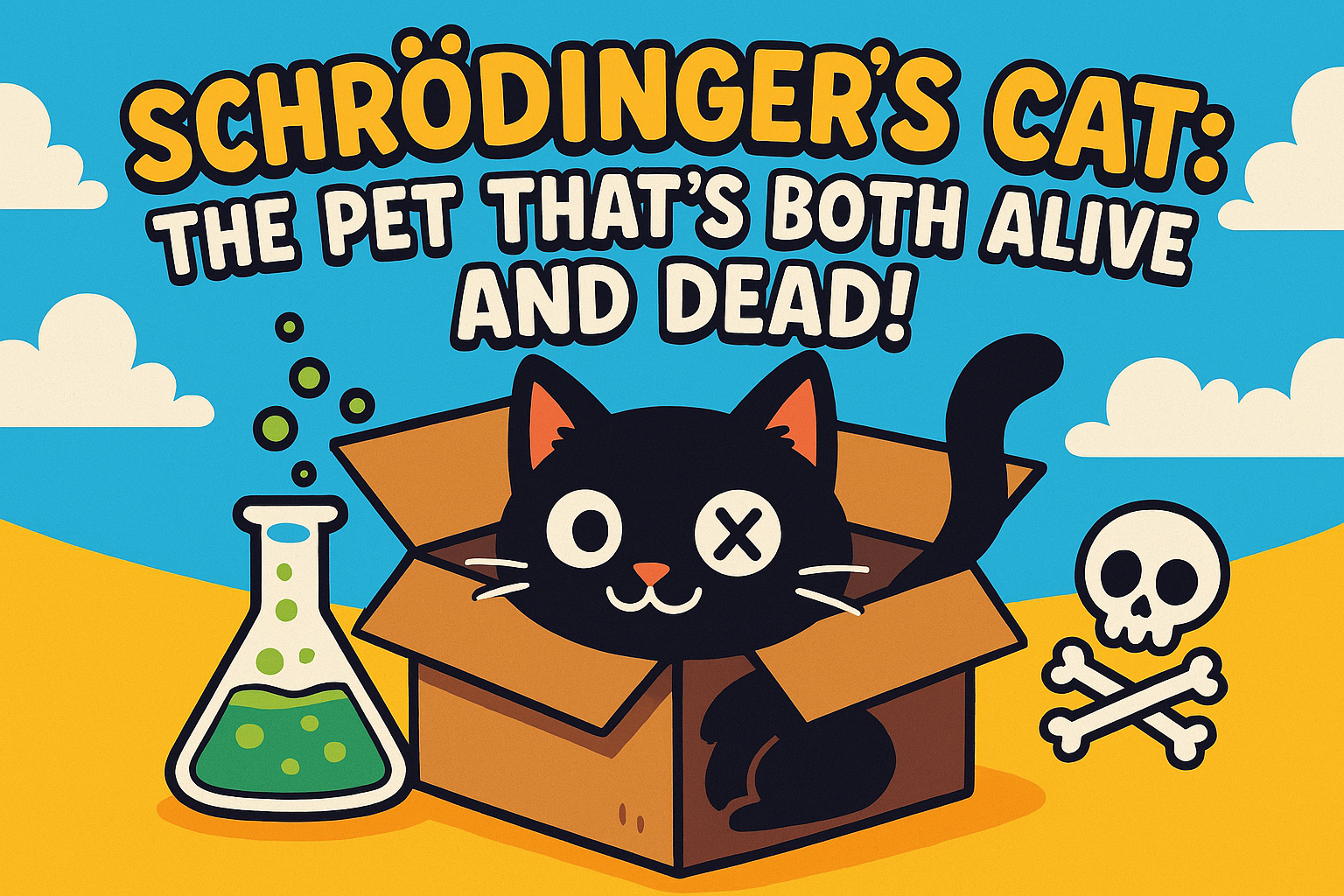
Schrödinger’s Cat: The Pet That’s Both Alive and Dead! (Q&A)
Q & A - Schrödinger’s Cat: The Pet That’s Both Alive and Dead!
This Parent Q&A sheet for Schrödinger’s Cat: The Pet That’s Both Alive and Dead! is designed to support families using Elective Home Education. It provides plain-English explanations and conversation-starters to help you guide your child through one of science’s most fascinating and puzzling ideas. You don’t need to be a science expert — this resource gives you the background knowledge and ready-made questions to build learning through discussion, play, and critical thinking.
The topic explores the imaginary Schrödinger’s Cat experiment and introduces the strange world of quantum physics. The Q&A covers key ideas such as superposition, observation, and thought experiments, while also offering extra creative ways to get your child thinking and talking. It’s ideal for ages 8 to 16 and can be adapted to suit different levels. Whether you use it alongside the lesson plan or just as a discussion tool on its own, it’s here to give you confidence and support as you explore science together at home.
This topic is part of our Info Zone collection. You can read the full article here: Schrödinger’s Cat: The Pet That’s Both Alive and Dead!
You’ll also find a full Lesson Plan and a handy Parent Q & A Sheet ready to use.
| Schrödinger’s Cat: The Pet That’s Both Alive and Dead! | |
|---|---|
| Tip for Parents | This sheet is here to help you understand the topic and guide learning conversations. You don’t need a science degree — just use these questions and answers to chat, ask what your child thinks, and encourage them to explore ideas through discussion, drawing, writing, or creative thinking. |
| 1. What is Schrödinger’s Cat? | It’s a famous thought experiment (an idea created to help people understand something difficult) made up by physicist Erwin Schrödinger in 1935. It imagines a cat in a box that is both alive and dead at the same time, until someone opens the box and checks. It shows how strange quantum physics can be. |
| 2. Was it a real experiment? | No. Schrödinger never put a real cat in a box. It was purely imaginary, used to make a point about how odd the rules of quantum physics are compared to what we see in normal life. |
| 3. Why did Schrödinger invent it? | He wanted to point out the problems with how quantum mechanics was being explained. Scientists were saying that particles could exist in multiple states at once, which seemed strange when applied to everyday objects like cats. |
| 4. What is a superposition? | In quantum physics, superposition means something can exist in more than one state at the same time. In the cat experiment, the cat is in a superposition of being both alive and dead — until it is observed. |
| 5. What makes the cat alive or dead? | Inside the box is a radioactive atom that may or may not decay (break apart). If it decays, it triggers a machine that releases poison and kills the cat. If it doesn’t decay, the cat stays alive. Until someone opens the box, the cat is thought to be in both states. |
| 6. Is this how real science works? | Quantum physics does behave this way with tiny particles, like electrons and atoms. But when it comes to big things like cats or humans, it gets much more complicated, and we don't see the same behaviour because of something called decoherence (when particles lose their special quantum state by interacting with the environment). |
| 7. Did Schrödinger believe the cat was really both alive and dead? | No. He actually thought the idea was ridiculous. He created the thought experiment to show how strange — and maybe flawed — the popular interpretation of quantum physics was at the time. |
| 8. What does this teach us about science? | It teaches us that science isn’t just about facts — it’s also about questioning ideas, testing theories, and using imagination to explain tricky concepts. Schrödinger’s Cat is a perfect example of using imagination to explore deep scientific ideas. |
| 9. What is quantum physics? | Quantum physics is the branch of science that deals with very small particles like atoms. These particles don’t follow the normal rules of physics. They can behave in strange ways, like being in two places at once, or instantly affecting one another over distance (called entanglement). |
| 10. How does this connect to real life? | Quantum physics is behind much of today’s technology — from computer chips to MRI scanners. It’s also being used to build new quantum computers that can solve problems much faster than normal ones. |
| 11. What is a thought experiment? | A thought experiment is when you imagine a situation to explore an idea or test a theory. It’s a powerful way scientists and philosophers work through complicated ideas without needing to do a real-life experiment. |
| 12. What is decoherence? | Decoherence is when quantum systems stop behaving in a strange way and start acting normally because they’ve interacted with their environment. For example, once you open the box, light and air interfere, and the cat can no longer be in a superposition. |
| 13. What are some challenges in understanding this topic? | Quantum physics uses ideas that don’t match what we see in everyday life. It can be hard to imagine particles being in two places at once or being affected by observation. That’s why using creative thinking and asking questions is so important. |
| 14. What age is this topic suitable for? | This topic can be adapted for ages 8 to 16. Younger learners can focus on the cat and the story, while older ones can dig deeper into quantum theory, probability, and the role of observation in science. |
| 15. How can I explain this simply? | You can say: "Imagine a box with a cat inside. Something might kill the cat, but until we look inside, we don’t know what’s happened. In some ways, it’s like saying the cat is both alive and dead — until we check." |
| 16. Why is observation important in quantum mechanics? | In quantum physics, some scientists believe particles only take on definite properties when they are observed. Before that, they exist in a mix of possibilities. This is very different from how things behave in everyday life. |
| 17. Can this be linked to other subjects? | Yes! It connects to philosophy (thinking about reality and truth), maths (probability and statistics), art (creating visual explanations), and computing (quantum computers). It also helps develop critical thinking skills. |
| 18. Are there other fun ways to explore this? | Yes! You can build a cardboard box model of the experiment, write a story from the cat’s point of view, or act it out with toys. Drawing diagrams also helps. Even playing “What if?” games based on the idea encourages creative thinking. |
| Extra Conversation Ideas |
|
[cl_logged_out]
Members Only
You need to be registered and logged in to access this Q and A sheet and all other learning resources, games and quizzes.
[/cl_logged_out]