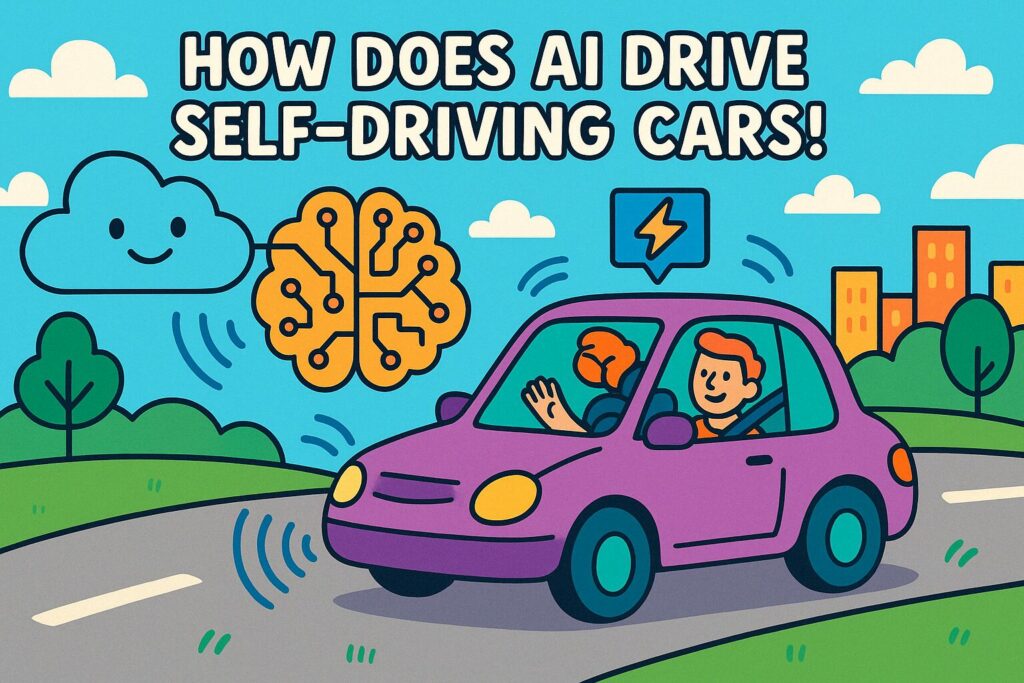
How Does AI Drive Self-Driving Cars!

How Does AI Drive Self-Driving Cars!

Have you ever wondered how AI self-driving cars actually work? You’ve probably seen videos or news stories about cars that drive themselves with no human touching the wheel. This incredible leap in technology is made possible by artificial intelligence in cars, working behind the scenes. And yep, autonomous vehicles are already out there on real roads.

How Does AI Drive Self-Driving Cars!
By Alan Lloyd

So what’s really going on inside these smart cars? Well, it’s not magic—it’s science, programming, and a huge amount of data. AI systems use sensors, cameras, and algorithms to “see” the world and decide what to do next. Think of it like the car having a brain that constantly learns, watches, and reacts faster than any human driver could.

In this article, we’ll explore how self-driving technology works in detail. You’ll learn how cars “think”, how they avoid crashes, and why training AI is a bit like teaching a child to ride a bike. We’ll also break down tricky terms and ask some big “what if” questions to get you thinking. Ready to hit the road?


This topic is part of our Info Zone collection. You can read the full topic, once logged in, here: How Does AI Drive Self-Driving Cars!

You’ll also find a full Lesson Plan and a handy Parent Q & A sheet, for this topic, ready to use..

[cl_logged_in]

What Makes a Car Self-Driving?

Self-driving cars, or autonomous vehicles, are powered by a mix of technologies that allow them to operate without human control. At the heart of it all is artificial intelligence (AI), which acts like the brain of the car. This AI system takes in information from various sensors and decides what the car should do next—whether that’s slowing down, changing lanes, or stopping at traffic lights.

These cars use GPS to understand where they are and how to reach their destination. But knowing the route is just the beginning. The real challenge is navigating all the unexpected things that happen on roads—like people crossing the street or other drivers acting unpredictably.

To deal with this, AI self-driving cars rely on tools like radar, cameras, and lidar (a laser scanning system) to detect what’s around them. These sensors act like the car’s eyes and ears. The data from these tools is constantly fed into the AI system, which uses machine learning to make sense of it all.

Machine learning means the car’s software learns over time by spotting patterns in data. So, the more it drives, the better it gets. It’s a bit like how a human gets better at driving with experience, only much faster and with a better memory.

All this comes together to create a car that doesn’t just follow instructions—it understands and reacts to the world in real time.

[br][br]

How AI Sees the RoadHow Does AI Drive Self-Driving Cars!

Imagine you’re blindfolded and trying to cross a busy street. That’s what driving would be like for a car without sensors. AI self-driving cars need to “see” everything around them, so they use cameras, radar, and lidar to gather visual and distance data.

Cameras capture images of the road, lane markings, signs, and objects. Radar helps detect the speed and distance of moving objects like cars or bikes. Lidar creates a 3D map of the surroundings using laser pulses—this is especially useful in low light or fog.

Each tool has strengths and weaknesses, so combining them gives the AI a fuller, more accurate view. For example, radar can see through fog, but it doesn’t show details. Cameras show colour and texture, but they struggle at night. Lidar is great for precise shapes, but it’s expensive.

The AI system compares this sensor data with stored maps and uses it to understand its location and surroundings. This process is called localisation, and it helps the car stay in its lane, follow the road, and avoid obstacles.

Think of it like the car having its own eyes, constantly scanning the road and checking with a map to make sure it knows exactly where it is.

[br][br]

How AI Understands What It Sees

Seeing is one thing—but understanding is another. That’s where computer vision and deep learning come in. These are parts of artificial intelligence that help the car make sense of what its sensors are telling it.

Computer vision allows the car to recognise objects, like traffic lights, pedestrians, road signs, and even animals. It can also tell if another car is about to merge or stop. Deep learning, a type of machine learning, is used to train the AI to spot these patterns over time.

This learning happens by showing the AI millions of images and correcting its mistakes. Eventually, it gets very good at recognising what’s what—just like we do when we learn to read.

To put it simply, the car sees a red octagon, checks its training data, and says, “Ah, that’s a stop sign!” Then it reacts accordingly. This ability is crucial to making safe decisions on the road.

Without this understanding, a self-driving car would just be guessing—and that’s not good enough when lives are at stake.

[br][br]

Decision-Making in Real Time

Once the AI knows what’s around it, it needs to decide what to do. This is called decision-making, and it’s one of the hardest parts of self-driving technology.

The AI has to answer questions like: Should I brake now? Can I safely overtake? Is that a cyclist or a shadow? It uses logic systems and probability models to predict what might happen next.

One key part is prediction. The AI doesn’t just see that someone’s crossing the road—it tries to guess if that person might stop or run. This kind of forecasting is based on millions of previous driving situations stored in its database.

Then there’s planning. After predicting what could happen, the AI plans its route and makes decisions about speed, steering, and when to change lanes.

All these steps must happen in under a second. That’s why the AI is built to process huge amounts of data very quickly. It’s like the car playing an ultra-fast game of chess, where each move must be safe and smart.

[br][br]

How AI Learns to Drive

Teaching a car to drive is a lot like teaching a teenager—it takes time, patience, and lots of trial and error. AI learns to drive using something called reinforcement learning. This means the AI gets rewarded for doing the right thing and penalised for mistakes.

For example, if the AI slows down for a pedestrian, it gets a “reward point.” If it swerves too late, it gets a penalty. Over time, it learns which actions are safe and which aren’t.

This learning doesn’t just happen on the road. Engineers also train AI using simulations. These are like video games for cars, where they can safely practise rare or dangerous situations—like icy roads or sudden obstacles.

Because real-world driving is unpredictable, the AI must keep learning. Engineers constantly update its software with new data, and the AI adapts to different cities, countries, and weather conditions.

It’s an ongoing process—AI self-driving cars never really stop learning.

[br][br]

What If Something Goes Wrong?

Even the best AI can make mistakes. So what happens when something unexpected occurs? Self-driving cars are programmed with safety protocols. If the system gets confused, it will usually slow down or stop safely.

Many autonomous vehicles have backup systems that monitor the main AI. If the main system fails, the backup can take over. It’s like having a co-pilot ready to step in at any moment.

There are also remote human operators for some test vehicles. If the AI gets stuck, a human can take over from a distance and guide the car through a tricky situation.

All of this shows that while AI is smart, it’s not perfect. Safety is always the top priority, so systems are built to be cautious and conservative in difficult situations.

After all, real-world driving isn’t just about rules—it’s also about handling the unexpected.

[br][br]

Levels of Autonomy Explained

The Society of Automotive Engineers defines six levels of driving automation—from Level 0 (no automation) to Level 5 (full autonomy). Understanding these helps us see how far AI self-driving cars have come.

Level 1 includes features like cruise control, where the driver still handles most tasks. Level 2 might include lane-keeping and automatic braking, but the driver stays alert. Tesla’s Autopilot is an example.

Level 3 cars can handle some driving on their own, but still need a human backup. Level 4 vehicles can operate independently in certain areas, like city centres, without help. Level 5 cars are fully autonomous anywhere—no steering wheel needed!

Right now, most cars on the road are Level 2 or below. Companies are testing Level 4 vehicles in controlled areas, but Level 5 is still in the future.

These levels show us that self-driving isn’t all or nothing—it’s a spectrum that’s slowly advancing.

[br][br]

The Challenges of AI Self-Driving Cars

While the technology is impressive, self-driving cars still face big challenges. One issue is that roads are made for humans. Signs, signals, and road rules often rely on human judgement.

Weather can also be a problem. Rain, fog, and snow can block sensors or confuse the AI. Roads can be unpredictable too—think potholes, construction, or drivers who don’t follow rules.

Another challenge is ethics. If a crash is unavoidable, how should the AI choose who to protect? These moral questions are still being debated.

Legal systems aren’t fully ready either. Who’s responsible if a driverless car causes an accident—the carmaker, the owner, or the software developer?

So, while AI self-driving cars are getting smarter every day, they’re still learning how to fit into our very human world.

[br][br]

What’s Next for Driverless Cars?

So what does the future hold? AI self-driving cars are expected to become safer, cheaper, and more common in the next 10 to 20 years.

We might first see them used for deliveries, taxis, or buses in cities. Then, as people trust them more, private self-driving cars will become more popular.

Cars may even talk to each other and to traffic lights to improve flow and avoid crashes. This kind of communication is called V2X—vehicle to everything.

In the long run, AI could change how we think about car ownership, traffic, and even the design of roads and cities.

It’s not science fiction anymore—it’s science fact, and it’s already happening.

[br][br]

A Final Thought

AI self-driving cars are changing the way we think about transport. They blend robotics, sensors, and decision-making into one powerful system. While the journey isn’t finished yet, every mile gets us closer to safer, smarter roads.

[br][br]

Quick Quiz

  • What is lidar, and what does it do?
  • How do self-driving cars “learn” to drive?
  • What are the six levels of driving automation?
  • Why is decision-making hard for AI?
  • What challenges do autonomous vehicles still face?

Write your answers in the comment section below.
[br][br]

Related Wikipedia Links

Want to dive deeper into the science and engineering behind autonomous vehicles? Here are some helpful Wikipedia links:

[br][br]

What Do You Think?

Would you feel safe riding in a car with no human driver? Why or why not? Do you think all cars will be driverless someday? Share your thoughts below!

[br][br]

[/cl_logged_in]

[cl_logged_out]

Members Only

You need to be registered and logged in to access this learning resource and other member only content. It only costs £1.99

[/cl_logged_out]

Leave a comment