The Mayflower Journey: How America Began
Have you ever wondered how a small wooden ship helped shape the future of an entire country? The Mayflower journey wasn’t just about travelling across the ocean — it was a daring adventure filled with hope, fear, and determination. In 1620, a group of people known as the Pilgrims set sail from England, searching for a place where they could live freely and follow their beliefs without fear. They boarded a ship called the Mayflower and began a long, dangerous trip across the Atlantic Ocean.
The Mayflower journey became one of the most important voyages in American history. But who were the Pilgrims? What made them leave their homes behind? And what happened when they finally arrived in the New World? In this article, we’ll explore the full story behind the Mayflower, from its departure to its landing, and the tough first years in America. Let’s set sail into the past and discover how this historic voyage helped start a new chapter in history.
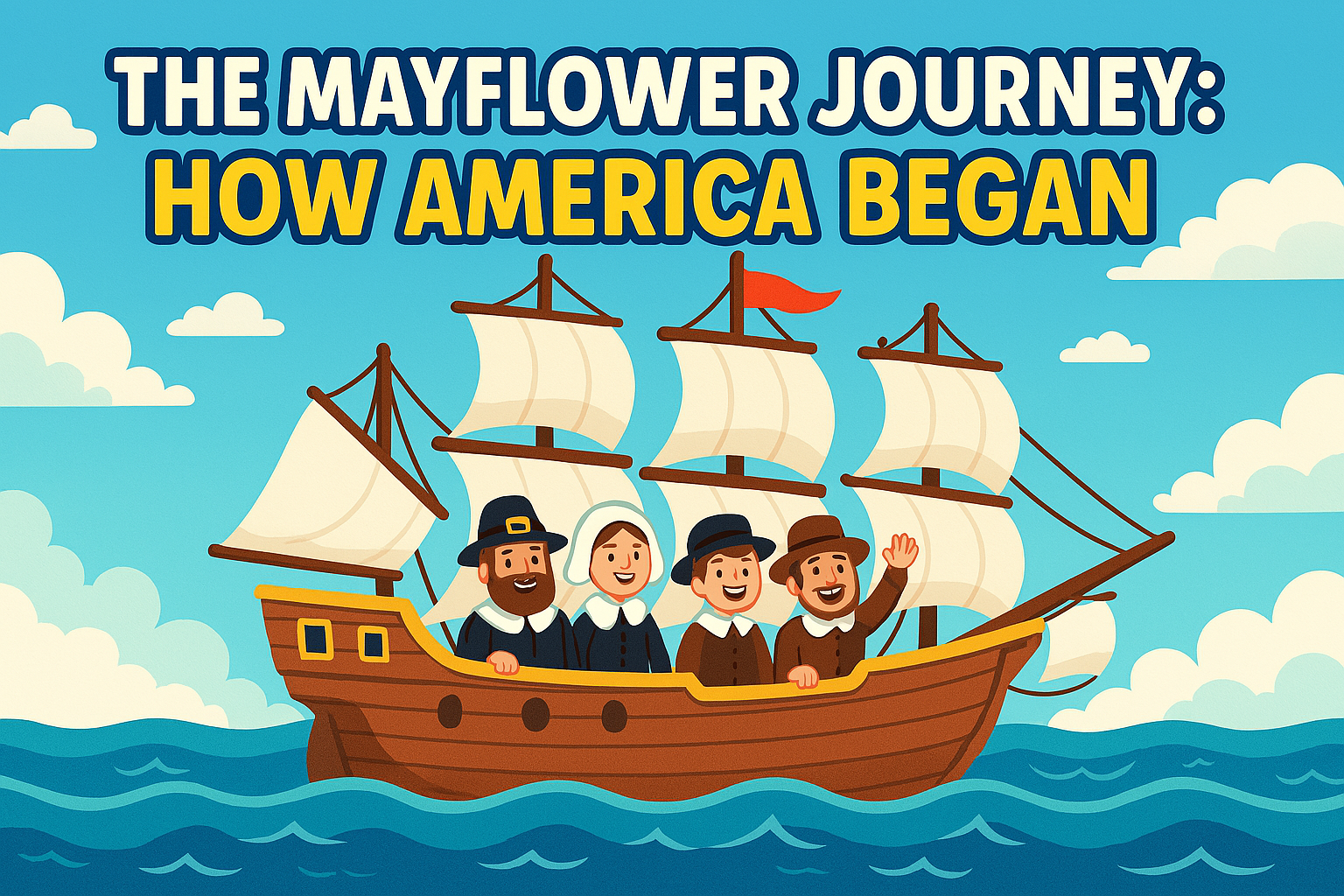
This topic is part of our Info Zone collection. You can read the full topic, once logged in, here: The Mayflower Journey: How America Began
You’ll also find a full Lesson Plan and a handy Parent Q & A sheet, for this topic, ready to use..
[cl_logged_in]
The World Before the Mayflower
Before the Mayflower journey began, England was going through big changes. In the early 1600s, King James I ruled the land, and the Church of England was the only legal church. People who didn’t agree with its teachings, like the Separatists, were often fined, imprisoned, or even worse. These groups wanted to practice their religion freely, without being told what to believe.
The Separatists, who later became known as the Pilgrims, first fled to the Netherlands. While they had more freedom there, life was tough. They had low-paying jobs, and their children were starting to lose their English culture. Many families worried their way of life would disappear completely.
That’s when they decided to take a huge leap of faith. They would travel to the New World — a land far across the sea — to start fresh. They believed it would be a place where they could build a better life and worship freely. But this wasn’t an easy choice. The trip would be dangerous and full of unknowns.
They weren’t alone, though. Some passengers on the Mayflower weren’t Separatists. They were adventurers, traders, and workers hoping to find new opportunities. These “Strangers,” as the Pilgrims called them, made up about half of the passengers. These two groups would soon have to live and work together in a strange new world.
And so, the idea of the Mayflower journey was born — a bold plan to leave behind the old world and build something entirely new.
[br][br]
All Aboard the Mayflower
The Mayflower was no cruise ship. It was a cargo vessel, about 30 meters (100 feet) long, designed to carry goods — not people. Still, it became the home for 102 passengers and around 30 crew members. That’s a lot of people for such a small space!
Passengers brought what little they could carry: clothes, tools, seeds, and books. There was no running water or toilets on board. The smell? Not great. The space? Crowded. Imagine trying to sleep, eat, and live in a dark, damp space no bigger than a classroom, with dozens of others!
Life on board was hard. Food was mostly salted meat, dried fish, and hard biscuits called “ship’s biscuit” or “hardtack.” Storms often rocked the ship, throwing people out of their makeshift beds. Seasickness was common, and fresh water was scarce. It’s no wonder some people wondered if they’d made a terrible mistake.
Yet, despite the challenges, there was hope. People sang, prayed, and supported one another. They believed their hardships had a purpose — they were part of something bigger than themselves. Every wave brought them closer to their dream.
The Mayflower set sail from Plymouth, England, on September 16, 1620 (September 6 in the Old Style Julian calendar). Their destination: the Virginia Colony in North America. But fate had other plans.
[br][br]
Storms, Delays, and a Surprise Destination
It didn’t take long for the journey to turn rough. Giant storms battered the ship. At one point, a main beam cracked, and everyone feared the Mayflower would sink. Luckily, a large iron screw — possibly from one of the passenger’s equipment — helped brace the beam in place.
After 66 long days at sea, the passengers finally saw land on November 9, 1620. But it wasn’t Virginia. The storms had blown them far off course. They had arrived at Cape Cod, in what is now Massachusetts.
They tried to sail south to Virginia, but dangerous shoals and strong headwinds forced them to turn back. It became clear they would have to settle where they were. This unexpected twist would shape history in ways no one could imagine.
Since they were outside the land controlled by the Virginia Company, the group needed a plan for how they’d govern themselves. They couldn’t rely on English laws here.
That’s when they came up with something brand new — a document that would lay the groundwork for their new society.
[br][br]
The Mayflower Compact: A New Way to Live
Before stepping off the ship, 41 adult male passengers signed a simple but powerful agreement called the Mayflower Compact. This document said they would form a “civil body politic” and make decisions together, for the general good. It was a promise to stick together and create fair laws for their new home.
This was a big deal. In 1620, most people were ruled by kings and queens. But here, these ordinary settlers were choosing to govern themselves. It was one of the first steps toward self-government in America.
The Compact didn’t go into lots of detail, but it created a sense of unity. It helped people from different backgrounds work together, even when they disagreed. They knew survival would depend on cooperation.
Thanks to the Mayflower Compact, the Pilgrims had a structure for making rules and resolving disputes. This idea — that people should have a say in their government — would influence future American documents like the Declaration of Independence and the Constitution.
It all started with a short agreement signed on a rocking ship by tired, hopeful travellers determined to start a new life.
[br][br]
Building a Life in the New World
Stepping off the Mayflower wasn’t the end of their troubles — it was just the beginning. The land was cold and unfamiliar. The Pilgrims had to build homes quickly before winter arrived. Many lived on the ship until shelters were ready.
That first winter was brutal. Nearly half the group died from cold, hunger, or illness. It was a heart-breaking time, but those who survived didn’t give up. They kept going, planting crops, building homes, and learning how to survive in this strange land.
One major reason they survived was the help of local Wampanoag Native Americans, especially a man named Tisquantum (commonly known as Squanto). He spoke English (having been previously captured by European explorers) and taught the Pilgrims how to grow corn, find fish, and use the land wisely.
Without this help, the colony might have failed. It’s a reminder that cooperation and friendship can make a huge difference — even between very different groups.
The Pilgrims eventually built a village called Plymouth. It was the beginning of one of the earliest successful English colonies in America.
[br][br]
A Final Thought
The *Mayflower journey* wasn’t just a sea voyage — it was a leap into the unknown. These brave travellers faced storms, starvation, and fear, but they also built the foundation for a new way of life. Their courage and ideas still inspire us today.
[br][br]
What Do You Remember?
- Why did the Pilgrims leave England in the first place?
- What kind of ship was the Mayflower?
- Why didn’t the Mayflower land in Virginia?
- What was the Mayflower Compact and why was it important?
- Who helped the Pilgrims survive their first year?
Write your answers in the comment section below
[br][br]
Related Wikipedia Links
Want to learn more about the people and events mentioned in the article? Try these links:
[br][br]
What Do You Think?
If you had been offered a place on the Mayflower, would you have gone? Why or why not? Share your thoughts below and tell us what you found most interesting about their journey.
[br][br]
[/cl_logged_in]
[cl_logged_out]
Members Only
You need to be registered and logged in to access this learning resource and other member only content. It only costs £1.99
[/cl_logged_out]

