Hello Alan Lloyd - Your Scores - Logout

Oumuamua, Was the Mysterious Interstellar Object an Alien Probe or Just a Meteor?

Was the Mysterious Interstellar Object an Alien Probe or Just a Meteor?

In 2017, astronomers spotted something strange moving through our solar system. It wasn’t acting like a comet or an asteroid, and it didn’t come from around here. This mysterious interstellar object had travelled from another star system and zipped past the Sun at incredible speed. Some scientists wondered — could it be an alien space probe?

Oumuamua, Was the Mysterious Interstellar Object an Alien Probe or Just a Meteor?
By Alan Lloyd

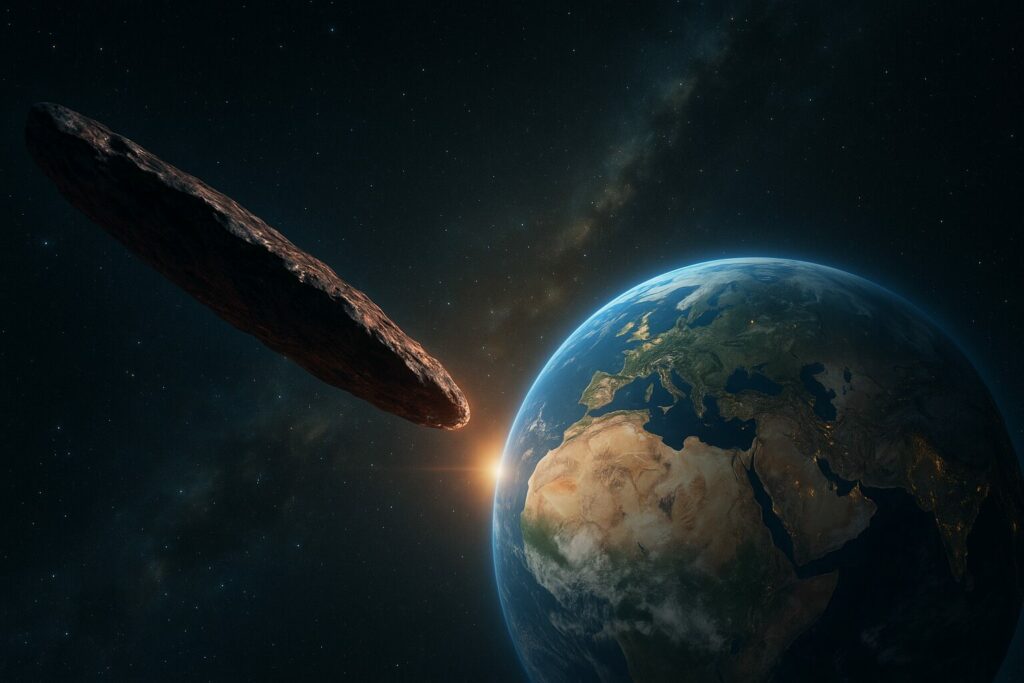
Its official name was ʻOumuamua, which means “scout” or “messenger” in Hawaiian. But this wasn’t your typical space rock. It was oddly shaped, unlike anything we’d seen before — more like a long, thin cigar than a round asteroid. It also sped up slightly as it moved away from the Sun, which made no sense if it was just a rock. Naturally, that raised eyebrows in the scientific world.

So what was it? Some researchers suggested it might be a comet that had lost its tail, or a broken fragment from another planet. Others went a bit further and asked, what if it was built — not formed? Could this unidentified space object be a spacecraft from another civilisation, passing through unnoticed?

Now let’s explore the facts, the theories, and the wild ideas behind this mysterious space visitor.


This topic is part of our Info Zone collection. You can read the full topic, once logged in, here: Oumuamua, Was the Mysterious Interstellar Object an Alien Probe or Just a Meteor?

You’ll also find a full Lesson Plan and a handy Parent Q & A sheet, for this topic, ready to use..

What Is a Mysterious Interstellar Object?

When scientists talk about a mysterious interstellar object, they mean something that entered our solar system from the space between stars — not from our own Sun’s neighbourhood. These are incredibly rare. In fact, before 2017, we’d never seen one for sure.

The object in question was later named ʻOumuamua. It came from outside our solar system, passed through quickly, and then left forever. What made it so strange was how it looked and moved. It didn’t behave like a comet, didn’t leave a visible trail, and didn’t reflect sunlight in the usual way.

This led to some serious debate among scientists. Was it a new kind of asteroid? Or something entirely different — maybe even artificial? While most interstellar visitors might go unnoticed, this one stood out because of how unique it was.

One key reason ʻOumuamua was labelled mysterious was because of its speed and direction. It was moving too fast to be from our solar system. It wasn’t orbiting the Sun like planets or comets. It was just passing through.

The very idea of a rogue space rock from another star system got everyone excited — and a little suspicious. So the mystery deepened.


How Was ʻOumuamua Discovered?

ʻOumuamua was first spotted on 19 October 2017 by astronomers using the Pan-STARRS telescope in Hawaii. They noticed a small, fast-moving dot that didn’t match anything in their database. It was moving quickly, already leaving our solar system, and had come from an odd direction.

Scientists tracked its path backward and realised it hadn’t come from inside the solar system at all. It had arrived from somewhere far beyond — possibly the direction of the star Vega, in the Lyra constellation.

This discovery was a big deal. It marked the first time we had clear evidence of an interstellar object entering our solar system. It also meant there could be millions more just like it, silently flying through space.

But the real shock came when astronomers started measuring how it moved. It didn’t just follow the expected gravitational path. Instead, it sped up slightly — without any clear cause.

That small change in speed got everyone asking, what was pushing it?


What Made ʻOumuamua So Unusual?

The shape of ʻOumuamua was its first mystery. Based on how its brightness changed as it tumbled through space, scientists guessed it was up to 400 metres long and about 40 metres wide — like a floating, spinning pencil.

Most asteroids we know are more rounded, or at least irregular in a blocky way. But this one was long and thin — which is why it’s often called a cigar-shaped asteroid. That shape is rarely seen in nature, especially for something so large.

Next was the fact that it didn’t have a visible tail, like most comets do when they heat up near the Sun. But it still accelerated slightly — just like a comet might if gases were being pushed off its surface. The problem? No gases were seen.

It also tumbled in an odd way, flipping end over end every 7–8 hours. That made it harder to study, since it was constantly changing its angle to the Sun and Earth. Some scientists think it might’ve been a flat, disc-like shape instead — we just couldn’t tell for sure.

All these weird traits added up to one big question: was this natural… or not?


Could It Have Been an Alien Space Probe?

One of the boldest theories came from Avi Loeb, a respected astrophysicist at Harvard. He suggested that ʻOumuamua might be an alien space probe — possibly a type of solar sail. That’s a spacecraft powered by sunlight, using thin, wide surfaces to catch solar radiation like a sail in the wind.

Loeb pointed out that the unexplained acceleration and odd shape could make sense if ʻOumuamua was a very thin, flat sheet — something not naturally formed, but built. He even compared it to devices we’re trying to create here on Earth for future space travel.

This idea stirred up both excitement and criticism. Most scientists think the alien probe idea is unlikely, mainly because there’s no hard proof — no signals, no energy emissions, no pattern of movement that looks intelligent.

Still, Loeb’s theory couldn’t be entirely ruled out. After all, we only had 11 days to observe the object before it became too faint to study in detail. And science often starts with wild questions.

So while the alien space probe idea is a long shot, it does remind us how little we really know about what’s out there.


What Are the Natural Explanations?

Most astronomers believe ʻOumuamua was a natural object. One leading idea is that it was a chunk of nitrogen ice, similar to Pluto’s surface. That could explain the acceleration — as the Sun warmed it, nitrogen gas might have escaped, giving it a push.

Another idea is that it was a hydrogen iceberg — a block of frozen hydrogen. But this is very rare and would melt quickly, making it hard to detect. Still, it could explain why we didn’t see any visible gases or debris trail.

Some scientists think it might have been a shard from a shattered planet. During the formation of solar systems, large objects often collide. A splintered fragment could’ve been flung into space millions of years ago and drifted until it found us.

In any case, the unusual shape and behaviour might just be a coincidence — a rare but natural mix of properties we hadn’t seen before. Nature can be strange and surprising like that.

These natural explanations still leave gaps, but they don’t require alien technology to fill them.


Why Was It So Hard to Study?

ʻOumuamua was already on its way out when we spotted it. That meant we had just days to gather data. It was moving at nearly 90,000 km/h and getting dimmer by the hour.

Because it was so faint, most of the information came from studying how its brightness changed. That’s how scientists estimated its shape, spin, and size. But these were guesses based on limited data.

We couldn’t send a probe to chase it — we weren’t prepared. It was already too far away, and we didn’t even know it existed until it was leaving. It’s like seeing a speeding car just after it’s passed your house — all you catch is a blur.

This shows how little warning we get with these types of objects. It also highlights why better space monitoring is so important. If another interstellar visitor arrives, we’ll want to be ready.

Some new projects are already being designed to do just that.


How Rare Are Interstellar Visitors?

Before ʻOumuamua, no one had seen an object like this. But after it was discovered, scientists realised we might’ve just missed others in the past. Our tools weren’t sensitive enough to catch them.

Since then, another interstellar visitor was spotted — comet 2I/Borisov in 2019. That one looked more like a classic comet, with a visible tail. But it confirmed that objects do enter our solar system from other stars.

These events might be more common than we thought — maybe one every few years. The problem is spotting them in time. They’re often small, dark, and fast-moving, so they’re easy to miss.

New telescopes like the Vera Rubin Observatory in Chile will help us catch more of them in the future. Better data means better chances to understand them.

And maybe, just maybe, we’ll catch one early enough to send a spacecraft after it.


What Could We Learn from These Objects?

Every interstellar object that enters our solar system is a visitor from another star. It brings with it clues about its home system — the chemistry, structure, and history of faraway places.

Studying them could reveal how planets form elsewhere, or even hint at conditions that support life. They’re like space messengers carrying cosmic secrets.

Imagine being able to pick up a rock from another solar system — without leaving home. That’s what makes these visitors so valuable to science.

If we can eventually collect samples or closely observe one in flight, we might learn how common life-supporting materials are in the galaxy. Maybe even how likely life is beyond Earth.

So each mysterious interstellar object isn’t just an oddity — it’s a scientific treasure.


A Final Thought

ʻOumuamua remains one of the strangest objects we’ve ever seen. Whether it was just an odd rock or something more, it opened our eyes to a universe full of surprises. The truth might still be out there — waiting for the next visitor to arrive.


Quick Quiz

  • What makes ʻOumuamua different from comets and asteroids?
  • Why did some scientists think it could be an alien probe?
  • What are some natural explanations for its acceleration?
  • How often do interstellar visitors enter our solar system?
  • Why was it difficult to study ʻOumuamua in detail?

Write your answers in the comment section below.


Related Wikipedia Links

You can find more technical details and theories by exploring these articles:


What Do You Think?

Was ʻOumuamua just a strange rock — or a message from another civilisation? Do you think we’ll ever find out for sure? What would you do if another unidentified space object entered our skies tomorrow?


Leave a comment

'; // Add header content for print html += '

Lenara Learning

Get more learning resources at www.lenara.uk

'; // Insert the worksheet content html += '
' + content + '
'; html += ''; printWindow.document.write(html); printWindow.document.close(); printWindow.focus(); // Trigger printing and auto-close the popup printWindow.print(); printWindow.onafterprint = function() { printWindow.close(); }; setTimeout(function() { printWindow.close(); }, 1500); }