Hello Alan Lloyd - Your Scores - Logout

Was the Mysterious Interstellar Object an Alien Probe or Just a Meteor? (Q&A)

Q & A - Was the Mysterious Interstellar Object an Alien Probe or Just a Meteor?

The mysterious interstellar object parent Q&A page explores the bizarre space visitor scientists named ʻOumuamua. It’s a rare example of something that came from outside our solar system, moved strangely, and left behind more questions than answers. Was it a comet without a tail? A tumbling space rock? Or, as a few scientists have wondered, something even more unusual—like an alien probe?
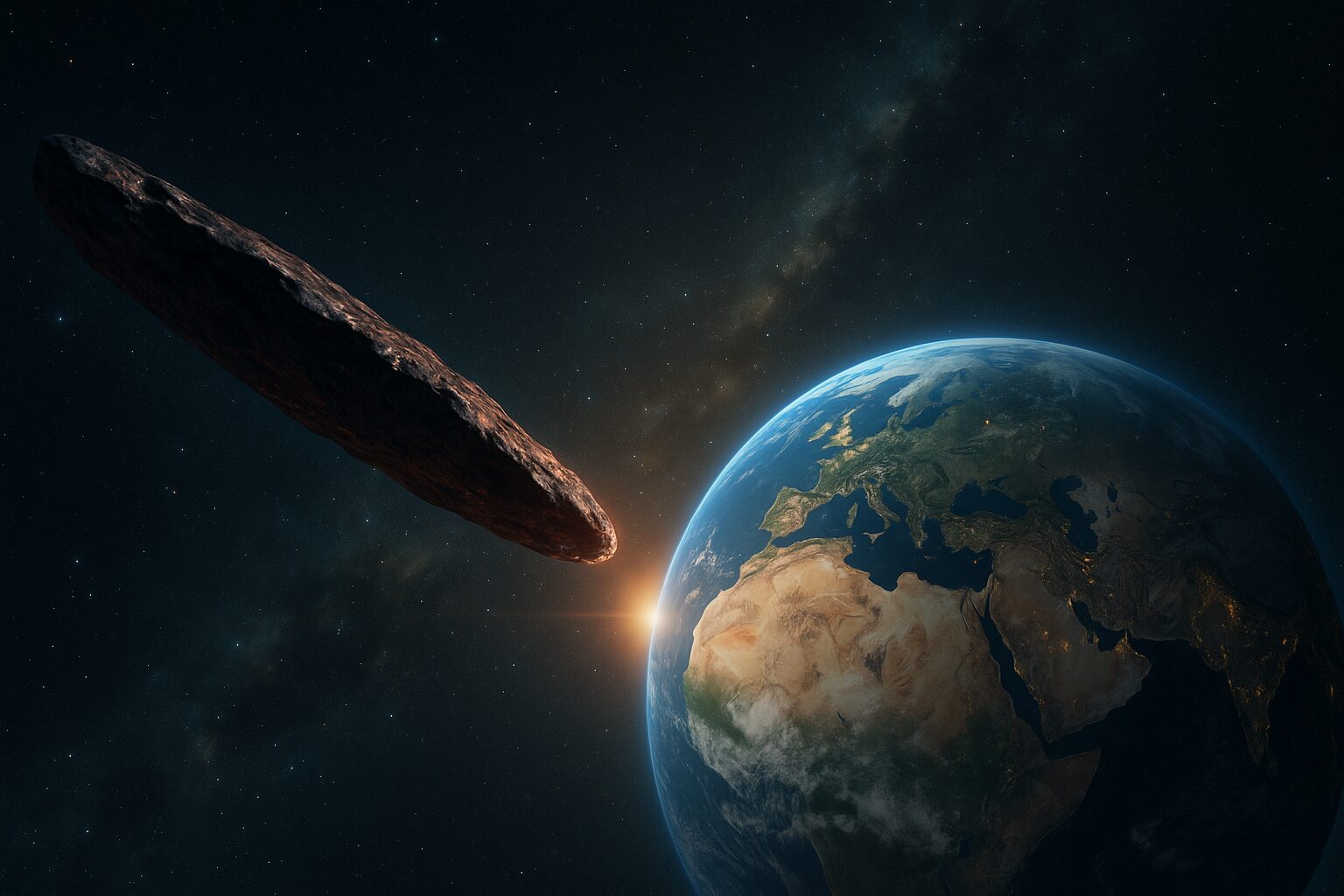
Oumuamua, Was the Mysterious Interstellar Object an Alien Probe or Just a Meteor?
By Alan Lloyd

This Parent Q&A page is designed to help you feel confident answering your child’s questions about this strange object. You don’t need to be a science expert or own a telescope. Everything’s explained in everyday language, and we include useful comparisons and simple ways to explain big ideas. If your child is curious about space, aliens, or just loves a good mystery, this page will help you talk it through.

We’ve also created a matching lesson plan if you want to explore the topic in more depth. But this page is great if you just want quick, trustworthy answers and a way to spark an interesting conversation.

What makes this topic perfect for home learning is how it encourages curiosity, questions, and critical thinking. It also ties directly into real-world science—how we watch the skies, track unknown objects, and decide what’s natural and what might not be.


This topic is part of our Info Zone collection. You can read the full topic, once logged in, here: Oumuamua, Was the Mysterious Interstellar Object an Alien Probe or Just a Meteor?

You’ll also find a full Lesson Plan and a handy Parent Q & A sheet, for this topic, ready to use..

Tip for Parents: Don’t worry if this topic feels a bit “out there” — it’s meant to be! Your child might ask unusual or imaginative questions. That’s great. Let them explore ideas, even if there’s no one clear answer.

What is a mysterious interstellar object?

It’s something that doesn’t come from our solar system. Instead, it travels between stars. ʻOumuamua was the first one ever spotted passing through. It wasn’t following an orbit like the planets — it just flew straight through and kept going.

Why was ʻOumuamua so important?

Because it came from another star system. That means it’s not connected to our Sun or planets. It was the first time we had direct evidence of something natural (or possibly artificial) visiting us from far beyond.

Where did it come from?

Scientists traced its path and think it came from the direction of the star Vega, in the Lyra constellation. But it may have been travelling for millions of years before it reached us.

How fast was it going?

It was moving at around 85,000 kilometres per hour. That’s fast enough to escape the Sun’s gravity, which is why it didn’t stay in orbit like a planet or comet would.

Why did some people think it was an alien probe?

ʻOumuamua sped up slightly as it left the solar system — but didn’t leave a visible gas trail like a comet. Its strange shape and movement made some scientists wonder if it was designed, not formed naturally. It’s only a theory, but it got lots of attention.

Could it really be alien technology?

Most scientists don’t think so — but they can’t completely rule it out. There’s no hard evidence either way. The alien idea is unlikely, but it shows how little we know about objects from deep space.

What shape was it?

Based on how its brightness changed, it was probably long and narrow — like a cigar or a pancake. But since we couldn’t see it clearly, we still don’t know its exact shape.

Was it spinning?

Yes, it was tumbling as it moved. That made it even harder to study because it kept changing its angle. It flipped roughly every 7–8 hours.

Why didn’t we send a spacecraft to follow it?

We noticed it too late. It was already on its way out when telescopes picked it up. No mission was ready to launch, and we couldn’t catch it in time. It was like spotting a car just as it drives off into the distance.

Could we track it again?

No, it’s long gone. It became too faint to see after about 11 days. It’s now travelling through space far beyond the reach of any telescope.

Are mysterious interstellar objects rare?

We used to think so, but maybe they’re just hard to spot. A second one, called 2I/Borisov, appeared in 2019. Now that we’re watching more closely, we might find more in the future.

What’s the difference between a comet, an asteroid, and this?

Comets have ice and leave tails. Asteroids are rocky and usually orbit the Sun. ʻOumuamua didn’t act like either. It didn’t have a tail, and it wasn’t orbiting — it was just passing through.

What does ʻOumuamua mean?

It’s a Hawaiian word meaning “messenger” or “scout.” The telescope that found it is based in Hawaii, so the name honours the language and culture.

What could explain its strange movement?

Some scientists think gas escaping from inside the object might have given it a push — even though no gas was seen. Others think it could’ve been made of unusual materials, like nitrogen ice or hydrogen, that vanish quickly.

How big was it?

Estimates say about 100 to 400 metres long and very narrow. That’s roughly the length of a football field, but much thinner. It reflected sunlight strangely, so measurements were tricky.

How do astronomers find things like this?

Telescopes scan the sky for moving objects. Most follow a set path, but when something moves oddly or too fast, it gets flagged. That’s how ʻOumuamua was spotted by the Pan-STARRS telescope.

Could there be millions of these flying around?

Yes — space is vast and full of debris. ʻOumuamua may be one of many. Most are probably too small or faint to see. But new telescopes might help us spot more of them.

What if we find another one?

Next time, we might catch it sooner. Some space agencies are designing missions to chase the next mysterious interstellar object — just in case it turns out to be even stranger than the last.

Why does this matter for science?

It shows us that the universe is full of surprises. Whether ʻOumuamua was natural or artificial, it proves we still have a lot to learn about what’s out there — and how often we’re being visited by objects from other stars.

Where can I read more?

You can explore more about the mysterious interstellar object and ʻOumuamua on our main topic page here: Oumuamua, Was the Mysterious Interstellar Object an Alien Probe or Just a Meteor?


Leave a comment

'; // Add header content for print html += '

Lenara Learning

Get more learning resources at www.lenara.uk

'; // Insert the worksheet content html += '
' + content + '
'; html += ''; printWindow.document.write(html); printWindow.document.close(); printWindow.focus(); // Trigger printing and auto-close the popup printWindow.print(); printWindow.onafterprint = function() { printWindow.close(); }; setTimeout(function() { printWindow.close(); }, 1500); }