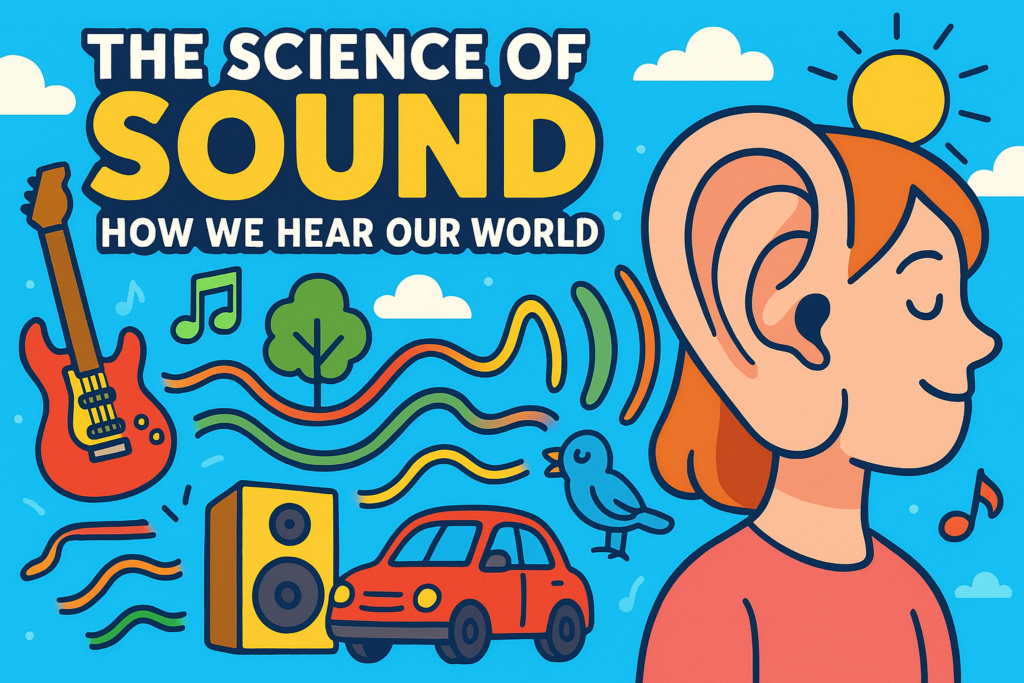
The Science of Sound: How We Hear Our World (Lesson Plan)

Lesson Plan - The Science of Sound: How We Hear Our World

This home education lesson plan explores the physics of sound—how vibrations create sound waves, how those waves travel, and how our ears and brain turn those vibrations into something we hear. It’s a fascinating topic that links science with everyday experience. Whether it’s music, speech, or environmental sounds, everything we hear starts with simple movement. This lesson plan helps you guide your child through that process step-by-step.

You don’t need to be a physics expert to teach this. I’ve included clear explanations, fun activities, and creative tasks that make complex ideas easier to understand. You’ll learn together how sound moves through air, why some sounds are loud or high-pitched, and what makes echoes and vibrations work the way they do. There’s a mix of questions, hands-on experiments, and imaginative thinking throughout.

This lesson plan is designed for children aged 8 to 16, with flexible tasks that can be adjusted based on ability. It encourages curiosity, discussion, and real-world connections. It also links to our full Info Zone article at Lenara.uk, so you can explore the science in more depth whenever you’re ready. Sound good? Let’s get started!


This topic is part of our Info Zone collection. You can read the full article here: The Science of Sound: How We Hear Our World

You’ll also find a full Lesson Plan and a handy Parent Q & A Sheet ready to use.

[cl_logged_in]
Lesson Plan
The Science of Sound – How We Hear Our World
Overview This home education lesson plan introduces the physics of sound. It explains how vibrations produce sound waves, how those waves travel, and how we hear them. The lesson connects everyday sounds with deeper scientific ideas like amplitude, frequency, energy, and resonance.
Learning Objectives - Understand what sound is and how it travels
- Explore the parts of the ear and how we hear
- Learn the difference between volume (amplitude) and pitch (frequency)
- Carry out simple investigations into sound waves
Estimated Time 60–75 minutes
Starter Activity Ask: “What’s the loudest or strangest sound you’ve ever heard?”
Try this experiment: Place your fingers lightly on your throat and hum. Can you feel the vibrations? That’s how sound begins.
Read and Learn Read the main topic page together: The Science of Sound: How We Hear Our World.

Discuss these questions:
  • What are sound waves made of?
  • Why can’t sound travel through space?
  • How do vibrations reach your brain?
  • Which part of the ear changes vibrations into signals?
Activities Comprehension Questions:
  1. What causes sound in the first place?
  2. What’s the difference between a loud and quiet sound?
  3. How does pitch relate to frequency?
  4. Why does sound travel faster in water than in air?
  5. What happens when sound waves reflect off surfaces?

Practical Task – Sound Through Solids:
Try the classic “string telephone” using two paper cups and a long piece of string. Talk into one and listen at the other. What happens if the string is loose vs tight?

Vocabulary Builder:
Match the term to its meaning: frequency, amplitude, resonance, wavelength, cochlea.
Deeper Thinking Big Question: “If no one is around to hear it, does a sound still exist?”
Talk about what sound really is. Does it need a listener?
Creative Projects - Create a poster showing the journey of a sound wave from a guitar string to your brain
- Design your own imaginary musical instrument. Explain how it creates vibrations and what materials it’s made from
- Record five different sounds around your home and describe how each one is produced
Review & Reflect Ask your learner:
  • What part of today’s lesson plan did you enjoy most?
  • Was there anything tricky or confusing?
  • If you could teach someone else one thing about sound, what would it be?
Extensions & Homework - Watch a video showing how your ear works
- Research an animal that hears differently than we do (like a bat or elephant)
- Try clapping in different rooms—notice the echoes? What do you think affects the sound?
[/cl_logged_in]

[cl_logged_out]

Members Only

You need to be registered and logged in to access this lesson plan and all other learning resources, games and quizzes.

[/cl_logged_out]