
Post-Scarcity Economy: How Technology Could Make Everything Free
Post-Scarcity Economy: How Technology Could Make Everything Free
What if we lived in a world where everything you needed—food, clothes, even technology—was free or nearly free? That’s the idea behind a post-scarcity economy. In this kind of system, goods and services are so abundant, nobody has to fight over them. It sounds futuristic, but with rapid advancements in AI, robotics, and 3D printing, some experts think it could happen sooner than we expect.
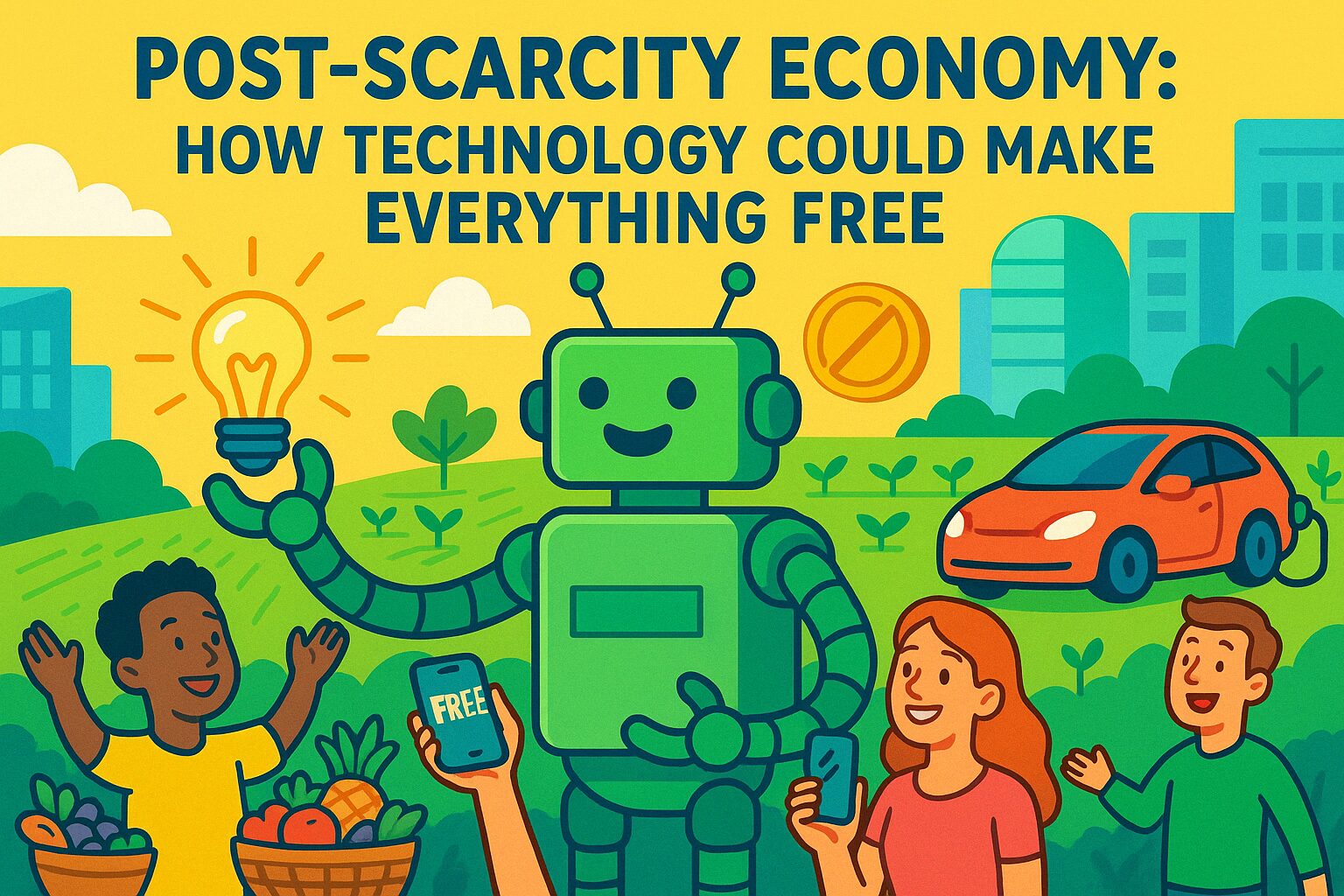
The post-scarcity economy challenges the way we think about money, work, and value. Instead of scarcity—where people have to compete for limited resources—we’d have resource abundance. Imagine self-repairing machines, vertical farms in every city, and nearly free electricity from solar power. All these could reduce the cost of producing almost anything.
But hold on—is this really possible? And if so, how would it change the world? In this guide, we’ll break down the science, economics, and technology behind this idea. We’ll also explore what might stand in the way, and what kind of world we might be stepping into.
This topic is part of our Info Zone collection. You can read the full topic, once logged in, here: Post-Scarcity Economy: How Technology Could Make Everything Free
You’ll also find a full Lesson Plan and a handy Parent Q & A sheet, for this topic, ready to use..
What Is a Post-Scarcity Economy?
A post-scarcity economy is a theoretical system where most goods and services are available in limitless amounts. The idea is simple: once we can produce things so cheaply that they’re practically free, scarcity disappears. But it’s not just about money—it’s about breaking the link between value and supply.
In our current economy, scarcity drives prices. If something is rare, it usually costs more. A post-scarcity model flips this idea. It imagines a future where technology makes production so efficient that cost becomes irrelevant. Food, housing, transport—even luxury items—might be accessible to everyone.
This kind of economy depends on extreme automation and high-tech systems. Think about AI systems that run entire factories or 3D printers that build houses in a day. These are the tools that could help us reach a state of resource abundance.
It’s important to note that “post-scarcity” doesn’t mean absolute infinity. It just means we can meet everyone’s basic needs without worrying about running out. It’s not magic—it’s the result of smart design, clean energy, and advanced machines.
So, is it just science fiction? Not entirely. Many technologies we’ll explore here already exist in some form. It’s more a question of scaling up, adapting systems, and making sure everyone benefits.
The Role of Technology in Abundance
The backbone of any post-scarcity economy is technology. Automation, artificial intelligence, and robotics play key roles. These systems reduce the need for human labour and lower production costs to near zero.
Picture a robotic farm that grows, harvests, and packages food with no human help. Or a self-driving electric truck delivering goods 24/7 without stopping for fuel or rest. These aren’t distant dreams—they’re already being tested today.
In a technology-driven society, machines do the heavy lifting. They don’t get tired, and they don’t need wages. This means things can be made faster, cheaper, and with less waste.
Technological innovation also solves resource limitations. For example, synthetic materials and lab-grown food reduce our need for natural resources like wood or meat. We can even recycle materials endlessly using molecular-level 3D printing.
As these tools become more widespread, the cost of making goods drops. Eventually, we reach what economists call “zero marginal cost”—where making one more item costs almost nothing.
Understanding Zero Marginal Cost
Marginal cost is the cost of making one more unit of something. In today’s world, that cost often includes labour, materials, and energy. But in a future economy powered by smart tech, those costs shrink dramatically.
Take solar panels, for example. Once installed, they produce electricity almost for free. Now apply that idea to other things—like 3D printers making shoes, or vertical farms growing vegetables in cities. After the initial setup, the extra costs are minimal.
This zero marginal cost idea is crucial. It’s the tipping point where businesses no longer need to charge high prices to stay afloat. And that changes how the economy works entirely.
When digital tools—like music files or software—are copied, they already have zero marginal cost. We don’t pay per download anymore. A post-scarcity system stretches that idea into the physical world too.
But it raises big questions. If everything is cheap or free, how do companies survive? Do we still need jobs? What happens to profit and ownership? We’ll dive into those questions later on.
Resource Abundance and the End of Limits
Resource abundance means we have enough materials, food, and energy to go around. That might seem impossible now, but technology helps unlock new supplies—or use existing ones more wisely.
Recycling at the atomic level, desalinating seawater, or creating meat from cells in labs—all of these increase supply without damaging the planet. They make abundance sustainable.
Abundance doesn’t just mean “more stuff.” It means smart systems that avoid waste and overuse. In nature, nothing is wasted—everything is reused. A post-scarcity economy aims to copy that model.
Access is key. It’s not just about having enough—it’s about making sure everyone can benefit. That might mean shared networks of tools, free public transport, or universal digital services.
We already see early signs of this in open-source software and sharing platforms. The future could be an expansion of those ideas into every part of life.
How Work and Jobs Might Change
In a post-scarcity economy, traditional jobs may disappear—but that’s not necessarily bad. If machines do the boring stuff, people are free to focus on creative, social, or personal goals.
Instead of working to survive, we might work to learn, build, and explore. Basic needs could be guaranteed by the system. Some people call this “economic freedom.”
Universal Basic Income (UBI) is one idea that fits well here. It’s a regular payment to every person, no strings attached. With UBI, people can still earn more if they want—but they won’t fall into poverty if they don’t.
New kinds of work may also emerge. Teaching robots, designing virtual worlds, or solving climate challenges could become everyday jobs. Work might become more about passion and impact.
Still, there will be challenges. Not everyone adapts easily to change. Some people may feel lost without traditional roles. That’s why education, mental health support, and community will matter more than ever.
Ownership and Access in the Future Economy
One big question in a post-scarcity world is: who owns what? If machines make everything and costs drop, do we still buy things, or just borrow them when needed?
This shift from ownership to access is already happening. Think of streaming instead of buying DVDs, or renting bikes instead of owning a car. These models reduce waste and increase sharing.
Digital tokens, like those used in blockchain technology, may help track usage without needing physical ownership. It’s a way to make sharing systems fair and secure.
Some argue that access-based models could reduce inequality. If everyone can use the same tools, nobody is left behind. But only if access is truly universal and not based on income or status.
This also brings up rights and rules. Who decides how these systems work? And how do we make sure they serve people—not just corporations?
Environmental Impact and Sustainability
A post-scarcity economy could be the most eco-friendly system ever—if done right. By reducing waste, reusing materials, and using clean energy, we can protect the planet while providing for all.
3D printing uses less material than traditional factories. AI systems can plan energy use more efficiently. Robots can grow crops with minimal chemicals or water.
But these systems still need raw materials and energy to start. So sustainability must be built into every step—from mining to disposal.
Environmental justice also matters. Communities that are already struggling shouldn’t be left out or harmed by new technologies.
If we design smart, the future could be both abundant and green. But if we repeat old mistakes, we’ll just create new kinds of inequality and pollution.
What Might Hold Us Back?
Not everything about a post-scarcity economy is easy. Politics, profit systems, and social habits can slow progress. Some companies may fight change to protect their profits.
People might resist giving up old systems—even if the new ones work better. Fear of change is powerful, especially when it affects money and status.
There’s also the digital divide. Not everyone has access to new tech. That could deepen inequality unless we fix it early.
Cybersecurity and data privacy are other risks. In a highly automated world, trust in systems becomes critical.
Finally, we need global cooperation. No one country can build a post-scarcity system alone. Climate, trade, and tech are all global issues.
Are We Already on the Way?
In many ways, we’ve already started the journey. Open-source platforms, solar energy, and shared-economy tools are small steps toward post-scarcity systems.
Digital goods—like ebooks, videos, and games—already follow zero marginal cost rules. We can copy them endlessly at no extra charge.
Electric vehicles, smart homes, and lab-grown food are no longer science fiction. They’re real, and they’re growing fast.
But we’re not there yet. Most people still face scarcity every day. The goal is to spread these tools and systems fairly and sustainably.
That’s where education, innovation, and policy all come in. If we plan wisely, the post-scarcity economy could become more than just a dream.
Could It Actually Work?
The post-scarcity economy isn’t guaranteed. But it’s a real possibility—and one worth exploring. It depends on how we handle technology, fairness, and the planet’s limits.
Will we share abundance, or hoard it? Will we redesign systems, or patch old ones? These are choices we’ll all face, sooner than we might think.
One thing’s clear: scarcity isn’t just a natural fact. It’s also a human system. And systems can change.
So, could technology make everything free? Not everything. But maybe everything we truly need. And that’s a future worth building.
The post-scarcity economy invites us to rethink what’s possible—and what kind of world we want to live in.
A Final Thought
The post-scarcity economy is more than a sci-fi dream—it’s a challenge to rethink how we live, work, and share. If we use technology wisely and fairly, abundance might not be so far away.
Quick Quiz
- What is the core idea behind a post-scarcity economy?
- How can zero marginal cost change how goods are priced?
- Why might some people resist this kind of economy?
- What technologies could make a post-scarcity system work?
- How might jobs change in a world of abundance?
Write your answers in the comment section below.
Related Wikipedia Links
Here are a couple of useful links to explore further:
What Do You Think?
Do you believe a post-scarcity world is possible? If so, what would you most want to see become free or widely available?