Post-Scarcity Economy: How Technology Could Make Everything Free (Lesson Plan)
Lesson Plan - Post-Scarcity Economy: How Technology Could Make Everything Free
Understanding how the world might change in the future is a brilliant way to spark curiosity in children. This post-scarcity economy lesson plan introduces a concept that’s both futuristic and grounded in real science. It explores what might happen if technology could make almost everything we need—like food, clothes, and energy—so cheap that it becomes free. The focus keyword for this lesson is post-scarcity economy lesson plan.
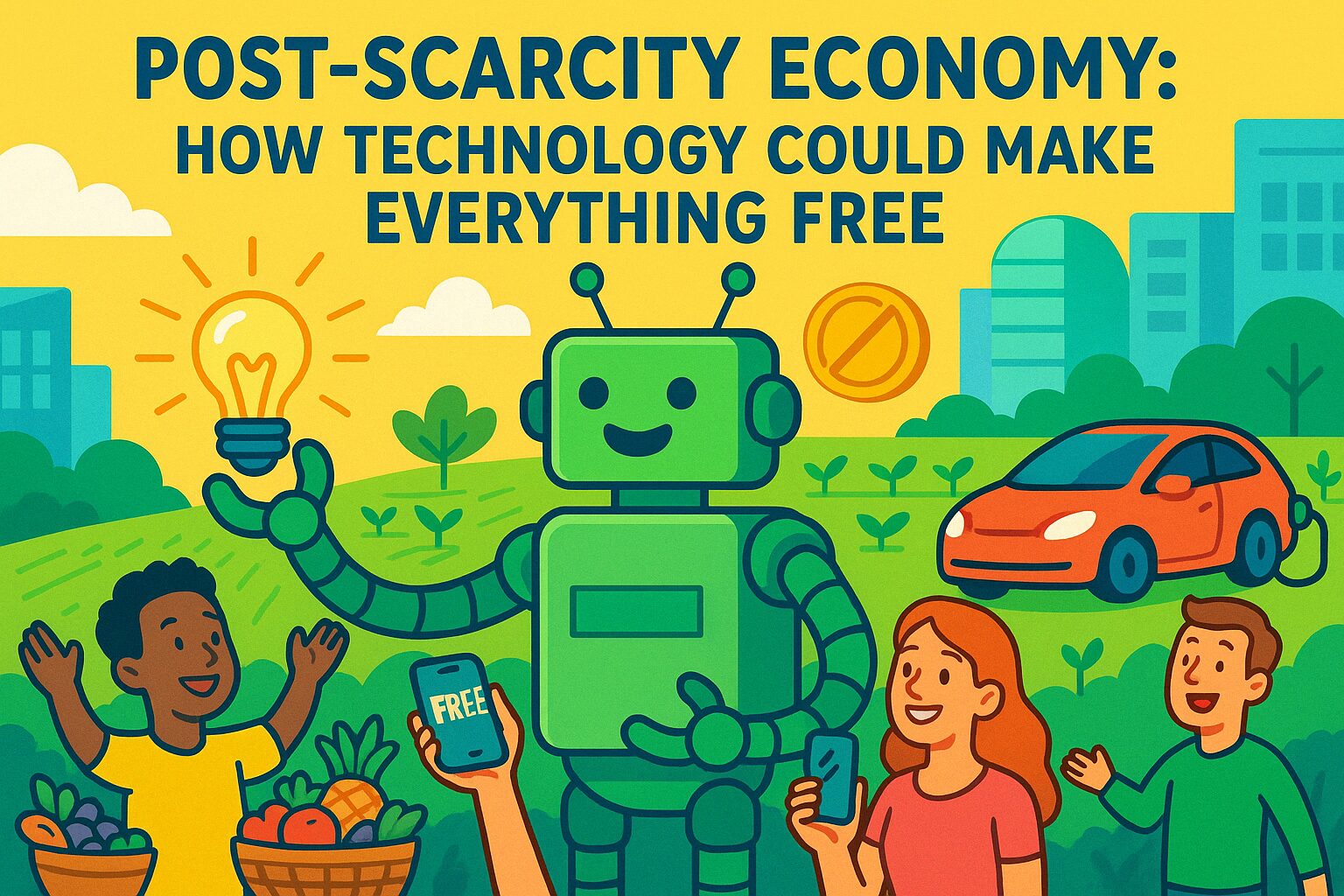
This structured approach supports home-educating parents in teaching a complex but fascinating topic. Your child will explore key ideas like automation, artificial intelligence, and renewable energy, and how they connect to economics and fairness. The lesson plan includes discussion questions, interactive tasks, and a quiz to help your child think critically and creatively about the future economy.
You don’t need a background in science or economics to teach this. Everything is clearly explained, with guidance to help you answer questions and keep your child engaged. Whether you’re covering science, citizenship, or technology, this resource makes it easy to adapt the topic to your schedule and your child’s interests.
By the end of the post-scarcity economy lesson plan, your child will have explored not just what’s possible, but what’s worth striving for in the world ahead.
This topic is part of our Info Zone collection. You can read the full topic, once logged in, here: Post-Scarcity Economy: How Technology Could Make Everything Free
You’ll also find a full Lesson Plan and a handy Parent Q & A sheet, for this topic, ready to use..
[cl_logged_in]
[br][br]
Post-Scarcity Economy: How Technology Could Make Everything Free
This lesson plan is designed to help you support your child with this topic: Post-Scarcity Economy: How Technology Could Make Everything Free
[br][br]
Learning Objectives (What You’ll Learn Today)
- Understand what a post-scarcity economy means and how it might work
- Explore how technology like AI and 3D printing could reduce production costs
- Think about how jobs, money, and ownership might change in the future
- Develop critical thinking through future-based discussion and mini-tasks
Estimated Time
60–90 minutes
Let’s Get Started
Ask your child: What would happen if robots could make everything we need, and nobody had to pay for food, energy, or transport?
[br][br]
The Main Lesson
What Is a Post-Scarcity Economy?
A post-scarcity economy is a system where goods and services are so easy and cheap to produce that they become widely available for free. This would mean everyone could get what they need without worrying about cost.
It’s not about having infinite resources, but using technology to make production so efficient that scarcity disappears. Food, water, shelter—even technology—might one day be freely available to everyone.
Mini-Task: Ask your child to name five things they use every day. Which of these do they think could be made free in the future? Why?
[br][br]
How Technology Makes Things Cheaper
Advanced tools like robots, artificial intelligence, and 3D printers are already reducing costs in many industries. These systems don’t need breaks, salaries, or holidays—they work constantly and efficiently.
For example, a robot-operated farm could grow, harvest, and pack vegetables all by itself. This lowers costs, saves time, and makes fresh food cheaper—or even free—over time.
Mini-Task: Watch a short video about automated farming or 3D printing. Can your child explain how the machine reduces costs?
[br][br]
Jobs and Work in a Post-Scarcity World
If machines handle most jobs, what will people do? One idea is that people will be free to choose meaningful activities, like art, science, or helping others—rather than working just to survive.
This could lead to new systems like Universal Basic Income (UBI), where everyone receives money whether they work or not. It’s a big shift from today’s economy.
Mini-Task: Ask your child what job they’d want if they didn’t need money. Would they still want to work? Why or why not?
[br][br]
Why Resource Abundance Matters
Right now, many people go without food, water, or shelter—not because we don’t have enough, but because of poor distribution or high costs. A post-scarcity economy would aim to fix that.
Technologies like lab-grown meat, recycled building materials, and solar power help create resource abundance—enough for everyone, with less environmental damage.
Mini-Task: Draw a “city of the future” where everyone has free access to food, transport, and energy. What technologies make that possible?
[br][br]
What Are the Challenges?
Not everyone supports a post-scarcity economy. Some worry about losing profits or jobs. Others fear that powerful companies might control the new technologies instead of sharing them.
Technology alone isn’t enough—we also need fair systems and global cooperation to make sure everyone benefits. Critical thinking helps your child understand why some ideas work better than others.
Mini-Task: Discuss what rules or systems we’d need to make sure a post-scarcity society stays fair for all.
[br][br]
Think and Discuss
- Could a world without money really work?
- What would you do with your time if you didn’t have to earn money?
- What technologies today could help us build a fairer economy tomorrow?
[br][br]
Wrap-Up Summary
In this lesson, your child explored how a post-scarcity economy could work and how technology could make life easier and fairer. They thought about the benefits, challenges, and what the future might look like.
[br][br]
Quiz
- What does “post-scarcity” mean?
- True or False: 3D printers increase the cost of goods.
- What is one example of a technology that can lower production costs?
- Why might traditional jobs become less common?
- What does UBI stand for?
- True or False: A post-scarcity economy guarantees infinite resources.
- What kind of food could be made using lab technology?
- What is one benefit of automation in farming?
- Who might resist a post-scarcity system, and why?
- True or False: A post-scarcity economy is already fully working today.
Answers
- An economy with nearly unlimited access to goods and services
- False
- Robotics, AI, 3D printing
- Machines may do most of the work
- Universal Basic Income
- False
- Lab-grown meat
- Lower costs and continuous production
- Companies that profit from scarcity
- False
Short Essay Prompt
Write a short essay, say 3 paragraphs, explaining how technology could change jobs in a post-scarcity economy. Include one example of a job that might disappear and one that might be created.
[br][br]
Extra Learning
Extra Learning: Research how 3D printers are used in different industries. Make a mini fact sheet or poster showing three real-world examples—such as house building, food printing, or healthcare devices.
[br][br]
Final Reflection (What Did You Learn?)
Talk with your child: Do they think a post-scarcity future is something we should aim for? What role should technology play in shaping a fair world?
[br][br]
[/cl_logged_in]
[cl_logged_out]
Members Only
You need to be registered and logged in to access this lesson plan and all other learning resources, games and quizzes.
[/cl_logged_out]