The Schrödinger Equation: The Mathematics of Quantum Waves (Lesson Plan)
Lesson Plan -The Schrödinger Equation: The Mathematics of Quantum Waves
The Schrödinger equation lesson plan introduces you and your child to one of the most powerful ideas in modern science — quantum waves. This topic explores how particles like electrons behave in ways we don’t see in everyday life, acting more like waves than tiny balls. It’s all about probability, not certainty, which can feel strange at first but opens up an amazing new way of thinking about the universe.
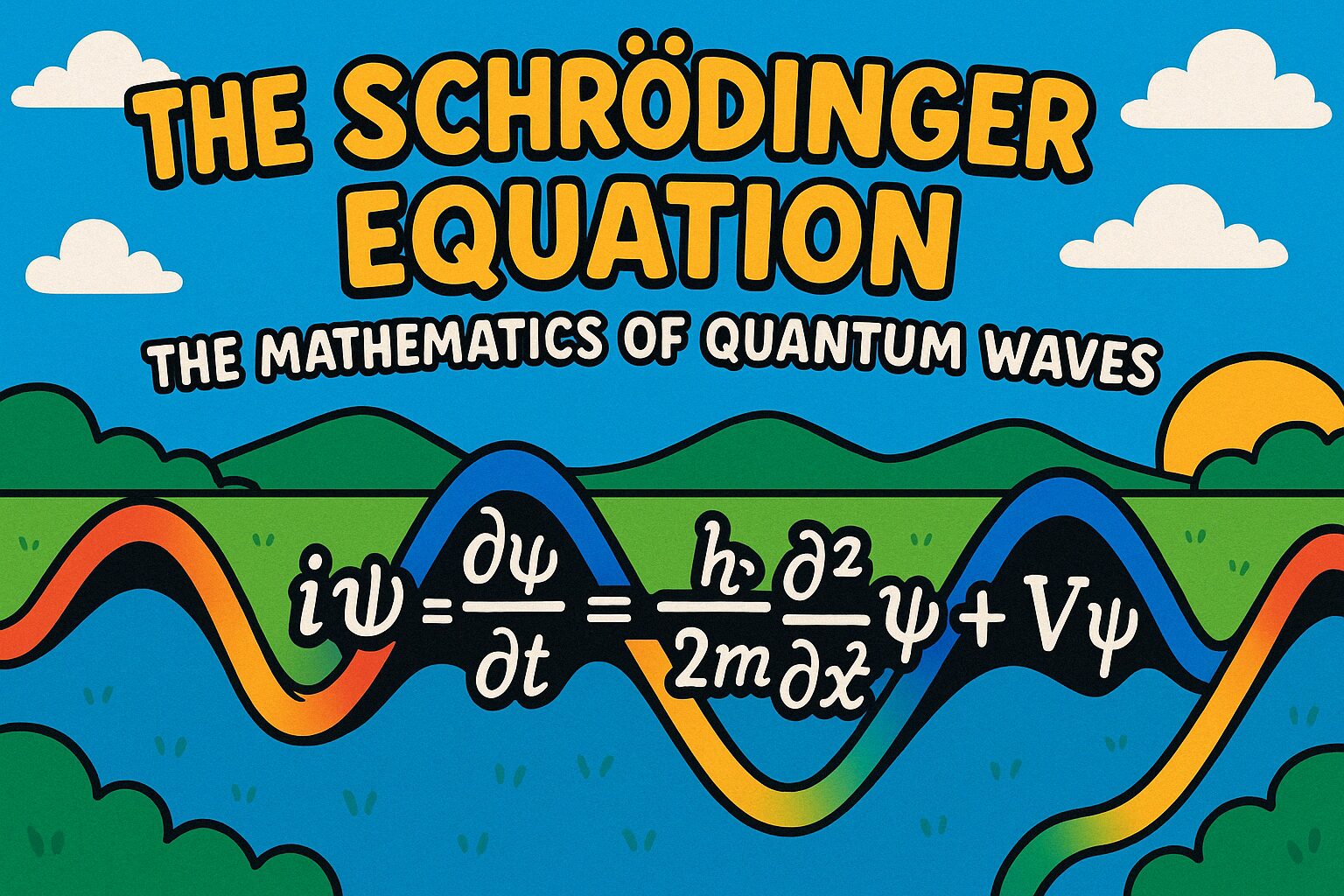
You don’t need a science background to use this lesson plan. It walks you through everything in a simple, step-by-step way, explaining key terms like wavefunction, probability fields, and quantum behaviour. You’ll help your child explore how this equation shows what’s likely to happen to particles and how it’s used in things like electronics and medical imaging.
The lesson plan is perfect for children aged 8–16, and includes clear learning goals, hands-on mini-tasks, and questions that encourage critical thinking. It turns an advanced physics topic into something approachable and fascinating. By the end, your child will understand not only what the Schrödinger Equation is, but why it matters in science, technology, and how we view the world.
This topic is part of our Info Zone collection. You can read the full topic, once logged in, here: The Schrödinger Equation: The Mathematics of Quantum Waves
You’ll also find a full Lesson Plan and a handy Parent Q & A sheet, for this topic, ready to use..
The Schrödinger Equation: The Mathematics of Quantum Waves
This lesson plan is designed to help you support your child with this topic: The Schrödinger Equation: The Mathematics of Quantum Waves
[br][br]Learning Objectives (What You’ll Learn Today)
- Understand what the Schrödinger Equation describes in quantum physics
- Explore the meaning of a wavefunction and how it relates to particles
- Learn how probability, not certainty, shapes quantum predictions
- Recognise real-world uses of quantum mechanics maths
Estimated Time
60–75 minutes, depending on discussion time and task depth
[br][br]Let’s Get Started
Ask your child: “Can something be in two places at once? Why or why not?” Let them share their ideas before introducing quantum waves.
[br][br]The Main Lesson
What Is the Schrödinger Equation?
The Schrödinger Equation is a mathematical tool that predicts how quantum systems behave. It helps scientists understand particles that act like waves. Unlike Newton’s equations, which work well for large things, this one works for the tiny particles inside atoms.
It’s used to describe what a particle is likely to do over time. It doesn’t tell us exactly where the particle is — only the chances of where it might be found.
Mini-Task: Ask your child to imagine a ball bouncing inside a closed box. Can we always know exactly where it is without looking? What if the ball were made of light?
[br][br]Understanding the Wavefunction
The wavefunction (usually written as the Greek letter ψ) is the key to the equation. It shows the probability of finding a particle in a certain place. It’s like a heat map that tells us where something might be, but never exactly where it is.
The Schrödinger Equation helps this wavefunction evolve — it shows how it changes over time, based on what’s happening to the particle.
Mini-Task: Sketch a wave and label high and low points. Then explain how that shape might show different chances of finding a particle.
[br][br]Particles Behaving Like Waves
In quantum mechanics, particles don’t behave like tiny marbles. They act more like vibrating strings or ripples on a pond. This strange idea — that matter can behave like a wave — is central to understanding the Schrödinger Equation.
This is why it’s often called the quantum wave equation. Particles “spread out” like waves and can even interfere with each other, like sound waves overlapping.
Mini-Task: Drop two small objects into water at the same time. Watch the ripples. How do they interact? How could that be like two quantum waves?
[br][br]Probability, Not Certainty
Classical physics is all about certainty. If you know where a football is and how fast it’s moving, you can predict where it will go. Not so in quantum physics. Here, you only get probabilities.
The Schrödinger Equation gives you a prediction of what might happen — not what will happen. This is a hard idea for many people, but it’s what experiments keep showing us.
Mini-Task: Roll a dice 50 times and record the outcomes. Talk about how some numbers happen more often — but you never know for sure what will come next.
[br][br]Real-World Uses of Quantum Mechanics Maths
Though it seems abstract, this equation is used in real technology. MRI machines, semiconductors, lasers, and even solar panels depend on principles from quantum physics.
Physicists and engineers solve versions of this equation to design better electronics, understand chemical reactions, and even build quantum computers.
Mini-Task: Ask your child to look around and list three things that might use quantum physics to work — then find out how one of them connects to the Schrödinger Equation.
[br][br]Think and Discuss
- What does it mean to say a particle is “probably” somewhere?
- Why do you think we can’t see quantum waves with our eyes?
- What would the world be like if everything acted like quantum particles?
Wrap-Up Summary
The Schrödinger Equation helps us describe and predict the behaviour of particles that act like waves. Instead of certainty, it deals in probabilities. It’s one of the most important tools in quantum physics — and it has real-world uses that affect our daily lives.
[br][br]Quiz
- True or False: The Schrödinger Equation shows exactly where a particle is.
- What does ψ represent in quantum mechanics?
- Which of these uses quantum physics: a toaster, a laser, or a bicycle?
- True or False: Quantum waves can interfere with each other.
- What does a wavefunction describe?
- Why is probability important in quantum mechanics?
- True or False: The Schrödinger Equation only applies to light.
- Name one real-life technology that relies on quantum mechanics maths.
- What does it mean when a particle behaves like a wave?
- Can we ever predict exactly where a quantum particle will be?
Answers
- False
- The wavefunction
- Laser
- True
- The probability of finding a particle
- Because quantum systems aren’t certain — only likely
- False
- MRI machines, solar panels, etc.
- It spreads out and shows wave-like behaviour
- No, only where it’s likely to be
Short Essay Prompt
Write a short essay, say 3 paragraphs explaining what a wavefunction is and how the Schrödinger Equation helps us understand it. Give one example of where this is used in technology.
[br][br]Extra Learning
Research the “double slit experiment” — a famous test of quantum wave behaviour. Draw a simple diagram and explain how it proves that particles can act like waves.
[br][br]Final Reflection (What Did You Learn?)
Ask your child: “What’s the most surprising thing you learned today? Do you think quantum physics changes how we see the world?”
[br][br] [/cl_logged_in][cl_logged_out]
Members Only
You need to be registered and logged in to access this lesson plan and all other learning resources, games and quizzes.
[/cl_logged_out]