The Schrödinger Equation: The Mathematics of Quantum Waves (Q&A)
Q & A - The Schrödinger Equation: The Mathematics of Quantum Waves
If you’re exploring quantum physics at home, this Schrödinger equation parent Q&A page will help you feel more confident. The Schrödinger Equation is a big idea in science, but don’t worry — you don’t need a maths degree to support your child with it. This topic is all about how tiny particles, like electrons, behave more like waves than solid objects. It may sound strange, but it’s a real and important part of how the world works.
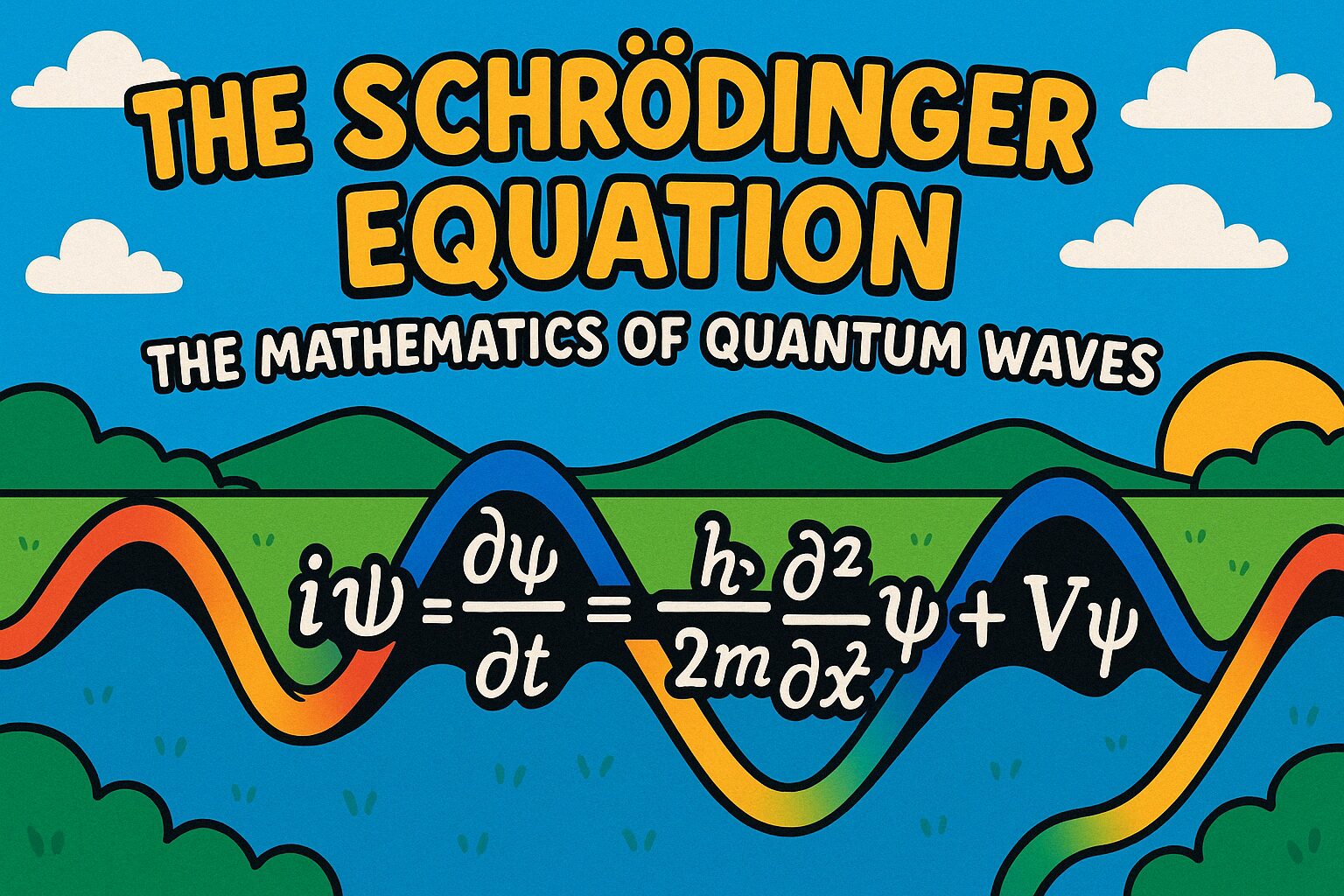
This Parent Q&A page is designed to help you answer tricky questions your child might ask while learning about quantum waves. Whether they’re curious about particles being in two places at once or how probability fits into physics, these simple explanations break it all down. You’ll find real-life examples, helpful comparisons, and ideas that make this complex subject much easier to talk about at home.
We also offer a separate lesson plan if you’d like to teach the topic more formally. But if you’re here just to support a curious mind, this page gives you all the tools you need. Learning at home doesn’t have to follow a school format — it just needs to spark thinking and conversation. This guide is built to do exactly that.
This topic is part of our Info Zone collection. You can read the full topic, once logged in, here: The Schrödinger Equation: The Mathematics of Quantum Waves
You’ll also find a full Lesson Plan and a handy Parent Q & A sheet, for this topic, ready to use..
Tip for Parents: Don’t feel like you need to explain everything perfectly. It’s okay to wonder together and explore ideas step by step.
What is the Schrödinger Equation, in simple terms?
It’s a maths formula that tells us how tiny particles like electrons behave over time. But instead of predicting their exact path, it predicts their chances of being in different places. It’s a bit like weather forecasting — only for particles.
Why do scientists say particles behave like waves?
In the quantum world, particles spread out and interfere like waves on water. They’re not bouncing balls — they can ripple, overlap, and change shape. This wave-like behaviour is at the heart of the Schrödinger equation.
What does a wavefunction mean?
A wavefunction is like a map that shows the likelihood of finding a particle in a certain place. It doesn’t give exact answers — just probabilities. The Schrödinger equation helps us calculate this wavefunction.
Can particles really be in two places at once?
Sort of. Until we measure them, particles exist in a spread-out state — like a cloud. They’re not in just one spot. Once we observe them, they “collapse” into one place. This is part of what makes quantum physics so different.
How does the Schrödinger equation show movement?
It shows how a particle’s wavefunction changes with time. As energy or surroundings change, so does the shape of the wave. This is how we model motion in the quantum world — not by tracking a straight line, but by watching the wave evolve.
Is this just a theory or does it have real uses?
It’s very real and widely used. The maths behind the Schrödinger equation powers MRI machines, lasers, and even helps build quantum computers. Chemists use it to predict how atoms bond in molecules.
Why is probability important in quantum physics?
In the quantum world, we can’t say exactly where things are — only how likely they are to be in certain places. The wavefunction, calculated using the Schrödinger equation, gives us those probabilities. That’s why it’s sometimes called a quantum wave equation.
Who came up with the Schrödinger equation?
It was created by Erwin Schrödinger in the 1920s. He was trying to explain the strange behaviours of electrons and other particles. His equation helped launch the field of quantum mechanics.
Why is this topic useful for children to learn?
It builds problem-solving, abstract thinking, and curiosity. Even if they don’t study physics later, understanding that the universe is complex and surprising is valuable. It’s also great for developing mathematical thinking.
What’s the link between the wavefunction and measurement?
Before a particle is measured, its wavefunction is spread out. When we measure it, the wave “collapses” to a specific point. This collapse isn’t caused by the equation — it’s part of how we interact with the quantum world.
What if my child asks why we can’t see these waves?
You can say that quantum waves are too small to see directly. They’re not like water waves — they’re patterns in the probability of finding particles. But scientists can measure them with very sensitive equipment.
How do you describe quantum uncertainty?
Uncertainty means we can’t know everything at once. For example, we might know where a particle is, but not how fast it’s going — or vice versa. This is a built-in rule of quantum mechanics, not just a gap in our tools.
What’s the most surprising part of this topic?
Probably the idea that reality isn’t fixed until it’s observed. That idea — known as superposition — leads to weird thought experiments like Schrödinger’s cat, where something can be alive and dead until someone checks.
Can this topic connect to everyday life?
Yes. From phone screens to GPS systems and medical scans, quantum principles are built into much of today’s tech. While we don’t “see” quantum behaviour daily, we definitely use it.
Is this too advanced for a child aged 8–12?
Not at all, if it’s explained in a way that makes sense. They might not solve the equation, but they can understand the ideas — like particles acting like waves, or that outcomes are about probability, not certainty.
How can I make this topic more visual?
Use analogies like ripples on a pond, weather forecasts, or tossing a dice. Even simple drawings of waves and peaks can help. Let them imagine — “what if you were small enough to ride a quantum wave?”
Where can I learn more about this?
We recommend reading the full topic guide: The Schrödinger Equation: The Mathematics of Quantum Waves. You’ll find a step-by-step breakdown with deeper insights.
