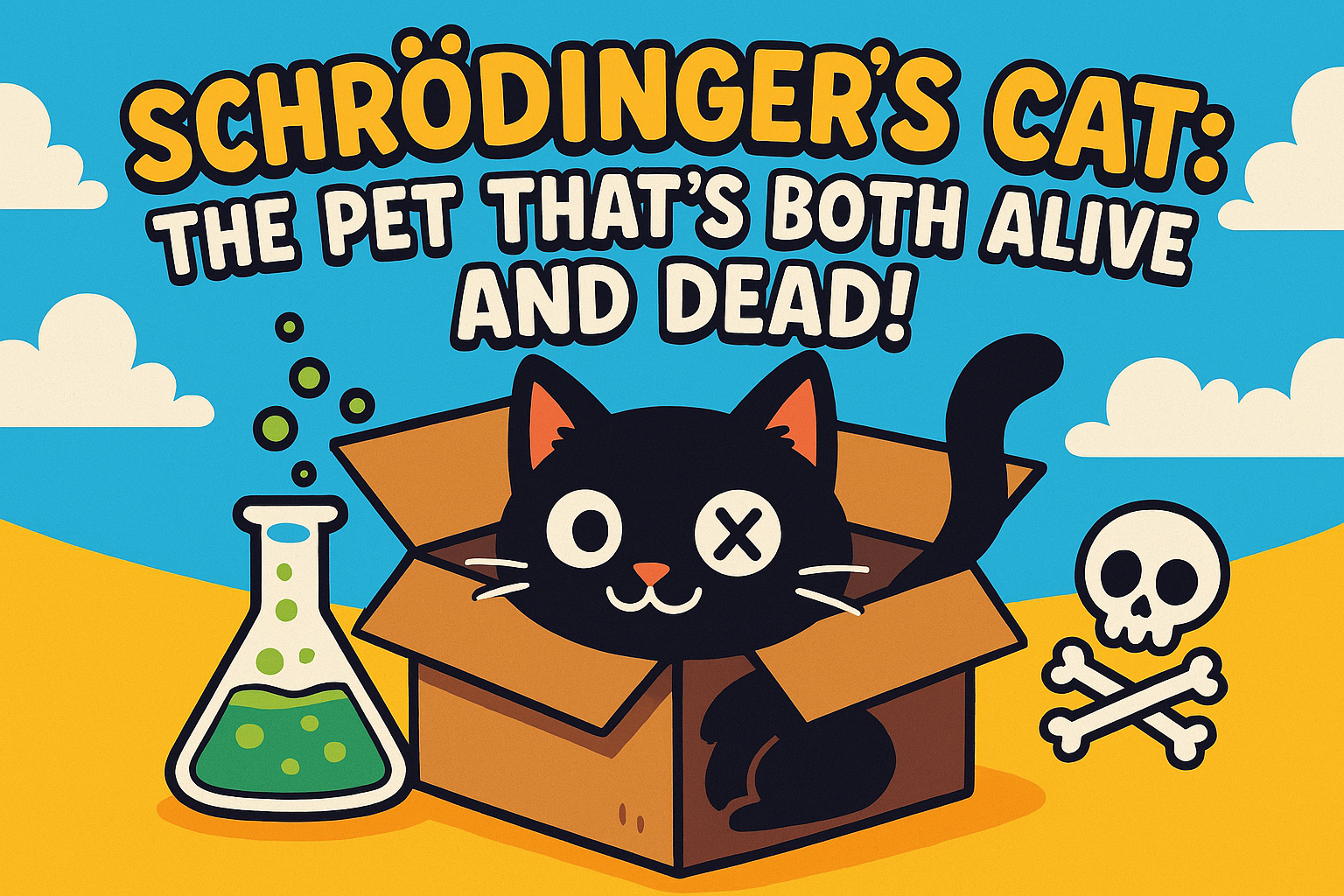
Schrödinger’s Cat: The Pet That’s Both Alive and Dead! (Lesson Plan)
Lesson Plan - Schrödinger’s Cat: The Pet That’s Both Alive and Dead!
The lesson plan for Schrödinger’s Cat: The Pet That’s Both Alive and Dead! helps parents and carers explore one of the most fascinating thought experiments in science history. This lesson dives into Erwin Schrödinger’s famous imaginary cat-in-a-box idea, which was created to explain just how strange quantum physics can be. It may sound silly at first, but this clever experiment challenged scientists to rethink what reality really means!
Designed for use in Elective Home Education, this plan is flexible and easy to follow. It includes structured activities, creative tasks, questions for deeper thinking, and ways to adapt the lesson to suit your child’s interests and level. Whether your child loves science, enjoys drawing and writing, or just likes puzzling ideas, there’s something here to spark curiosity. The lesson can be used as a one-off topic or linked into wider themes like space, technology, or how science explains the universe. Everything is explained in plain English, with support for parents at every step.
This topic is part of our Info Zone collection. You can read the full topic, once logged in, here: Schrödinger’s Cat: The Pet That’s Both Alive and Dead!
You’ll also find a full Lesson Plan and a handy Parent Q & A sheet, for this topic, ready to use..
|
Lesson Plan Schrödinger’s Cat — The Pet That’s Both Alive and Dead! | |
|---|---|
| Overview | This home education lesson explores the famous Schrödinger’s Cat thought experiment. It helps learners understand how it was used to explain the strange world of quantum mechanics. The plan encourages curiosity and offers creative, reflective, and science-based tasks for a range of ages and abilities. |
| Learning Objectives |
- Understand what Schrödinger’s Cat is and why it was invented - Explore the ideas of quantum physics, superposition, and measurement - Encourage learners to think critically and creatively about scientific models |
| Estimated Time | 60–90 minutes (flexible depending on depth) |
| Starter Activity |
Ask: “Can something be in two different states at the same time?” Show a closed box and ask: “Is the cat inside alive, dead, or both?” Introduce the idea of a thought experiment and explain it means imagining something to help explain a hard idea. |
| Read and Learn |
Read the learning resource: Schrödinger’s Cat: The Pet That’s Both Alive and Dead! together or independently. Then discuss:
|
| Activities | Comprehension Questions:
Creative Writing: Imagine you are the cat inside the box! Write a short story or diary entry describing what it’s like to be in a superposition (both alive and dead), and what happens when someone opens the box. Draw or Model: Create a comic strip showing Schrödinger preparing the experiment, the box, the cat, and what happens when the box is opened. |
| Deeper Thinking | Big Question: “What is more real — what we see, or what might be happening before we look?” Talk about how science uses models and theories to explain things we can't always see. Why do we need experiments — even imaginary ones — to help us think clearly? |
| Creative Projects |
- Design your own thought experiment to explain a weird idea (e.g., “If a tree falls and nobody hears it, does it make a sound?”) - Build a cardboard box and create a scene showing Schrödinger’s Cat inside with props - Create a poster explaining quantum superposition in simple words and pictures |
| Review & Reflect | Ask the learner:
|
| Extensions & Homework |
- Research: Who was Erwin Schrödinger, and what else did he do? - Watch a short science video about quantum physics (e.g., TED-Ed: Schrödinger’s Cat explained) - Explore the idea of quantum computers and how they use superposition |