
Aliens, UFOs, and Life Beyond Earth: Are We Really Alone?
Aliens, UFOs, and Life Beyond Earth: Are We Really Alone?
People have always wondered if we are the only ones in the universe. From strange UFO sightings to the search for alien life on distant planets, this topic is full of mysteries. Scientists are exploring space to find out if life could exist beyond Earth.
This topic is part of our Info Zone collection. You can read the full topic, once logged in, here: Aliens, UFOs, and Life Beyond Earth: Are We Really Alone?
You’ll also find a full Lesson Plan and a handy Parent Q & A sheet, for this topic, ready to use..
Aliens, UFOs, and Life Beyond Earth
For thousands of years, humans have gazed at the stars and wondered if someone, or something, might be looking back. Are we truly alone, or is there life beyond our planet? This question has led to stories, science, and serious space investigations. The idea of aliens and UFOs is not just about science fiction anymore — it’s a mystery that real scientists try to solve every day.
What Does ‘Alien’ Really Mean?
The word alien simply means something that comes from somewhere else. In space talk, aliens are life forms that do not come from Earth. They could be tiny bacteria, strange plants, or even intelligent beings who might wonder about us just like we wonder about them.
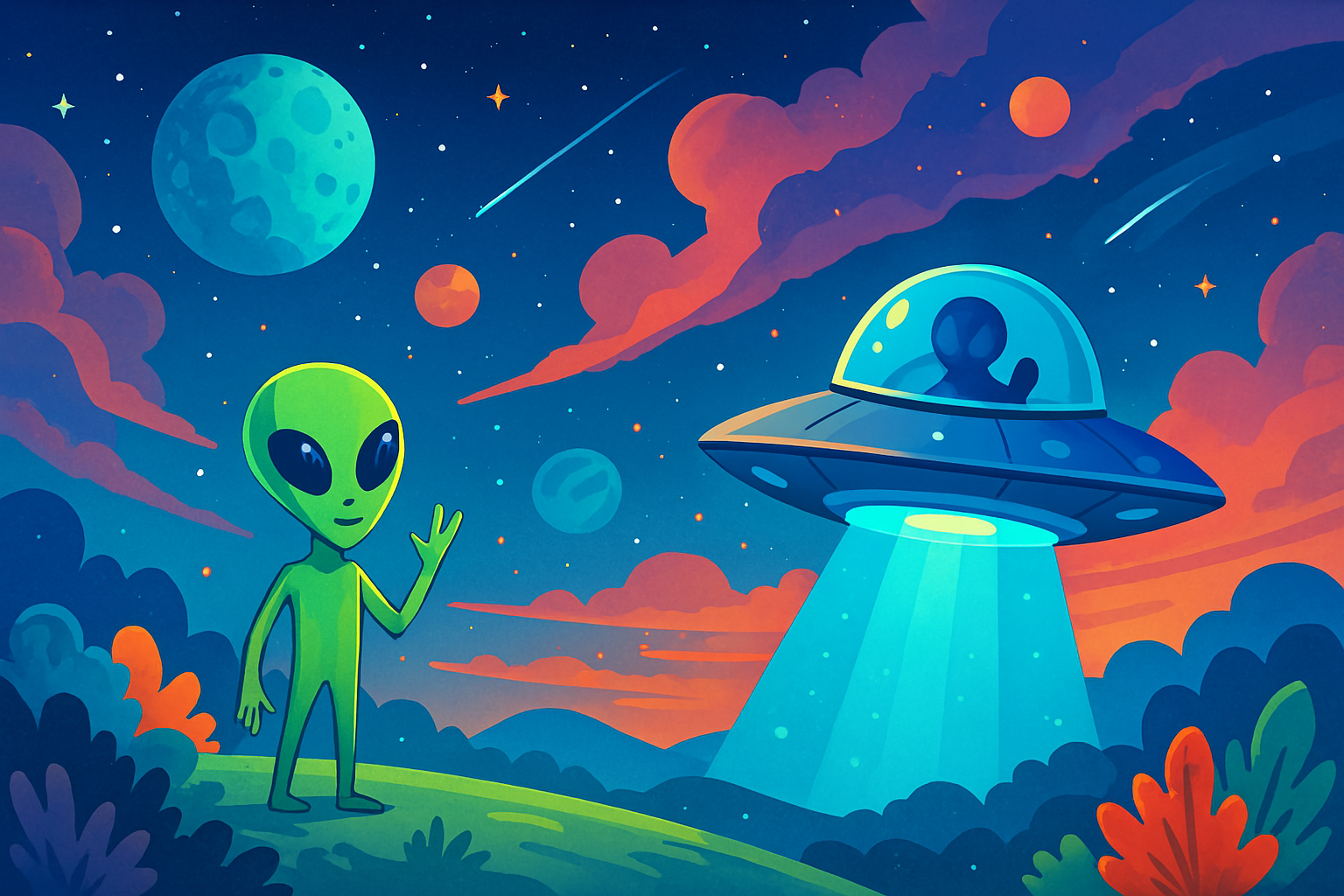
When people think of aliens, they often imagine green creatures with big eyes and antennas. But scientists are open-minded. Aliens might look nothing like that. They could be simple microscopic (tiny) life, or creatures so strange that we wouldn’t recognise them as living things at all.
So, when we ask if aliens exist, we are really asking if life exists in any shape or form somewhere out in space.
What are UFOs?
UFO stands for Unidentified Flying Object. It doesn’t mean alien spaceship — it just means something seen flying in the sky that people cannot identify. Over the years, pilots, astronauts, and ordinary people have reported seeing strange objects moving quickly, glowing, or behaving oddly.
Most UFO sightings end up having simple explanations like weather balloons, aircraft, or light reflections. However, a few sightings are still unexplained, which keeps the mystery alive. Recently, even governments, including the United States, have admitted that some UFOs have been spotted and are still puzzling scientists.
Does that mean they are aliens? Not necessarily. But it does make scientists more curious about what might be out there.
What is the Search for Extraterrestrial Life?
Scientists call the search for alien life “the search for extraterrestrial life.” Extraterrestrial means anything that comes from outside Earth. Researchers use telescopes, spacecraft, and radio signals to look for signs of life beyond our planet.
One famous project is called SETI — the Search for Extraterrestrial Intelligence. It listens for unusual signals from space that might come from another civilisation. So far, nothing has been confirmed as alien, but the search continues.
Scientists also study planets in our solar system and beyond, looking for water, oxygen, and other signs that life could exist or might have existed in the past.
Could Aliens Be Very Small?
Yes! Not all life has to be like us. In fact, on Earth, the first living things were simple microbes (tiny organisms). Many scientists believe that if we find aliens, they will likely be microbes living in places like underground oceans or inside rocks.
Places like Mars, Europa (one of Jupiter’s moons), and Enceladus (a moon of Saturn) might have the right conditions for tiny alien life. Water, heat, and certain chemicals are needed for life, and these places might have them.
Even small alien life would be an incredible discovery. It would prove that life can appear in more than one place in the universe.
Why is Water Important for Life?
Water is one of the key ingredients for life as we know it. On Earth, every living thing needs water to survive. That is why scientists searching for aliens always ask, “Is there water there?”
Planets or moons with signs of water become top targets for space missions. Even frozen water or water under thick layers of ice could help tiny life survive.
Without water, it is much harder for life to exist. So, wherever we search in space, finding water is always exciting news for scientists.
Have We Found Aliens Yet?
So far, scientists have not found any aliens, big or small. No spaceships, no radio signals, and no alien microbes have been confirmed. But that does not mean they aren’t out there. Space is huge — much bigger than we can imagine.
New planets are being discovered all the time. Some of these planets, called “exoplanets,” are similar to Earth and might have the right conditions for life. The search is still young, and many scientists believe we might find evidence of life in the future.
The fact that we haven’t found aliens yet doesn’t stop people from searching. In fact, it makes the hunt even more exciting!
What are Exoplanets?
Exoplanets are planets that orbit stars outside our solar system. Thanks to new telescopes like the James Webb Space Telescope, scientists are finding thousands of exoplanets.
Some of these planets are in what scientists call the “habitable zone.” This means they are just the right distance from their star — not too hot and not too cold — for water to exist. This gives them a chance of supporting life.
By studying these planets, scientists hope to find clues about alien life, or even planets that are Earth-like in other ways.
Could There Be Intelligent Aliens?
Some scientists wonder if there could be aliens that are intelligent like us or even more advanced. Intelligent life means creatures that can think, build, and communicate like humans.
If intelligent aliens exist, they might live very far away, or they might have come and gone long before humans even existed. Some people believe UFOs might be alien spacecraft, but so far, there is no proof of this.
Scientists hope that by listening carefully and exploring space, we might one day find a signal or clue that shows intelligent life is out there.
Why Haven’t We Found Them Yet?
There are many ideas about why we haven’t found aliens yet. One idea is called “The Great Silence.” It means space is so big and so quiet that signals take too long to reach us.
Another idea is that we might not be looking in the right way or at the right time. Aliens might use technology we don’t understand, or they could be living so far away that we haven’t seen them yet.
It is also possible that life is very rare, and we really might be alone — but most scientists think it is too early to say for sure.
What is the Fermi Paradox?
The Fermi Paradox is a famous question: If the universe is so big, where is everybody? With so many stars and planets, it seems like life should be everywhere — but we haven’t found any yet.
Some think civilisations might destroy themselves before they can travel far. Others believe aliens might choose to stay hidden. Or perhaps we just haven’t looked hard enough yet.
Whatever the answer, the Fermi Paradox reminds us that the universe is full of mysteries waiting to be solved.
How Do We Search for Aliens?
Scientists use many tools to search for alien life. Powerful telescopes can spot distant planets and galaxies. Space probes travel to other planets and moons to collect information. Radio telescopes listen for strange signals from space.
NASA and other space agencies also send robots and rovers to places like Mars to look for signs of past or present life. They test soil, rocks, and even the air for clues.
Every discovery brings us closer to answering the big question: Are we really alone?
What is SETI?
SETI stands for the Search for Extraterrestrial Intelligence. It is a group of scientists who listen carefully to the universe, hoping to hear signals sent by intelligent aliens.
SETI uses giant radio telescopes to pick up signals from space. Most signals turn out to be natural, like from stars or planets, but scientists always check in case something special is hiding among the noise.
SETI is one of the longest-running searches for alien life and continues to inspire young people to become space scientists.
Do UFOs Prove Aliens Are Real?
No, not yet. Even though many people have seen strange things in the sky, there is no clear proof that they come from aliens. Most UFOs turn out to be things like aircraft, weather balloons, or natural events.
However, some UFO sightings remain unexplained, which is why governments and scientists are still interested in investigating them. They might lead to new discoveries about space or our own planet.
The search for alien life is about gathering evidence, not just stories. Scientists need facts to prove aliens exist, and that search is still going.
Should We Be Scared of Aliens?
Most scientists don’t think we should be scared. Even if life exists elsewhere, it is probably very far away and may not even be interested in us. Space is huge, and distances between stars and galaxies are enormous.
Many scientists believe that if intelligent aliens exist, they might be peaceful explorers just like us. For now, there is no reason to worry — just reasons to stay curious and keep learning.
In fact, the search for alien life brings people together, helping us learn more about the universe and ourselves.
Could We Ever Meet Aliens?
Maybe, but it might not happen anytime soon. The distances are so great that even travelling at the speed of light would take years to reach the nearest stars.
But science is always advancing. New ways of exploring space and faster spacecraft might one day make contact more likely. Until then, we can keep watching, listening, and wondering.
One thing is certain — the search for life beyond Earth is one of the most exciting adventures in science!
What Do You Remember?
- 1. What does the word ‘alien’ really mean in science?
- 2. What is a UFO, and does it always mean an alien spaceship?
- 3. What is the Fermi Paradox, and what question does it ask?
- 4. Why do scientists search for water when looking for life?
- 5. Have scientists found proof of aliens yet?
Write your answers in the comment section below.
Related Topics
If you enjoyed exploring the mysteries of alien life and UFOs, you might also like learning about black holes, space exploration, or the search for exoplanets. The universe is full of exciting puzzles still waiting to be solved.
Learn more here:
- https://en.wikipedia.org/wiki/Extraterrestrial_life
- https://en.wikipedia.org/wiki/Unidentified_flying_object
What Do You Think?
If you found this to be an interesting topic, why not have your say. Or if you can think of ways we could improve it. We would love to know what you learned and more importantly, what you think. So now is your chance, use the comments section below to let us know your thoughts.