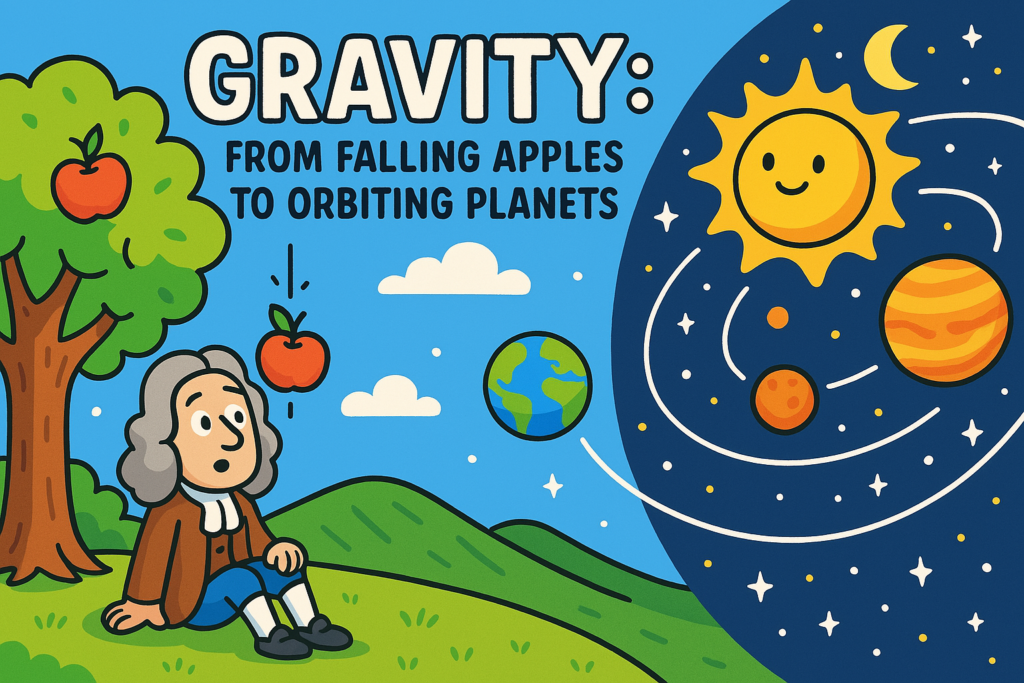
Gravity: From Falling Apples to Orbiting Planets
What makes an apple fall from a tree, but stops the Moon from crashing into Earth? The answer is a powerful force that affects everything in the universe—gravity! Whether you’re jumping, throwing a ball, or watching the stars, gravity is always pulling something towards something else.
In this topic, we’ll explore gravity from falling apples to orbiting planets, starting from the simple fall of an apple to the massive orbits of planets and moons. We’ll look at famous discoveries, fascinating facts, and strange space science. By the end, you’ll know exactly why we don’t float away into space—and why planets keep circling the Sun!
This topic is part of our Info Zone collection. You can read the full topic, once logged in, here: Gravity: From Falling Apples to Orbiting Planets
You’ll also find a full Lesson Plan and a handy Parent Q & A sheet, for this topic, ready to use..
What Is Gravity?
Gravity is a force of attraction between two objects with mass. That means anything that has weight pulls on other things with weight. It’s what keeps your feet on the ground and makes a dropped object fall instead of float.
Every object in the universe, from a tiny pebble to a massive planet, has gravity. The more mass an object has, the stronger its pull. Earth’s gravity is strong because it’s big. That’s why when you jump, you come back down.
Gravity is also invisible. You can’t see it, hear it, or touch it—but it’s always there. You feel it every day when you stand, walk, or even lie down. It’s like an invisible string pulling everything towards the centre of the Earth.
This pull isn’t the same everywhere. The higher you go—like in a plane or mountain—the weaker the force of gravity becomes. In space, it gets even weaker, which is why astronauts float around!
So, gravity is more than just a force. It’s the glue that holds the universe together. Without it, nothing would stay put—not even you.
The Apple That Changed Everything
You’ve probably heard the story: Sir Isaac Newton was sitting under an apple tree when an apple fell on his head. That moment sparked a question—why did it fall straight down?
Newton realised that some invisible force must pull objects towards the Earth. He called it gravity. He didn’t just guess; he used maths to describe how it works. His laws of motion and gravity changed science forever.
Before Newton, people didn’t fully understand why things fell or how planets stayed in orbit. Thanks to him, we now know that gravity pulls everything with mass towards everything else.
Of course, the apple might not have actually hit his head—but the falling apple certainly helped him think deeply about forces and motion. Funny how a fruit snack led to a giant discovery!
Newton’s ideas became the foundation for physics. Even today, we use his equations to launch rockets and understand how objects move on Earth and beyond.
How Gravity Works in Space
Gravity doesn’t stop at Earth. It stretches across the entire universe, shaping the motion of stars, planets, and galaxies. It’s why planets orbit the Sun, and why the Moon goes around Earth.
Every object pulls on every other object, but the pull gets weaker the farther away they are. The Sun is so massive that its gravity pulls all the planets into orbit around it. Earth does the same to the Moon.
Gravity makes space travel tricky. When astronauts go into orbit, they’re actually falling around Earth. They’re not floating because there’s no gravity—they’re floating because they’re in free fall!
The International Space Station stays in orbit because it’s moving forward fast enough to keep missing Earth as it falls. It’s like swinging a bucket of water: if you spin it fast enough, the water doesn’t fall out.
Gravity keeps space from being chaos. Without it, planets would fly off into deep space, stars wouldn’t form, and galaxies wouldn’t stay together.
Orbits: Cosmic Tug-of-War
An orbit is the path one object takes around another due to gravity. It’s a balance between speed and the pull of gravity. Go too slow, and you fall in. Go too fast, and you escape completely.
The Moon orbits Earth because gravity pulls it in, but its forward motion keeps it from crashing. It’s stuck in a constant fall—around the planet instead of into it.
The same thing happens with satellites, planets, and even comets. Some orbits are circular, while others are stretched into ovals. It all depends on speed, direction, and distance.
Ever seen the rings of Saturn? Those are billions of tiny particles trapped in orbit by Saturn’s gravity. Space is full of these beautiful gravitational dances.
Understanding orbits helps scientists send spacecraft where they need to go. Without gravity, space missions wouldn’t get far!
Weight vs Mass: What’s the Difference?
People often mix up mass and weight, but they’re not the same. Mass is how much stuff is in an object. Weight is the pull of gravity on that object.
Your mass doesn’t change, but your weight does depending on where you are. On the Moon, you’d weigh about one-sixth of your Earth weight. Why? Because the Moon has less gravity.
If you went to Jupiter (not recommended!), you’d weigh more because Jupiter’s gravity is stronger. But you’re not gaining or losing mass—just feeling more or less gravitational pull.
Scales measure weight, which is why astronauts seem to weigh nothing in space. But their mass—how much matter they’re made of—stays the same.
Understanding this difference helps scientists calculate forces, space missions, and even health in space.
Black Holes: Gravity Gone Wild
What happens when gravity gets too strong? You get a black hole—a place in space with gravity so powerful that nothing, not even light, can escape it!
Black holes form when massive stars collapse at the end of their lives. The matter is squeezed into a tiny space, creating a point with enormous gravity.
If you got too close, you’d be pulled in and never come out. Scientists call this the “event horizon”—the point of no return. Spooky, right?
Even though they sound scary, black holes help us understand gravity better. They warp space and time, showing us how the universe really works.
Scientists study black holes using telescopes and computer models. In 2019, we even saw a photo of one—proof they’re real, not just science fiction!
Living with Gravity
Gravity shapes life on Earth. It affects how animals grow, how plants rise toward the Sun, and how we move and build things.
Your body relies on gravity for balance and strength. That’s why astronauts lose muscle and bone in space—they’re not using their bodies against gravity.
Engineers design buildings, bridges, and vehicles to work with gravity, not against it. Pilots and astronauts even train to handle changes in gravity, called “G-forces.”
In sport, gravity plays a key role. Think of skateboarding, trampolining, or even a simple game of catch. It’s all about timing and the pull of gravity.
Without gravity, life as we know it wouldn’t exist. Even sleeping would be a struggle without being held down!
A Final Thought
Gravity might seem ordinary, but it’s actually one of the most mysterious forces in the universe. It pulls galaxies together and helps us stay grounded. From falling apples to swirling planets, gravity is everywhere—and it never takes a break.
Scientists are still studying gravity, hoping to understand how it fits with other forces like magnetism and electricity. There’s still so much to discover.
Next time you drop something or see the Moon in the sky, remember: gravity is working its magic.
What Do You Remember?
- What is gravity and how does it work?
- Why do planets stay in orbit?
- What’s the difference between weight and mass?
- How do black holes form?
- What happens to astronauts in low gravity?
Write your answers in the comment section below
Related Wikipedia Links
If you want to learn more, check out these helpful pages:
What Do You Think?
Do you think we’ll ever learn to control gravity? What would you do if you could float anywhere for a day? Share your ideas below!