Hello Alan Lloyd - Your Scores - Logout

The Big Bang and Beyond: What Happened Before Time Began?

The Big Bang and Beyond: What Happened Before Time Began?

The universe started with a huge event called the Big Bang about 13.8 billion years ago. Before that, there was no time, space, or matter. Scientists are still exploring what could have existed before the Big Bang. Get ready for a journey through space and time!
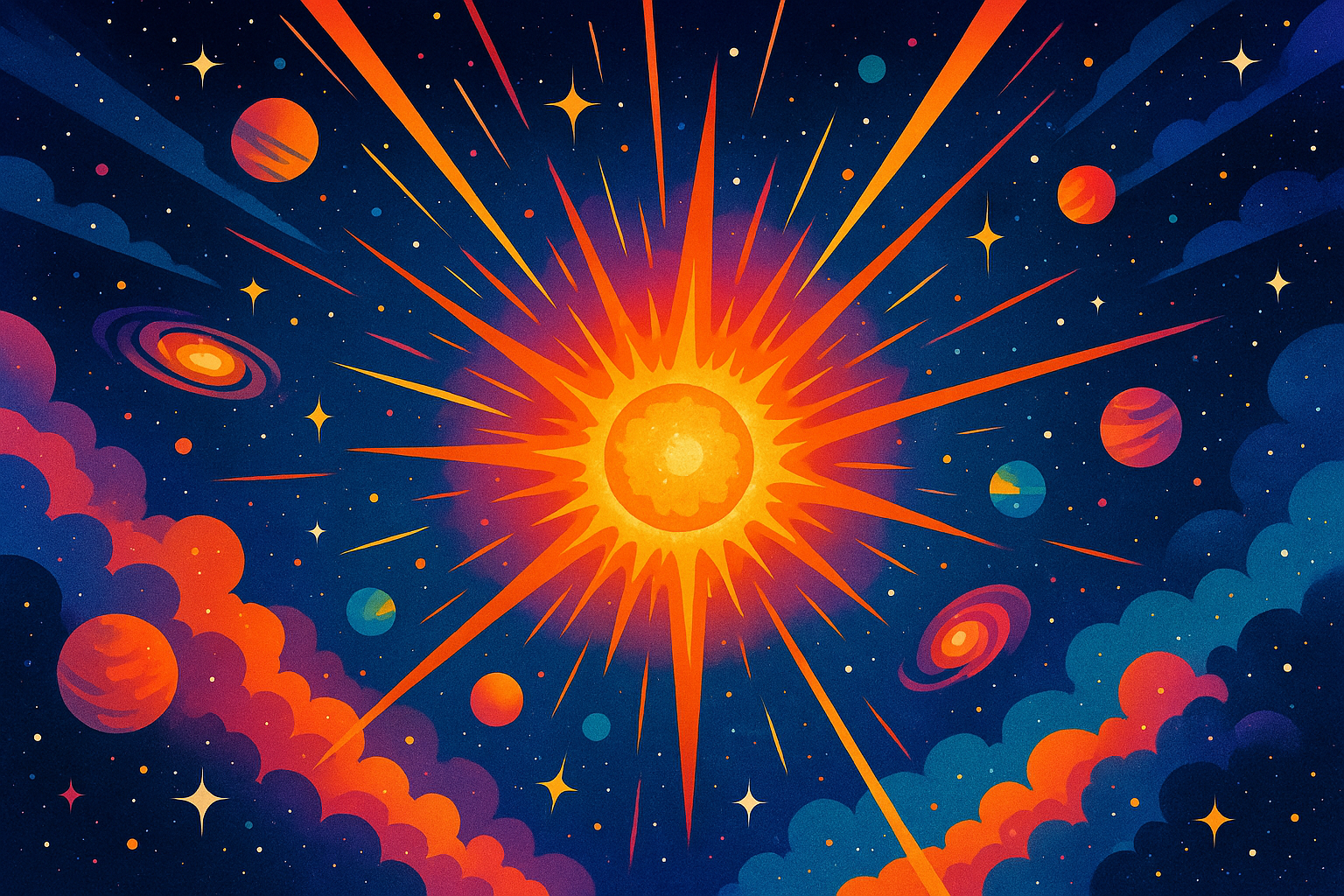
The Big Bang and Beyond: What Happened Before Time Began?
By Alan Lloyd


This topic is part of our Info Zone collection. You can read the full topic, once logged in, here: The Big Bang and Beyond: What Happened Before Time Began?

You’ll also find a full Lesson Plan and a handy Parent Q & A sheet, for this topic, ready to use..

The Big Bang and Beyond: What Happened Before Time Began?

Have you ever looked up at the night sky and wondered where it all came from? The stars, planets, galaxies, and even space itself had to start somewhere. Scientists believe it all began with an amazing event called the Big Bang. But what’s even more mind-boggling is the mystery of what happened before the Big Bang. Could there have been something before everything?


What is the Big Bang?

The Big Bang wasn’t an explosion like fireworks or a rocket launch. It was more like space itself suddenly stretching out super-fast. Imagine blowing up a balloon where every dot on the surface moves away from every other dot — that’s a bit like how the universe expanded.

Scientists think this happened around 13.8 billion years ago. Before the Big Bang, there was no space or time at all — no stars, planets, or even dust! Then, in less than a blink of an eye, the universe went from smaller than a pinhead to huge, and it’s still getting bigger today.

This idea is called the Big Bang Theory, and it’s one of the best explanations we have for how the universe began. But don’t worry, it doesn’t mean there was a loud bang — it’s just a catchy name!


How Do We Know the Big Bang Happened?

Good question! Since no one was around to film it, scientists had to find clues. One of the biggest clues is the cosmic microwave background radiation. This is like a faint glow left over from the very early universe, and it’s still floating around us today!

Another clue is that galaxies are moving away from each other. When scientists use telescopes to look deep into space, they notice that distant galaxies are racing away in all directions. This shows that the universe is still expanding, just like after the Big Bang.

These clues, along with others, help scientists build a picture of what happened during the Big Bang. It’s like being a space detective solving a really, really old mystery!


What Was Before the Big Bang?

Now comes the tricky part. What happened before the Big Bang? Well, the truth is, we don’t exactly know! It’s one of the biggest mysteries of science.

Some scientists think there was simply nothing — no time, no space, and no matter. Time itself might have started with the Big Bang. Before that, there wasn’t even a “before” to talk about!

Other scientists wonder if there could have been a different universe before ours, or maybe even many universes. Some even think the universe could collapse and start again, like a cosmic bounce. These are ideas, but we don’t yet have proof.


What is Space-Time?

When people talk about the Big Bang, they often mention something called space-time. Space and time are connected like a giant stretchy fabric. The Big Bang stretched this fabric out and started the cosmic clock ticking.

Before the Big Bang, there might not have been any fabric at all. Space and time could have popped into existence together. Without space-time, there would be nowhere for planets to spin and no time for anything to happen.

So when people ask, “What was before the Big Bang?” scientists might answer, “There was no ‘before’ because there was no time yet!”


Could There Be Other Universes?

Some scientists believe in something called the multiverse. This idea suggests there might be many universes, not just ours. Maybe our universe is just one bubble in a huge cosmic foam of bubbles!

Each bubble could be a different universe with its own stars, planets, and rules of physics. Maybe some are tiny, some are huge, and some could even be completely weird and wacky compared to ours.

We don’t yet have evidence for the multiverse, but it’s an exciting idea that helps scientists think outside the box and imagine how things could work beyond our universe.


What is Cosmic Inflation?

Cosmic inflation is like the Big Bang’s turbo boost! Scientists think that just after the Big Bang, the universe expanded faster than the speed of light for a tiny fraction of a second. This super-fast stretching is called inflation.

Inflation helps explain why the universe looks smooth and even when we look far away with telescopes. Without inflation, things might have looked bumpy and uneven, but instead, space seems very calm and organised (at least on large scales).

This idea fits nicely with the clues we see, like the cosmic microwave background and how galaxies are spread out across the universe today.


What Happened After the Big Bang?

After the Big Bang and cosmic inflation, the universe was hot, glowing, and full of energy. Slowly, it cooled down enough for tiny particles to stick together and form atoms. These atoms then formed stars, galaxies, and eventually planets.

Over millions and billions of years, stars exploded, making heavier elements like iron and gold. These materials became part of new stars and planets, including the one you’re standing on right now — Earth!

Without the Big Bang, cosmic inflation, and all those exploding stars, we wouldn’t have planets, animals, or even people. We owe our very existence to these ancient cosmic events!


Is the Universe Still Growing?

Yes! The universe is still getting bigger every single second. Scientists have discovered that not only is it expanding, but it’s also speeding up. This strange behaviour is caused by something called dark energy.

Dark energy makes up about 70% of the universe, but we don’t really know what it is yet. It’s like a cosmic push making everything spread out faster and faster.

Even though we don’t fully understand it, we know that galaxies will keep drifting apart, and the universe will continue to grow and change for a very, very long time.


Will the Universe Ever End?

What happens in the future? Will the universe go on forever or eventually stop? Scientists aren’t sure, but there are a few ideas.

Some think the universe will keep expanding until everything is too far apart to form new stars, leading to a “Big Freeze.” Others suggest it might slow down and collapse in a “Big Crunch.” Or maybe it will keep speeding up forever.

For now, the most likely idea is the Big Freeze, where the universe gets colder and emptier as galaxies drift apart. Don’t worry, though — this won’t happen for billions of years!


How Do Scientists Study the Universe?

Scientists use powerful telescopes on Earth and in space to look deep into the universe. These telescopes can see galaxies so far away that their light has taken billions of years to reach us!

By studying this ancient light, scientists can learn about what happened just after the Big Bang. They also use computers to make models of how the universe might have evolved over time.

Thanks to these tools, we can discover new planets, stars, and galaxies every day, helping us learn more about our incredible universe.


Why Does It Matter?

Learning about the Big Bang and the universe helps us understand where we come from. It’s like knowing the history of your family, but much, much bigger — it’s the history of everything!

It also helps scientists answer big questions like, “Are we alone?” or “Could life exist on other planets?” By understanding how the universe works, we get clues about how life might have started and where it could be hiding out there.

So next time you look up at the stars, remember that you are looking at a universe full of mysteries just waiting to be solved.


What Do You Remember?

  • 1. What is the Big Bang?
  • 2. What is the cosmic microwave background?
  • 3. What is cosmic inflation?
  • 4. Could there be more than one universe?
  • 5. What is dark energy?

Write your answers in the comment section below.


Related Topics

If you enjoyed learning about the Big Bang and the universe, you might want to explore more about galaxies, black holes, or how stars are born and die. Space is full of surprises!

Learn more here:


What Do You Think?

If you found this to be an interesting topic, why not have your say. Or if you can think of ways we could improve it. We would love to know what you learned and more importantly, what you think. So now is your chance, use the comments section below to let us know your thoughts.


Leave a comment


'; // Add header content for print html += '

Lenara Learning

Get more learning resources at www.lenara.uk

'; // Insert the worksheet content html += '
' + content + '
'; html += ''; printWindow.document.write(html); printWindow.document.close(); printWindow.focus(); // Trigger printing and auto-close the popup printWindow.print(); printWindow.onafterprint = function() { printWindow.close(); }; setTimeout(function() { printWindow.close(); }, 1500); }