
Schrödinger’s Cat: The Pet That’s Both Alive and Dead!
Schrödinger’s Cat: The Pet That’s Both Alive and Dead!
Imagine a cat that’s both alive and dead at the same time. Sounds like something from a spooky story or a video game glitch, right? Well, believe it or not, this strange idea came from one of the world’s smartest scientists.
His name was Erwin Schrödinger, and he used this idea to explain how weird the world of quantum physics can be. This article will help you understand what Schrödinger’s Cat really means, why he thought it up, and how it changed science forever. Get ready for a mind-bending journey into one of the strangest science stories ever told!
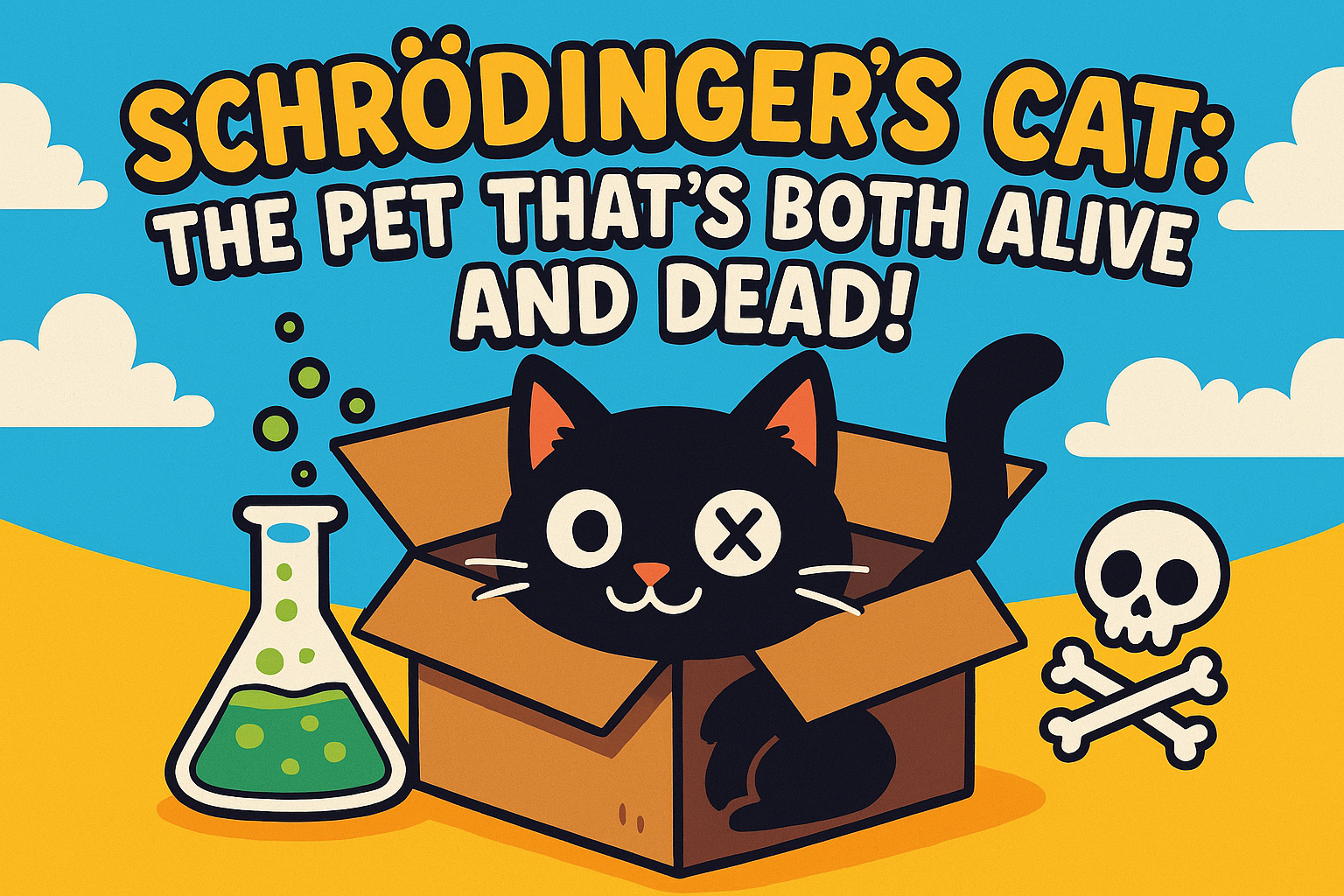
This topic is part of our Info Zone collection. You can read the full topic, once logged in, here: Schrödinger’s Cat: The Pet That’s Both Alive and Dead!
You’ll also find a full Lesson Plan and a handy Parent Q & A sheet, for this topic, ready to use..
What Is Schrödinger’s Cat?
Schrödinger’s Cat is not a real animal, but a thought experiment. That means it was never actually done in real life — it was an idea used to help people understand something tricky. Erwin Schrödinger came up with it in 1935 to show how strange quantum mechanics can be. Quantum mechanics is the science that studies really tiny things like atoms and particles. These things don’t follow the same rules as bigger objects, like footballs or cats.
In Schrödinger’s imaginary experiment, a cat is placed in a sealed box. Inside the box, there’s a tiny bit of radioactive material, a Geiger counter (a machine that detects radiation), a hammer, and a bottle of poison. If the radioactive material decays, it triggers the Geiger counter, which releases the hammer to smash the bottle and kill the cat. If it doesn’t decay, the cat stays alive.
The twist? In quantum mechanics, until you look inside the box, the radioactive atom is both decayed and not decayed at the same time. That means the cat is both alive and dead at once! It’s only when someone opens the box and checks that the cat becomes clearly alive or clearly dead.
Why Did Schrödinger Create This Weird Idea?
Schrödinger wasn’t trying to scare people with zombie cats. He was actually trying to show how strange the rules of quantum mechanics really are. At the time, many scientists believed that tiny particles existed in all possible states until someone measured them. Schrödinger thought that idea sounded silly when applied to real-world things like cats.
By creating this imaginary cat, Schrödinger wanted people to see how odd and confusing quantum physics could be if you took it too far. He was saying, “Look! If this is how you think quantum mechanics works, then you’re saying a cat can be alive and dead at the same time. Does that really make sense?”
So, the cat experiment was actually a way of criticising the popular ideas of the time. It sparked big debates between scientists about how to understand the quantum world.
What Does It Really Mean?
Schrödinger’s Cat shows how the world of quantum physics is different from everyday life. In the real world, things are either one way or another — a light is either on or off. But in quantum physics, particles can be in a “superposition”, which means they can be in two states at the same time. The cat in the box represents this idea of superposition.
Scientists still don’t fully agree on what this means. Some say the cat is in a superposition of life and death until the box is opened. Others believe the universe splits into two versions — one where the cat is alive and one where it is dead — and both happen in different realities.
That’s right — Schrödinger’s Cat even led to ideas about parallel universes! It’s one reason the experiment is still famous today.
Who Was Erwin Schrödinger?
Erwin Schrödinger was an Austrian physicist born in 1887. He was one of the most important scientists in the field of quantum mechanics. In fact, he won the Nobel Prize in Physics in 1933 for developing a key equation that explained how particles like electrons behave. This equation, called the Schrödinger Equation, is still used in science today.
Even though he was a brilliant mathematician and scientist, Schrödinger was also known for thinking deeply about what science means. He often asked questions about the nature of reality and how we know what is true. The cat experiment is just one example of his clever way of thinking.
Schrödinger’s work laid the foundation for modern technology, including lasers, MRI machines, and even smartphones. So, even if you’ve never heard of him before, you’ve definitely used things that depend on his ideas!
What Is Superposition?
Superposition is a strange idea in quantum mechanics where something can be in two or more states at once. For example, a particle could be spinning clockwise and anti-clockwise at the same time — at least, until someone measures it.
In Schrödinger’s experiment, the atom inside the box is both decayed and not decayed at the same time. Because the cat’s life depends on the atom, the cat is also both alive and dead — until the box is opened.
This isn’t something we see in normal life. It’s what makes quantum physics so confusing and exciting. Superposition is also what makes quantum computers possible, because they can work on multiple things at the same time using “qubits.”
Why Don’t We See Superposition in Real Life?
Even though superposition happens with tiny particles, we don’t notice it in big objects like cats or humans. That’s because of something called “decoherence.” It’s a process where quantum systems interact with their surroundings and lose their special quantum state.
As soon as something is measured or affected by the outside world, it “chooses” one state — like being either dead or alive, but not both. So, in reality, the cat in the box wouldn’t stay in superposition for long. Opening the box — or even light or air getting in — would cause decoherence to happen.
This is one reason quantum physics is so hard to test with big things. The environment messes things up too quickly for us to see the weirdness directly.
Did Schrödinger Believe the Cat Was Really Both?
No, Schrödinger didn’t believe a cat could actually be alive and dead at the same time. He thought the idea was silly. That’s why he invented the thought experiment — to show how weird the current ideas were when taken to the extreme.
He hoped scientists would think more carefully about what quantum mechanics really meant. And they did! His cat helped shape new theories and questions in physics for decades to come.
So while Schrödinger’s Cat isn’t real, the thinking behind it is very important in science history. It challenged scientists to ask better questions and try to understand the strange rules of the tiny world.
How Does Schrödinger’s Cat Help Science?
Schrödinger’s Cat helps scientists and students understand that quantum mechanics is very different from normal physics. It shows that you can’t always trust your everyday experience when thinking about tiny particles.
It’s used in classrooms and books to explain complicated ideas in a simple way. Scientists use it to talk about things like quantum computers, teleportation, and entanglement — all strange effects that happen in the quantum world.
In short, the cat made people stop and think. And sometimes, that’s the first step to learning something amazing.
Quantum Physics in the Real World
Even though Schrödinger’s Cat is just an idea, the science behind it is very real. Quantum physics helps build technology we use every day — like computer chips, GPS satellites, and lasers. It’s even being used to develop super-fast computers called quantum computers.
These devices use the idea of superposition to do many calculations at once. That means they could solve problems that normal computers take years to work out. It’s like giving your calculator a brain boost!
So, while a cat being alive and dead is just pretend, the science behind it is shaping the future.
What Can We Learn from Schrödinger’s Cat?
Schrödinger’s Cat teaches us that science isn’t always black and white. Sometimes, the truth is hidden in strange places, and we have to think carefully to understand it. It also shows how powerful imagination is in science. By thinking up a silly cat-in-a-box idea, Schrödinger changed how people thought about the universe.
It reminds us that questioning things — even the rules — is a big part of science. Great scientists don’t just follow instructions. They ask, “Why?” and “What if?”
And you can do that too. Every time you wonder how something works or why things are the way they are, you’re doing what Schrödinger did. You’re being a scientist.
What Do You Remember?
- What was the purpose of Schrödinger’s Cat experiment?
- Why did Schrödinger put a cat in a box (in his imagination)?
- What does “superposition” mean in quantum physics?
- How does decoherence affect the experiment?
- Did Schrödinger believe a cat could really be alive and dead at the same time?
Write your answers in the comment section below.
Related Topics
If you enjoyed this mind-boggling journey into the world of quantum physics, you might like learning more about other famous physics ideas. The Theory of Relativity by Einstein is another big one, as well as Quantum Entanglement, which sounds like something from a sci-fi film but is totally real!
What Do You Think?
If you found this to be an interesting topic, why not have your say. Or if you can think of ways we could improve it. We would love to know what you learned and more importantly, what you think. So now is your chance, use the comments section below to let us know your thoughts.