Hello Alan Lloyd - Your Scores - Logout

Wave Properties: Amplitude, Frequency, and Wavelength

Wave Properties: Amplitude, Frequency, and Wavelength

Have you ever watched waves roll onto a beach and wondered how they work? Well, those wavy patterns happen all around us—not just in the sea. Sound, light, radio signals, even how you see and hear—these all involve waves. In science, waves carry energy from one place to another. They do it without actually moving any matter along with them.

So today, we’re diving into wave properties: amplitude, frequency, and wavelength. These are just fancy names for how big a wave is, how fast it vibrates, and how far apart the waves are. Sounds tricky? Don’t worry—I’ll explain everything step by step. By the end, you’ll see that waves aren’t mysterious at all—they’re just full of energy, patterns, and surprises.

Wave Properties: Amplitude, Frequency, and Wavelength
By Alan Lloyd


This topic is part of our Info Zone collection. You can read the full topic, once logged in, here: Wave Properties: Amplitude, Frequency, and Wavelength

You’ll also find a full Lesson Plan and a handy Parent Q & A sheet, for this topic, ready to use..

What Are Waves, Really?

Let’s start with the basics. A wave is a repeating pattern of movement that transfers energy. That energy can move through water, air, or even empty space. There are two main types of waves—mechanical and electromagnetic.

Mechanical waves need a medium like air or water. Think sound waves or water ripples. Electromagnetic waves, like light, can travel even through the vacuum of space.

Imagine shaking a rope. The motion travels down the rope, but the rope itself doesn’t move forward—it just wobbles in place. That’s kind of how waves work.

All waves have certain parts and behaviours. They can be long or short, fast or slow, tall or flat. That’s where amplitude, frequency, and wavelength come in.

These three wave properties help us describe how a wave looks and acts. Without them, scientists would be pretty stuck!


Amplitude: The Height of a Wave

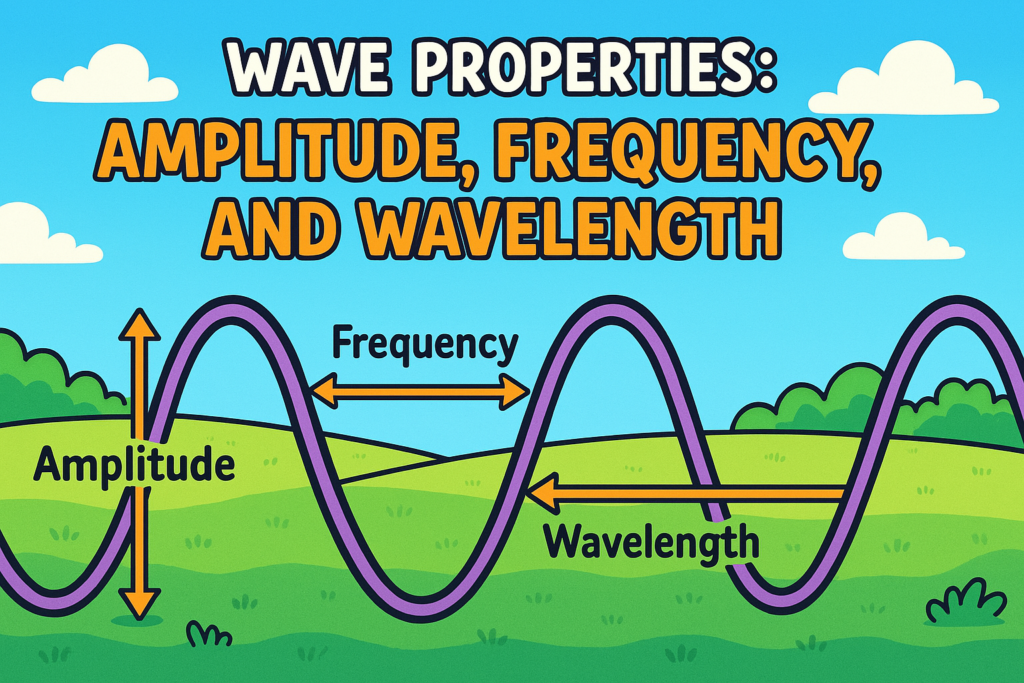
Amplitude is all about size. It measures how tall a wave is from the middle line (called the rest position) to the top or bottom of the wave.

The bigger the amplitude, the more energy the wave is carrying. High amplitude? Loud sound or bright light. Low amplitude? Soft sound or dim light.

In a sound wave, amplitude affects how loud the sound is. In light, it affects brightness. So amplitude really matters in everyday life.

If you’ve ever turned up the volume on your speakers, you’ve increased the amplitude of the sound waves. More shake, more boom!

Amplitude can also show how strong an earthquake is. The more violent the shaking, the higher the amplitude of the seismic waves.


Wavelength: The Length Between Waves

Wavelength is exactly what it sounds like—how long a wave is. More precisely, it’s the distance between two matching points on a wave, like crest to crest or trough to trough.

If waves are close together, they have short wavelengths. If they’re spread apart, they have long wavelengths.

Different wavelengths do different things. For example, red light has a long wavelength, while blue light has a short one.

In the ocean, long wavelengths create rolling waves that come slowly. Short wavelengths create choppy waves that come quickly.

Wavelength affects the type of energy a wave carries. Some wavelengths are even dangerous—like ultraviolet or X-rays—because they carry so much energy.


Frequency: How Often Waves Occur

Frequency tells us how often a wave happens in a certain time—usually one second. It’s measured in hertz (Hz). One hertz means one wave per second.

High frequency? That means lots of waves in a short time. Low frequency? Fewer waves.

In sound, high frequency makes high-pitched sounds (like a whistle). Low frequency makes deep sounds (like a drum).

In radio signals, different frequencies carry different channels. So yes—frequency decides what music comes through your speakers!

The faster a wave vibrates, the higher its frequency. And higher frequency often means more energy too.


Putting It All Together: Amplitude, Frequency, and Wavelength

These three wave properties don’t work alone. They all connect and affect each other.

If you change one, you might change another. For example, if you increase frequency but keep wave speed the same, the wavelength gets shorter.

Scientists use these wave properties to understand all sorts of things—from earthquakes to mobile phones to music.

Knowing amplitude tells you about energy. Knowing wavelength and frequency helps you figure out wave speed and type.

It’s a bit like baking—each ingredient adds something special. Together, you get something amazing!


Visualising Waves: Crest, Trough, and Midline

Waves have clear parts. The highest point is the crest. The lowest is the trough. The midline is the middle, or rest position.

Amplitude is the height from the midline to a crest or trough. Wavelength is the distance from crest to crest.

Some diagrams show arrows or colours to make wave parts clearer. These visuals help people understand wave motion better.

Don’t worry if it looks confusing at first. Once you spot the pattern, waves become easy to read.

Try drawing a few waves on paper and labelling their parts. It really helps cement the idea.


Real-Life Examples of Wave Properties

Look around—wave properties are everywhere! Sound waves, light waves, radio waves, even microwaves in your kitchen.

When a singer hits a high note, that’s high frequency. When a rock concert feels super loud, that’s high amplitude.

TV and mobile phones use different wavelengths and frequencies to carry signals. That’s why they don’t interfere.

Doctors use ultrasound, which is a sound wave with super high frequency, to see inside your body.

Even animals like bats and dolphins use wave properties to find their way around with sound. It’s called echolocation.


Why Do Waves Matter?

Understanding wave properties helps in loads of ways. Engineers use them to design bridges, submarines, and sound systems.

Musicians tweak wave amplitude and frequency to shape their sound. Artists play with light waves to mix colours.

Wave science also helps us predict natural disasters, like earthquakes and tsunamis, using seismic wave data.

Space scientists use radio waves to communicate with spacecraft and telescopes to catch light waves from distant stars.

Knowing wave properties gives you superpowers—well, sort of! It helps you make sense of the world around you.


Fun Facts About Waves

The loudest sound on Earth? It was a volcanic eruption in 1883. The amplitude was massive—it shattered windows 160km away!

Dogs can hear higher frequencies than humans. That’s why a dog whistle seems silent to you but not to them.

Light waves travel faster than sound waves. That’s why you see lightning before you hear thunder.

Waves in space have no air to travel through. But light waves can still get to us because they don’t need a medium.

Wi-Fi, GPS, and Bluetooth all rely on wave properties. Without them, your gadgets wouldn’t work at all.


A Final Thought

Wave properties might sound complex at first, but they’re part of your daily life. From the sounds you hear to the light you see, it’s all waves doing their thing.

Amplitude, frequency, and wavelength are just tools we use to describe how those waves behave. Once you understand them, you unlock a whole new level of science knowledge.

Keep your eyes and ears open—you’ll notice wave properties in places you never expected.


What Do You Remember?

  • What is amplitude, and what does it tell us about a wave?
  • How do you measure a wave’s wavelength?
  • What unit is frequency measured in?
  • Why do waves with higher frequency often carry more energy?
  • Can you name a real-life use for each wave property?

Write your answers in the comment section below


Related Wikipedia Links

Want to dive deeper into the science of wave properties? Here are a couple of helpful links:


What Do You Think?

Have you spotted wave properties in your own life—maybe in music, mobile phones, or nature? Which part do you find the most fascinating? Let’s chat in the comments!


Leave a comment


'; // Add header content for print html += '

Lenara Learning

Get more learning resources at www.lenara.uk

'; // Insert the worksheet content html += '
' + content + '
'; html += ''; printWindow.document.write(html); printWindow.document.close(); printWindow.focus(); // Trigger printing and auto-close the popup printWindow.print(); printWindow.onafterprint = function() { printWindow.close(); }; setTimeout(function() { printWindow.close(); }, 1500); }