The Doppler Effect – Lesson Plan
Lesson Plan - The Doppler Effect: Why Sounds Change as They Move
Have you ever noticed how a siren sounds different as it passes by? This Doppler effect lesson plan helps explain why that happens and what it means. Whether your child is just starting to explore sound or diving deeper into wave physics, this topic builds understanding of how motion affects sound waves and frequency. The Doppler effect appears in everyday life—from speeding cars to space science—making it both practical and fascinating.
This topic is often taught in school, but it can be clearly explained at home too. This lesson plan supports home educators with step-by-step guidance, mini-tasks, quiz questions, and structured sections. You’ll explore how sound waves behave when sources move, how pitch changes depending on direction, and even how this same principle applies to light in astronomy.
The goal is to give your child a solid grasp of the physics behind sound shifts, and to spark their curiosity about how we experience the world through waves. Everything is written in everyday language with no science background required. You can teach this with confidence and enjoy discovering it together.
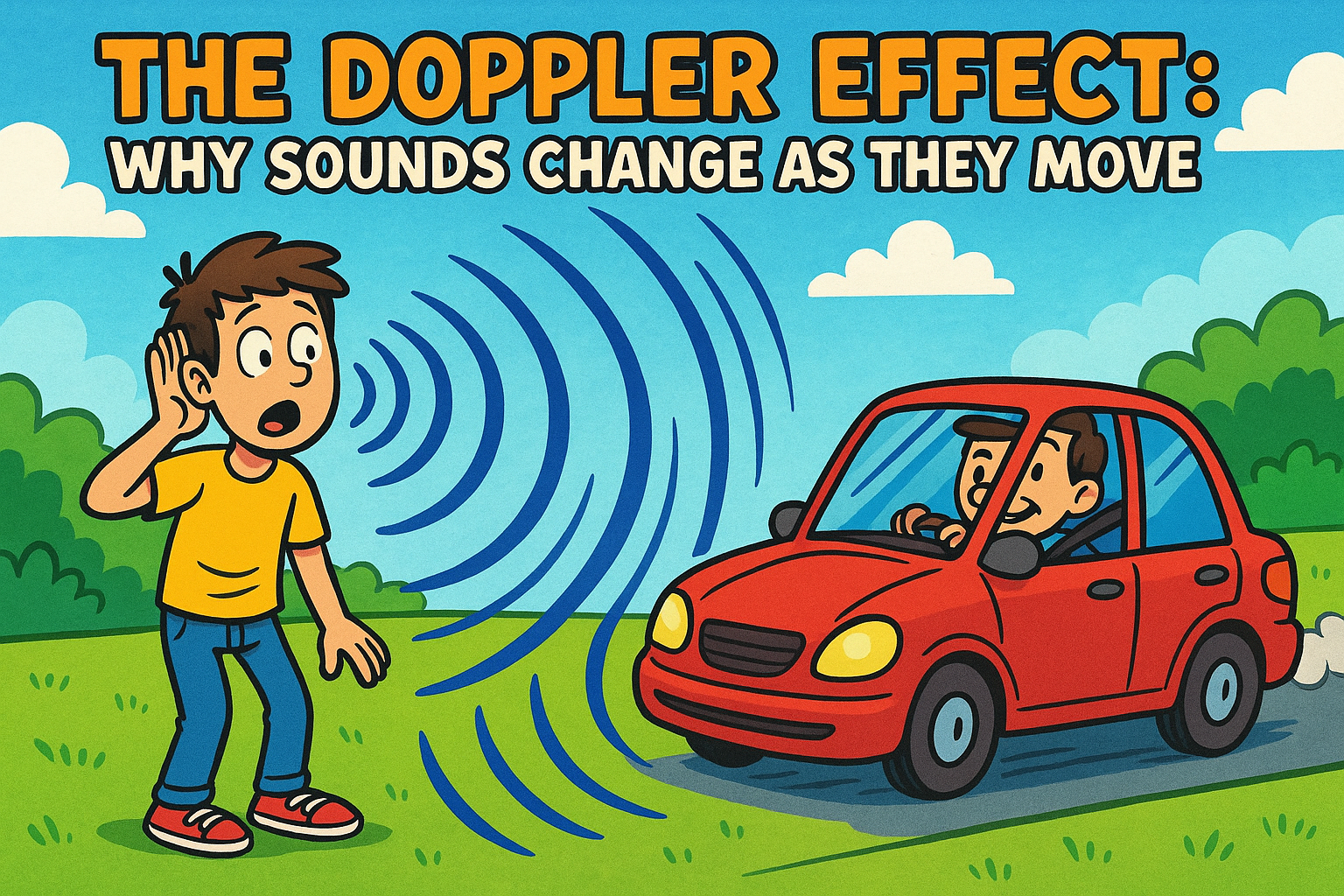
This topic is part of our Info Zone collection. You can read the full topic, once logged in, here: The Doppler Effect: Why Sounds Change as They Move
You’ll also find a full Lesson Plan and a handy Parent Q & A sheet, for this topic, ready to use..
Printable Doppler Effect Lesson Plan
The Doppler Effect Lesson Plan
This lesson plan is designed to help you support your child with this topic: The Doppler Effect: Why Sounds Change as They Move
Learning Objectives (What You’ll Learn Today)
- Understand what the Doppler effect is and why it happens
- Learn how moving sound sources affect pitch and frequency
- Recognise everyday examples of the Doppler effect
- Explore how it applies to both sound and light waves
Estimated Time
45–60 minutes
Let’s Get Started
Ask: “Have you ever noticed how a siren sounds higher when it’s coming towards you and lower when it’s moving away? Why do you think that is?”
The Main Lesson
What Is the Doppler Effect?
The Doppler effect is what happens when a sound source moves towards or away from a listener. It causes a change in the sound’s pitch because the sound waves get squashed or stretched depending on the direction of movement. This effect is why ambulance sirens sound different as they approach and then pass.
When the source moves closer, the waves are compressed—so the frequency goes up and the pitch sounds higher. When it moves away, the waves are stretched out—so the frequency drops and the pitch sounds lower. That’s the key idea behind the Doppler effect.
Mini-Task: Try making a “siren” sound and walk past someone. Can they hear the pitch change?
How Do Sound Waves Work?
Sound waves are vibrations that move through air (or another material). They travel in patterns of compressions (high pressure) and rarefactions (low pressure). The number of waves that pass a point in one second is called frequency, and this is what we hear as pitch.
If nothing is moving, the waves spread out evenly. But if the source moves, it changes how the waves are spaced out. This is called a sound wave shift—and it’s the root of how the Doppler effect works. The speed of sound stays the same, but the pattern of waves is altered by movement.
Mini-Task: Draw a set of sound waves coming from a still speaker and another from a moving speaker. Label the wave spacing.
Everyday Examples of the Doppler Effect
Sirens are the classic example, but this effect is all around us. Think about a train whistle, a car engine passing by, or even fireworks. In each case, the sound changes as the object moves because of the Doppler effect.
This same idea is used in radar speed traps, ultrasound scans in hospitals, and even weather tracking systems. These devices use moving sound or radio waves and detect changes in frequency to measure speed or direction.
Mini-Task: Listen carefully to a passing vehicle and describe how the pitch changes before and after it goes by.
What Is Pitch Shift?
Pitch shift is what we hear when the Doppler effect happens. It’s not that the sound source changes what it’s producing—the sound itself stays the same—but motion changes how many waves reach your ear each second.
Imagine throwing balls while running. If you throw one every second while moving, they land closer together in front of you. That’s like sound waves from a moving source—closer together means higher frequency and higher pitch. Behind you, they land farther apart—that’s lower pitch.
Mini-Task: Act out this analogy using a soft ball and walking forward. Discuss what happens if you walk faster.
The Doppler Effect and Light
The Doppler effect also applies to light, not just sound. When stars or galaxies move away from Earth, their light shifts toward the red end of the spectrum—this is called redshift. When they move towards us, their light shifts toward blue—blueshift.
Astronomers use this to measure the speed and direction of distant objects in space. Redshift helped scientists discover that the universe is expanding. So, the Doppler effect lesson actually links everyday experiences to deep questions about the cosmos.
Mini-Task: Research what redshift tells us about the age and size of the universe. Write down two things you learned.
Think and Discuss
- Why does sound change when something moves past you?
- Can we use this effect to measure things that are far away?
- What would happen if you could move faster than the sound you made?
Wrap-Up Summary
The Doppler effect helps us understand how sound and light waves change when the source or observer is moving. It explains real-world things like sirens, redshift, and speed traps—all through wave patterns and motion.
Quiz
- What is the Doppler effect?
- True or False: The Doppler effect changes the speed of sound.
- What does pitch mean in sound?
- Why does pitch rise as a sound source moves closer?
- True or False: The Doppler effect only applies to sound.
- What’s one tool that uses the Doppler effect?
- What is redshift?
- True or False: Redshift shows an object moving towards us.
- How does the Doppler effect help doctors?
- What changes when a wave source moves: the wave speed or the wave spacing?
Answers
1. A shift in pitch caused by motion
2. False
3. How high or low a sound is
4. The waves get squashed together
5. False
6. Radar gun or ultrasound scanner
7. Light shifting to longer wavelengths
8. False
9. By measuring blood flow using sound wave changes
10. The wave spacing
Short Essay Prompt
Write a short essay, say 3 paragraphs explaining how the Doppler effect works. Include one real-life example and describe what changes in the sound or light wave when something moves.
Extra Learning
Find a video or animation showing redshift and blueshift in astronomy. Watch how the colour changes and write a short explanation of why this happens. If you like, try to simulate wave compression and expansion using a spring or slinky toy.
Final Reflection (What Did You Learn?)
Ask: “What surprised you most about sound and motion today? Can you think of any place where you’ve heard this effect but didn’t know it had a name?”

