What Is a Black Hole? The Terrifying Space Monster That Eats Everything!
What Is a Black Hole? The Terrifying Space Monster That Eats Everything!
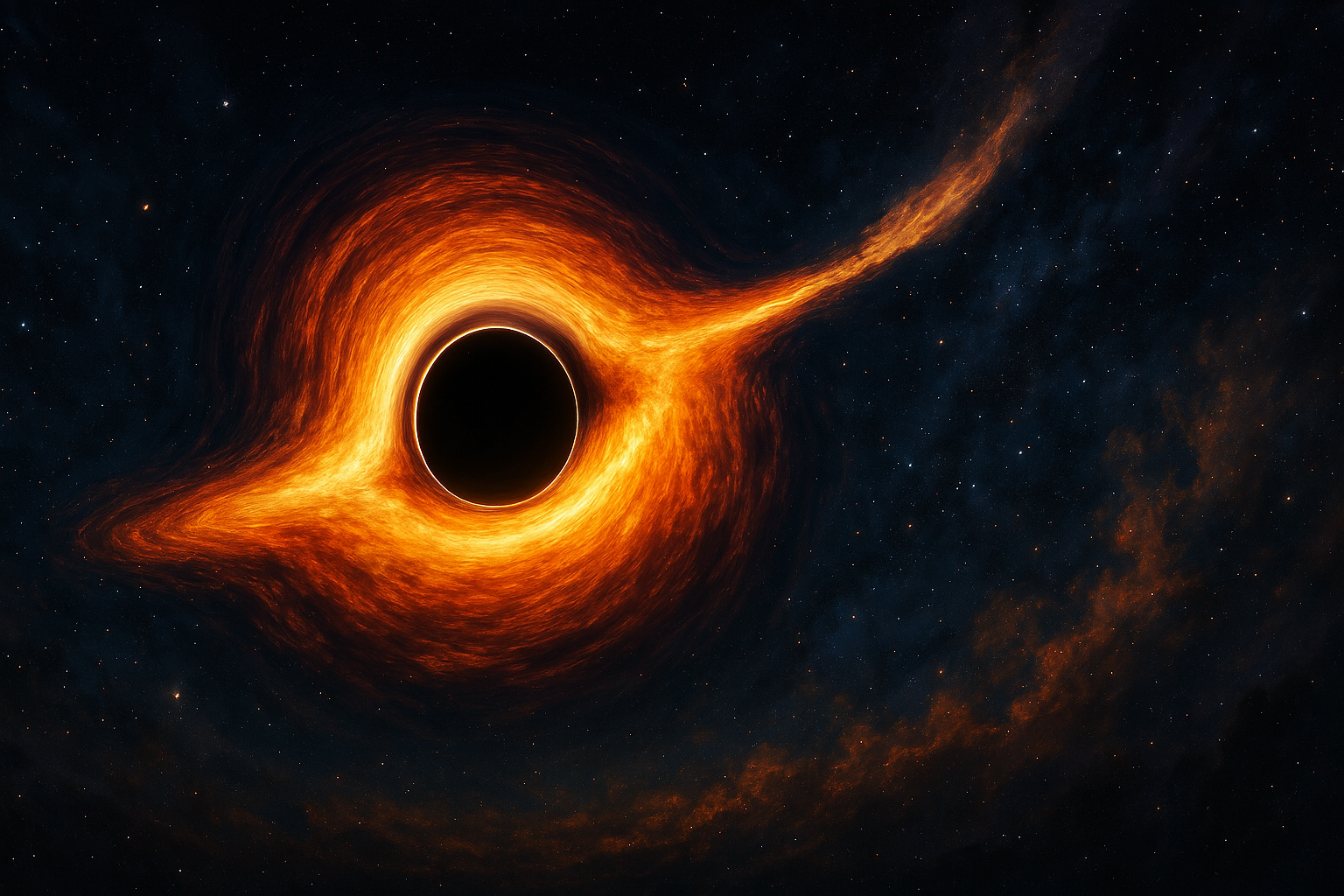
What is a black hole? It’s one of the strangest and most fascinating objects in space. A black hole is like a cosmic vacuum, sucking in everything nearby—even light. These mysterious giants form when massive stars collapse in on themselves. Once something crosses the event horizon, there’s no way out.
By Alan Lloyd
Black holes aren’t just invisible holes in space. At their core lies a gravitational singularity—a point so dense, the laws of physics break down. Some, called supermassive black holes, are millions of times heavier than the Sun and sit at the centre of galaxies. So, how do they work? And what really happens if you fall into one?
You’ll also find a full Lesson Plan and a handy Parent Q & A sheet, for this topic, ready to use..
What Is a Black Hole, Really?
A black hole is a region of spacetime where gravity is so intense that nothing—not even light—can escape its pull. The defining boundary of a black hole is called the event horizon, which marks the point beyond which escape is impossible. This isn’t just a strong gravitational field—it’s a complete breakdown of classical escape velocity logic.
According to general relativity, gravity isn’t a force pulling on objects. It’s the curvature of spacetime itself, caused by mass and energy. A black hole curves spacetime so extremely that all paths—no matter what direction you try—lead inward. The mathematical solution describing a non-rotating black hole is called the Schwarzschild solution, derived from Einstein’s field equations. It introduces the concept of the Schwarzschild radius (rₛ), the radius of the event horizon: rₛ = 2GM/c².
In this formula, G is the gravitational constant, M is the mass of the object, and c is the speed of light. When an object’s radius is compressed to less than its Schwarzschild radius, it becomes a black hole. This is not theory anymore—astronomers have found overwhelming observational evidence, including X-ray binaries, gravitational wave mergers, and images of the black hole shadow in M87.
So, black holes are not science fiction—they’re real, observable consequences of general relativity. And their properties stretch our understanding of physics to the limit.
There are several classes of black holes: stellar (about 3–100 solar masses), intermediate (hundreds to thousands), and supermassive (millions to billions), each formed through different processes.
How Do Black Holes Form?
Stellar black holes form at the end of a massive star’s life. When nuclear fusion in the core stops, the outward pressure can no longer balance the star’s own gravity. If the remaining mass of the core is above the Tolman–Oppenheimer–Volkoff limit (around 2–3 solar masses), it collapses into a black hole. This process often involves a supernova explosion that expels the outer layers of the star.
More massive black holes can form through successive mergers. When two stellar black holes collide, they emit gravitational waves and combine into a larger black hole. This is one pathway toward intermediate-mass black holes, which are suspected to exist in dense star clusters and dwarf galaxies.
Supermassive black holes (SMBHs), which sit at the centre of most galaxies, are still poorly understood. They may have formed through the direct collapse of massive gas clouds in the early universe, or through runaway growth from seed black holes and accretion over billions of years. The one at the centre of our Milky Way, Sagittarius A*, has about four million times the mass of the Sun.
In theory, black holes could also have formed in the early universe through high-energy density fluctuations. These are known as primordial black holes, though we have yet to confirm their existence.
The key point: a black hole forms whenever an amount of mass becomes confined within its Schwarzschild radius. At that point, not even light has the escape velocity to get out.
The Event Horizon and Causal Disconnection
The event horizon isn’t a physical surface—it’s a mathematical boundary in spacetime. Once something crosses it, no signal, particle, or information can return to the outside universe. The cause? The structure of spacetime itself has tilted inward so completely that all future paths point toward the centre.
At the event horizon, the escape velocity equals the speed of light. Beyond this point, even photons, which travel at c, are doomed to spiral inward. The event horizon also marks a causal disconnect. Anything inside is causally disconnected from the outside world—it can’t affect events beyond the horizon in any way.
Black holes can have event horizons shaped by charge and spin. The Kerr solution describes rotating black holes, which have an oblate (squashed) event horizon and an inner surface called the ergosphere. Inside the ergosphere, space is dragged around by the black hole’s rotation—a phenomenon called frame dragging.
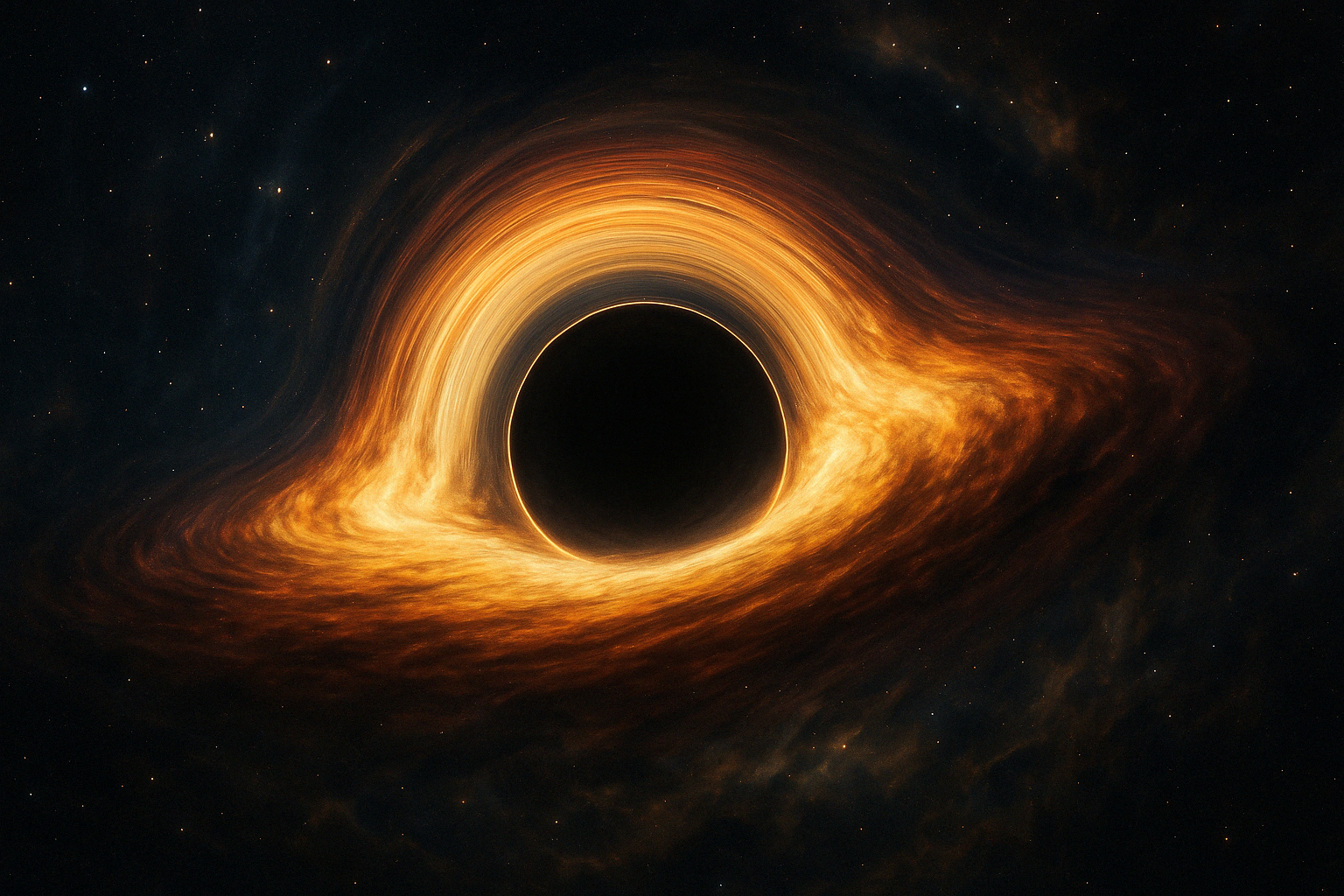
Though the event horizon itself is invisible, we can detect its effects. Matter falling toward it forms an accretion disk that heats to millions of degrees and emits X-rays and radio waves. This radiation helps us spot black holes despite their invisibility.
Crossing the event horizon means the loss of all external communication. From that moment on, no rescue is physically possible—not even in theory.
What Is a Gravitational Singularity?
At the centre of a classical black hole lies the gravitational singularity, a point of infinite density and zero volume. According to general relativity, this is where the curvature of spacetime becomes infinite. The singularity represents the breakdown of the laws of physics as we know them.
In practical terms, the singularity is where all the matter that formed the black hole has collapsed. General relativity predicts that tidal forces (the stretching due to differential gravity) become infinite here. This leads to the well-known problem that a falling object is destroyed by spaghettification long before reaching the centre.
However, the singularity is likely a signal that our current theories are incomplete. Quantum mechanics, which governs the very small, is not included in general relativity. A complete theory of quantum gravity may resolve the singularity into a finite, but extreme, state of matter.
Proposals include loop quantum gravity (which predicts a “bounce” rather than a singularity) and string theory (which smears out the pointlike nature of particles). Until we unify gravity with quantum mechanics, the singularity remains a mathematical artefact with no direct physical explanation.
Regardless, the singularity is hidden from external view by the event horizon. This is known as the cosmic censorship hypothesis: nature hides its singularities behind horizons, so the universe outside remains predictable.
Falling Into a Black Hole: Relativity Meets Reality
From your point of view, falling into a black hole is surprisingly uneventful—until it isn’t. If the black hole is large enough, you might not even notice crossing the event horizon. Tidal forces grow gradually, and you’d continue falling inward, unable to communicate with the outside world.
From an external observer’s point of view, however, you never quite cross the event horizon. Due to gravitational time dilation, your fall appears to slow down, and light from you becomes increasingly redshifted. Eventually, you fade from view entirely—stuck forever just outside the horizon, from their perspective.
This strange effect is predicted by the Schwarzschild metric, which governs the geometry outside a non-rotating black hole. It shows that time and space trade roles inside the event horizon—“going forward in time” means “moving toward the singularity.” You have no freedom to avoid it.
In small black holes, you’d be torn apart by tidal forces well before reaching the singularity. In supermassive black holes, the journey would be smoother—tidal forces at the event horizon can be weak enough to pass without injury.
But the end is inevitable. Once inside, your timeline leads to one place only: the singularity. No trajectory, no rocket, no physics can prevent it.
Can Black Holes Evaporate?
Yes—according to Stephen Hawking’s theory, black holes can slowly lose mass through Hawking radiation. This process occurs due to quantum fluctuations near the event horizon, where virtual particle-antiparticle pairs spontaneously appear.
Normally, these pairs annihilate instantly. But near an event horizon, one particle can fall in while the other escapes. The escaping particle becomes real, taking energy from the black hole. Over time, this causes the black hole to shrink.
Hawking radiation is extremely weak. For stellar-mass black holes, the temperature is less than a billionth of a kelvin—impossible to detect with current instruments. But for tiny, hypothetical black holes (like primordial black holes), this effect could be significant.
If Hawking is right, black holes will eventually evaporate completely, ending in a final burst of radiation. But this raises a deep puzzle: what happens to the information that fell in? If it’s lost, quantum mechanics is violated. If it’s not, how does it get out?
This is known as the black hole information paradox. It remains unsolved, but leading proposals include the holographic principle and firewall theories.
Do We See Black Holes? How We Detect Them
Since black holes emit no light, we detect them indirectly. One method is observing X-ray binaries, where a black hole pulls gas from a companion star. The gas heats up in the accretion disk and emits X-rays, revealing the presence of an otherwise invisible object.
Another method is stellar motion. If a star orbits an unseen, massive object, we can measure its speed and deduce the hidden mass. This is how we found Sagittarius A*, the supermassive black hole at the centre of the Milky Way.
In 2015, LIGO detected gravitational waves from merging black holes—tiny ripples in spacetime predicted by general relativity. These detections opened a whole new field: gravitational wave astronomy.
And in 2019, the Event Horizon Telescope captured the shadow of the black hole in galaxy M87. It wasn’t a photo of the black hole itself, but of the light bent and trapped around it—a powerful confirmation of theory.
Black holes are no longer invisible mysteries. They are measurable, testable, and absolutely real.
A Final Thought
Black holes represent the extreme edge of physics. They connect gravity, quantum theory, thermodynamics, and cosmology. To understand them fully is to understand the universe more deeply. And yet—we’re still only scratching the surface.
Quick Quiz
What is the Schwarzschild radius, and how is it calculated?
What happens to time near a black hole?
Why do singularities challenge general relativity?
How do we observe black holes indirectly?
What is the black hole information paradox?
Write your answers in the comment section below.
Related Wikipedia Links
These links offer deeper information and references: