
What Is a Black Hole? The Terrifying Space Monster That Eats Everything! (Lesson Plan)
Lesson Plan - What Is a Black Hole? The Terrifying Space Monster That Eats Everything!
What is a black hole, and why does it fascinate scientists, students, and space lovers alike? This black hole lesson plan explores one of the most extreme and mind-bending objects in the universe. Your child will learn how black holes form, what happens at the event horizon, and why these cosmic vacuums warp time and space. With clear explanations, visual comparisons, and engaging tasks, they’ll start to understand the real science behind these mysterious space phenomena.
This black hole lesson plan is perfect for learners aged 8–16, whether they’re just getting curious about space or already exploring physics in depth. You don’t need any background in science—just use the clear sections, fun mini-tasks, and discussion questions to guide your child’s learning. The topic encourages critical thinking, imagination, and curiosity about how the universe works. You’ll be amazed at how much your learner can understand when it’s explained step by step.
This topic is part of our Info Zone collection. You can read the full topic, once logged in, here: What Is a Black Hole? The Terrifying Space Monster That Eats Everything!
You’ll also find a full Lesson Plan and a handy Parent Q & A sheet, for this topic, ready to use..
What Is a Black Hole? The Terrifying Space Monster That Eats Everything!
This lesson plan is designed to help you support your child with this topic: What Is a Black Hole? The Terrifying Space Monster That Eats Everything!
Learning Objectives (What You’ll Learn Today)
- Understand what a black hole is and how it forms
- Explore the event horizon and gravitational singularity
- Learn what happens when matter falls into a black hole
- Discover how scientists detect black holes using indirect evidence
Estimated Time
60–75 minutes including discussion, tasks, and quiz
Let’s Get Started
Ask your child: “If nothing can escape a black hole—not even light—how do scientists know they exist?”
The Main Lesson
What Exactly Is a Black Hole?
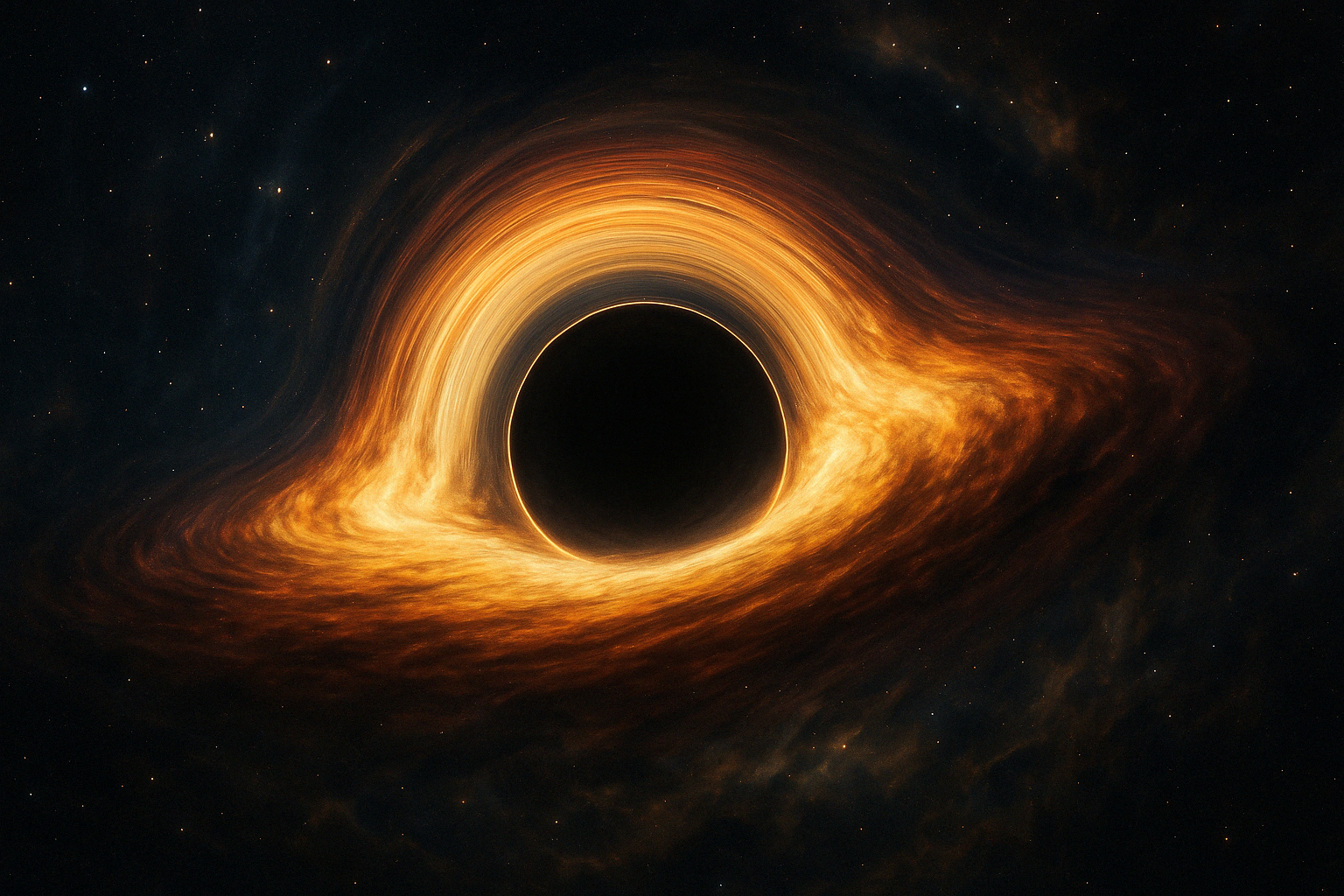
A black hole is a region in space where gravity is so strong that not even light can escape. At its centre lies a gravitational singularity—a point of infinite density where our current understanding of physics breaks down. Surrounding it is the event horizon, the boundary beyond which escape becomes impossible.
This happens when a huge amount of mass gets squeezed into a tiny space. When that mass becomes so dense it collapses into its Schwarzschild radius (rₛ = 2GM/c²), it forms a black hole. Black holes aren’t objects in the traditional sense—they’re regions of curved spacetime.
Mini-Task: Look up the Schwarzschild radius of a black hole with the mass of our Sun.
How Do Black Holes Form?
Black holes usually form when massive stars run out of nuclear fuel. Without fusion to hold them up, gravity collapses the core. If it’s massive enough, it passes the neutron star stage and becomes a black hole. This is known as a stellar black hole.
Supermassive black holes, found in the centre of galaxies, likely formed early in the universe’s history. They could have started as smaller black holes that merged or formed directly from collapsing gas clouds. These giants may weigh millions or billions of times more than our Sun.
Mini-Task: Draw a timeline showing the life of a massive star and how it can end as a black hole.
What Is the Event Horizon?
The event horizon is the boundary around a black hole where the escape velocity equals the speed of light. Once anything passes this point—even light—it can’t get out. It’s not a surface or wall, but a zone where spacetime is bent so completely that all paths lead inward.
Imagine being caught in a current so strong that no matter how hard you swim, you’re dragged inward. That’s what the event horizon is like—except it’s the very fabric of space pulling you in. For anything outside the event horizon, the black hole appears invisible.
Mini-Task: Explain to someone how the event horizon is different from a physical object or barrier.
What Happens Inside a Black Hole?
Inside the event horizon, all paths lead to the singularity. This is where gravity compresses matter into an infinitely dense point. Space and time effectively trade places. That means moving forward in time also means moving toward the singularity—you can’t avoid it.
In smaller black holes, tidal forces tear apart objects—a process called spaghettification. In supermassive black holes, this stretching is gentler at the horizon, but the singularity still awaits. What actually happens there? We don’t fully know yet. Quantum gravity may one day provide an answer.
Mini-Task: Write a fictional journal entry from an astronaut falling into a black hole. How would time feel?
How Do We Detect Black Holes?
Even though black holes don’t emit light, we can detect their effects. When gas falls in, it heats up and emits X-rays. Some black holes also affect nearby stars, causing them to orbit something we can’t see. By tracking these orbits, we estimate the black hole’s mass.
We’ve also detected gravitational waves—ripples in spacetime—caused by black hole collisions. And in 2019, astronomers captured the shadow of a black hole in galaxy M87 using a global telescope array. These clues help confirm what theory predicted decades ago.
Mini-Task: Watch a video of the M87 black hole image and describe what you see in your own words.
Think and Discuss
- Why can’t even light escape a black hole?
- What might be inside the singularity?
- Could black holes be used for space travel in the future?
Wrap-Up Summary
Black holes are cosmic regions where gravity becomes extreme. They form from collapsing stars, bend time and space, and challenge everything we know about physics. Though invisible, their effects are powerful and measurable.
Quiz
- What is the boundary of a black hole called?
- True or False: Light can escape from within the event horizon.
- What does the term “spaghettification” refer to?
- Which famous scientist predicted black hole evaporation?
- What equation gives the Schwarzschild radius?
- How are supermassive black holes different from stellar ones?
- Can we observe black holes directly?
- True or False: The singularity has zero volume and infinite density.
- What waves are emitted when black holes merge?
- Name one way we detect black holes indirectly.
Answers
1. Event horizon
2. False
3. Stretching due to extreme gravity
4. Stephen Hawking
5. rₛ = 2GM/c²
6. They are millions to billions of times more massive
7. No
8. True
9. Gravitational waves
10. X-rays or orbital motion of nearby stars
Short Essay Prompt
Write a short essay (3 paragraphs) explaining how a black hole forms and what happens to matter once it crosses the event horizon. Include at least one analogy or visual explanation to help clarify your points.
Extra Learning
Explore the idea of Hawking radiation and how it means black holes might slowly evaporate. Try modelling this with a simple analogy or drawing. Can your child explain whether black holes last forever?
Final Reflection (What Did You Learn?)
Ask your child: “What was the most surprising thing you learned about black holes today, and what do you still wonder about?”