
Work, Energy and Power: How Things Get Done
Work, Energy and Power: How Things Get Done
Work, energy and power might sound like things only scientists worry about, but they’re actually part of your everyday life. Every time you lift your school bag, ride your bike, or even plug in your phone to charge – you’re dealing with work, energy or power. Understanding how they work together helps us understand how the world moves, changes and gets things done.
In this topic, you’ll explore how energy can’t be created or destroyed, why work isn’t always about homework, and how power shows how quickly energy is used. We’ll explain key ideas in simple steps, with examples you’ve probably seen around your house or garden. You’ll discover how everything from a football kick to a moving train uses energy and does work. And by the end, you’ll be able to explain how your own body is a power machine too!
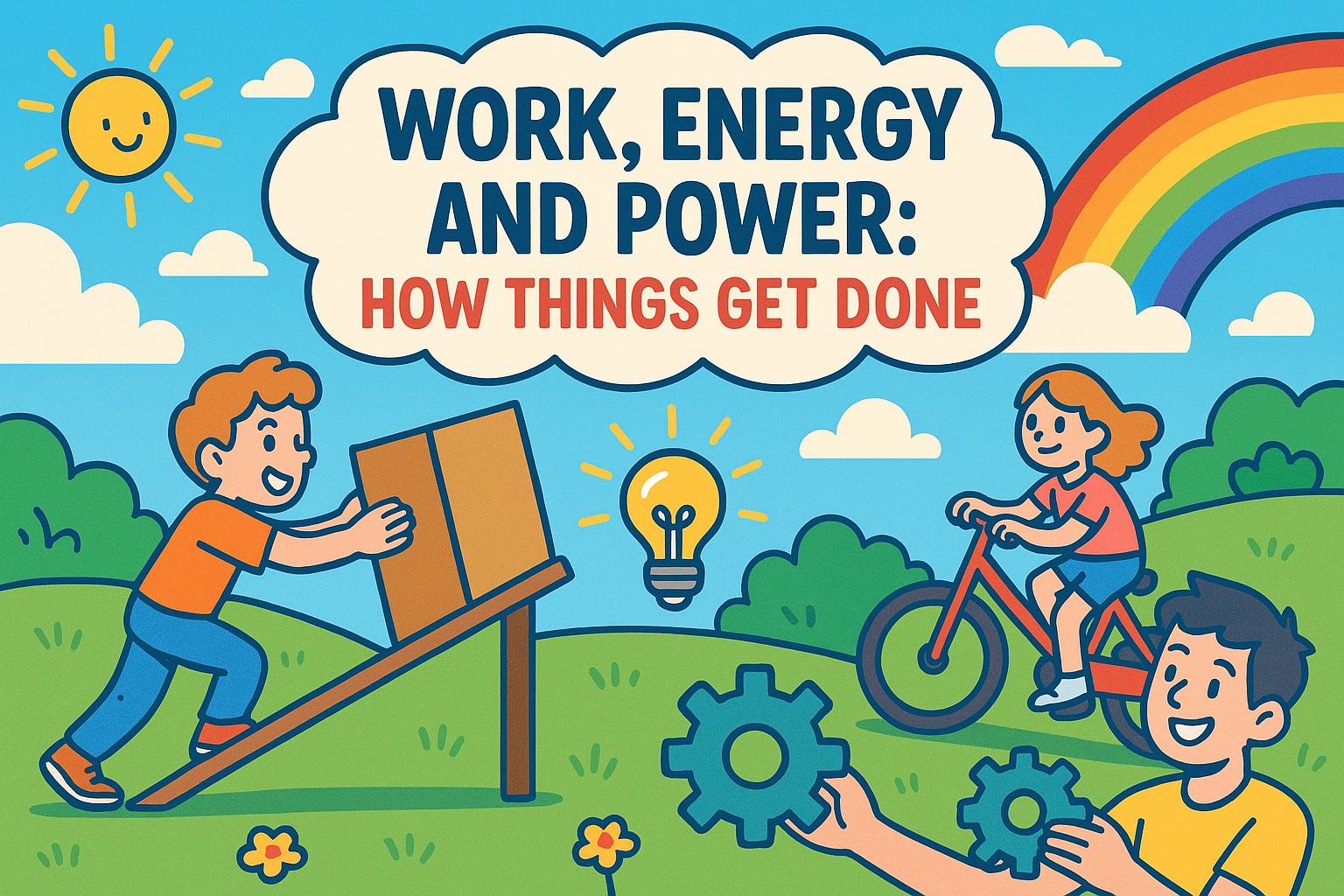
This topic is part of our Info Zone collection. You can read the full topic, once logged in, here: Work, Energy and Power: How Things Get Done
You’ll also find a full Lesson Plan and a handy Parent Q & A sheet, for this topic, ready to use..
What Do We Mean by Work, Energy and Power?
Let’s get one thing clear before we begin: in physics, “work” doesn’t mean chores or homework. Instead, it has a special meaning. You do work when you use a force to move something in the same direction as the force. So, pushing a box across the floor counts as work – but holding it still, no matter how heavy, does not.
Energy is what gives something the ability to do work. Every movement, light, sound, or heat you experience uses energy. Whether you’re jumping, charging a phone, or turning on a light, energy is at play.
Power, on the other hand, tells us how quickly energy is used. If someone does the same job faster, they’re using more power. For example, imagine a sprinter and a walker climbing the same hill. The sprinter uses more power because they do the work in less time.
These three concepts – work, energy, and power – work together like parts of a machine. If you understand one, you’ll start to understand the others. In fact, almost everything in your daily life depends on how these forces interact.
Let’s explore how they work, how they connect, and how they help us get things done every day.
The Science of Work
In science, you calculate work using a simple formula: Work = Force × Distance. This means that whenever a force moves something over a distance, work has been done.
The unit we use for measuring work is the joule (J). One joule equals the work done when a force of one newton moves something one metre. It may sound small, but joules add up quickly!
Here’s a fun twist: if you push a wall and it doesn’t move, you haven’t done any work in physics terms. Even though your muscles feel tired, no movement means no work.
Suppose you carry a shopping bag upstairs. You are lifting it against the force of gravity, over a distance. That definitely counts as doing work.
Work only happens when there’s a force and movement in the same direction. So, simply standing still while holding something doesn’t count – physics insists on action!
All About Energy
Energy is all around us, even though we can’t always see it. It powers everything – from the biggest rockets to the smallest insects. You use it to move, to think, and even to stay warm.
There are many different types of energy. These include kinetic (movement), potential (stored), thermal (heat), chemical, electrical, and light energy. Each type has a unique role in how the world works.
For example, when you ride your bike downhill, the potential energy you’ve built up changes into kinetic energy. When you brake, that energy becomes heat – which is why your brakes feel warm after a long ride.
One of the most important rules in physics is the Law of Conservation of Energy. It says that energy can’t be created or destroyed. Instead, it changes from one form into another, but the total amount always stays the same.
So, whether you’re charging a phone, eating lunch, or flying a kite, you’re witnessing energy in action – always moving and transforming to help things get done.
What Is Power?
Power tells us how fast energy is being used. It helps us understand how quickly a job gets done. You measure power in watts (W), and one watt means one joule of energy is used each second.
Imagine two friends racing up the stairs. They both do the same work, but the one who finishes first uses more power. That’s because they use their energy faster.
Think of a torch. A dim torch uses less power than a bright one because it gives out less energy each second. Similarly, a car engine with more power can speed up faster than one with less.
At home, powerful devices like kettles and ovens use more watts. That’s why they cost more to run – they burn through energy quickly.
So, if energy is like the fuel, power is like the speed of the engine. The faster the energy flows, the higher the power you’re using.
How Work, Energy and Power Fit Together
Let’s take a football match as an example. When a player kicks the ball, their muscles do work using energy from food. That work makes the ball fly, giving it kinetic energy. The quicker and harder the kick, the more power they’ve used.
Machines follow the same idea. A crane lifting a weight does work using energy from electricity or fuel. If it lifts faster, it uses more power. If it lifts slower, it takes less power but still does the same work.
These three things always go together. Energy is the source, work is the task, and power is the speed. Remove one, and things stop working properly.
You can’t have work without energy. And if nothing’s happening fast, then power is low. This triangle of ideas explains how the world moves and changes around us.
Understanding how they connect helps you spot them in action – in machines, sports, nature, and even in yourself.
Machines That Help Us Do Work
Machines don’t magically reduce the amount of work needed, but they do help make it feel easier. A simple tool, like a ramp or a pulley, spreads out the effort so you don’t have to use as much force all at once.
Think about using a ramp to load a heavy box onto a van. The box still ends up at the same height, but you’ve made the job easier by spreading the work over a longer distance. That’s clever physics!
Machines also help us change energy from one form to another. For example, an electric fan turns electrical energy into movement. A windmill does the opposite – it turns wind into electricity.
By helping us control energy and movement, machines make our lives much easier. Engineers use their knowledge of work, energy and power to design better tools, vehicles, and buildings.
So, even a simple screwdriver or lever has a bit of science magic hidden inside it. Once you understand how machines work, the world becomes a lot more interesting.
The Human Body: A Power Machine
Your body is full of energy – and it uses it constantly! When you eat food, your body stores that chemical energy. Then it turns it into movement, heat, and brain power.
Running, lifting, jumping – these actions all count as doing work. If you do them quickly, you use more power. That’s why sprinting takes more out of you than walking, even if the distance is the same.
Your muscles are like engines, turning stored fuel into action. Even when you’re sitting still, your body uses energy to keep your heart beating and lungs working.
So, every time you get up, stretch, or blink, you’re using the same rules of physics that power rockets and rollercoasters!
Next time you feel tired, remember – you’ve been doing real work. That’s physics in action, and your body is the machine behind it.
A Final Thought
Work, energy and power aren’t just ideas from a textbook – they’re everywhere. Once you start spotting them, you’ll realise how much science goes on in your daily life. From brushing your teeth to riding a bike, these ideas explain how things get done. Now that’s real power!
What Do You Remember?
- What is the definition of work in physics?
- Why is energy important for doing work?
- Can you name different types of energy?
- How does a machine help you do work more easily?
- What part of your body turns food into energy for work?
Write your answers in the comment section below
Related Wikipedia Links
Curious to go deeper? Explore these helpful pages to learn even more about the science behind work, energy and power:
What Do You Think?
Have you ever noticed work, energy or power in your daily routine? Whether you’re walking the dog or gaming online, physics is always part of the action. Share your examples in the comments!