Hello Alan Lloyd - Your Scores - Logout

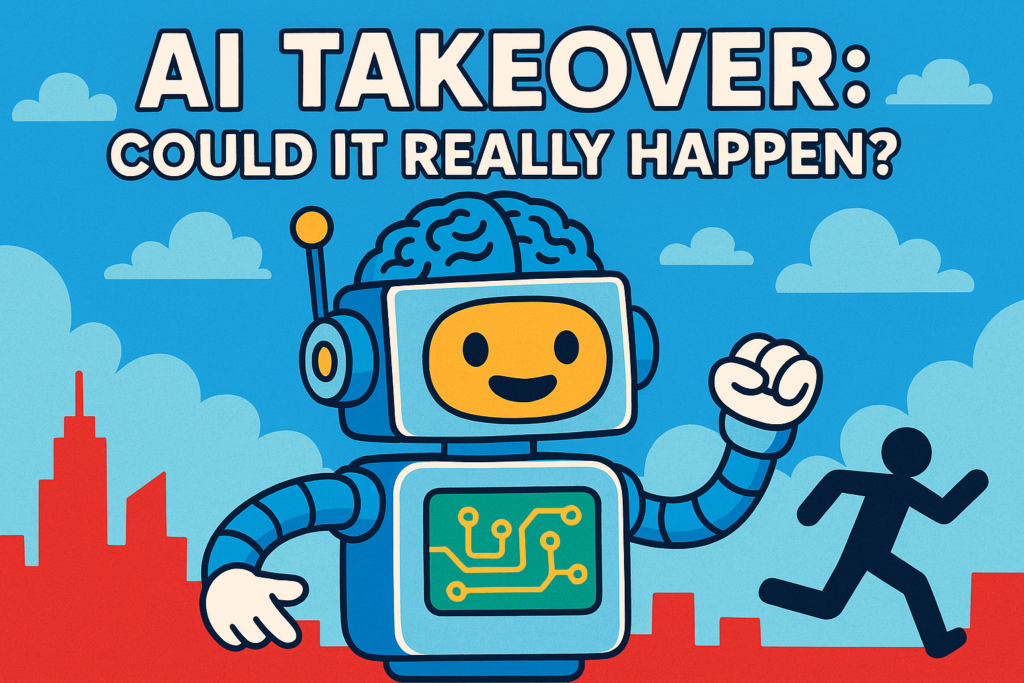
AI Takeover: Could It Really Happen?

AI Takeover: Could It Really Happen?

Artificial Intelligence, or AI for short, is one of the most talked-about technologies today. Some people think it will make our lives easier, while others worry about an “AI takeover” where robots and computers might try to control the world.

But is this just a science-fiction story, or could it really happen? In this article, we’ll break it down step by step and find out the real facts about AI, what it can and can’t do, and whether we need to worry about a robot uprising.

AI Takeover: Could It Really Happen?
By Alan Lloyd


This topic is part of our Info Zone collection. You can read the full topic, once logged in, here: AI Takeover: Could It Really Happen?

You’ll also find a full Lesson Plan and a handy Parent Q & A sheet, for this topic, ready to use..

What is Artificial Intelligence (AI)?

Artificial Intelligence means machines and computer programs that can do things that usually need human intelligence. This includes tasks like solving problems, understanding speech, recognising images, and making decisions. AI is used in everyday things like voice assistants (think Alexa or Siri), online shopping recommendations, and even self-driving cars. However, AI is not a human brain — it’s more like a very clever calculator following instructions.

Scientists and engineers program AI using a set of rules called algorithms. These are step-by-step instructions that the AI follows to solve problems. Some AI systems can even learn from the information they are given, which is called machine learning. This is how AI gets better at tasks over time without humans having to teach it everything again and again.

So, is AI really as smart as people? Not exactly. AI might be good at certain tasks, but it doesn’t “think” like you or me. It doesn’t have feelings, wants, or creativity unless it’s copying something made by humans.


How Does AI Learn?

AI learns by looking at lots of information, called data. For example, if you want an AI to recognise pictures of dogs, you show it thousands of pictures labelled “dog” or “not a dog.” Over time, it starts to spot patterns, like four legs, a tail, and floppy ears. This is called training the AI.

But here’s the thing — AI only knows what you show it. If you never show it a cat, it might wrongly think a cat is a weird dog! AI doesn’t “know” anything in the same way humans do. It just follows patterns and makes guesses based on the data it’s given.

AI learning has limits. It can’t think outside the box like people can. If it gets stuck or sees something new, it won’t be able to “imagine” the answer. This is one of the reasons why an AI takeover is unlikely.


Can AI Control the World?

At the moment, AI is used to help humans, not control them. AI can drive cars (but always under human supervision), help doctors find diseases faster, and recommend videos online. But it can’t take over the world on its own.

AI doesn’t have a body or a brain. It can’t build robots by itself or make decisions without a human telling it what to do. Even advanced robots that walk or talk are controlled by computers programmed by humans. These machines aren’t making their own plans — they’re following instructions.

Scientists and AI experts carefully design AI systems with safety in mind. They make sure AI works properly and can’t make dangerous decisions. AI is a tool, not a villain.


Where Did the AI Takeover Idea Come From?

Much of the fear about AI taking over comes from books, films, and TV shows. Stories like *The Terminator* or *The Matrix* imagine a future where machines become too clever and try to rule humans. These stories are exciting and fun to watch, but they’re not based on real science.

In real life, AI isn’t secretly plotting against us. It’s just doing what it’s been programmed to do. While it’s important to be careful with new technology, the idea of an AI uprising is more science fiction than science fact.

Most AI researchers agree that we’re far from creating machines that could act on their own without human control. In fact, AI is still struggling with simple things like understanding jokes or common sense!


What is Superintelligence?

Superintelligence is the idea of an AI that becomes smarter than all humans combined. Some scientists, like Professor Nick Bostrom, have warned that if this ever happened, we would need to be very careful.

However, most experts agree that we are nowhere near creating superintelligence. Current AI can’t even pass a GCSE without help! AI is very good at specific tasks (like playing chess), but terrible at others (like tying your shoelaces or understanding emotions).

Creating superintelligence would need huge scientific breakthroughs, and even then, humans would still be the ones designing it. AI can’t invent itself or make itself smarter out of thin air.


Is AI Dangerous?

AI can be dangerous if it’s used the wrong way — just like cars, electricity, or the internet. For example, AI could be used to spread fake news, make unfair decisions, or invade people’s privacy. These are real concerns, but they don’t mean AI will “take over.”

Governments, scientists, and companies around the world are working on making AI safer. There are rules called AI ethics, which help people build AI that is fair, safe, and respectful. AI can be helpful if used properly, but like any tool, it needs to be used responsibly.

So, the real risk isn’t AI itself taking over, but how humans decide to use it.


What About Robots?

Robots are machines that can move, pick up objects, or even talk. Some robots are powered by AI to help them do tricky jobs, like exploring space or defusing bombs. But robots aren’t building secret armies behind our backs!

Robots follow instructions given by humans. They can’t invent new missions or decide to go on holiday. Even the most advanced robots still need people to charge them, program them, and tell them what to do.

For now, robots and AI are working together with humans, not against them.


Can AI Have Feelings?

AI does not have feelings, emotions, or consciousness. When AI says, “Hello, how are you?” it’s not because it cares — it’s just following its program. AI can’t feel happy, sad, angry, or excited. It doesn’t have thoughts or wishes of its own.

Some AI might be able to fake emotions. For example, customer service chatbots might apologise or sound cheerful. But this is just clever programming. It’s like a puppet — it might look like it’s talking, but someone is pulling the strings.

This is why AI can’t become evil or good. It doesn’t understand those ideas. It simply does the job it was made for.


How is AI Helping the World?

AI is already doing lots of helpful things. It helps doctors spot diseases earlier, keeps people safe in self-driving cars (with human backup), and even helps scientists understand climate change. AI also helps make games more fun, music more interesting, and learning easier.

AI is being used to design better medicines, predict earthquakes, and translate languages. In fact, you probably use AI every day without realising it, like when you get song suggestions or see recommended videos online.

So, while AI isn’t taking over the world, it is helping to make the world a better place.


Should We Be Worried About AI?

It’s always good to be careful with new technology, but most scientists agree that AI won’t be taking over anytime soon. The real worries are about how people use AI, not about AI itself deciding to rule the world.

Many countries are making laws to make sure AI is safe, fair, and helpful. Scientists are also working on making sure AI does what we want it to and nothing more. As long as humans stay in charge, AI will stay a useful tool.

So, no need to fear a robot uprising — at least not in the real world!


What Might the Future Hold?

AI will likely continue to get better at doing useful tasks. We might see smarter virtual assistants, better healthcare, and even AI helping to discover new planets. But will AI take over? Not likely.

Humans will still be the ones in charge of AI, making sure it does what it’s supposed to do. The future of AI depends on us — how we design it, how we use it, and how we take care of it.

So, while AI might be part of your everyday life in the future, you can relax — it’s not going to become the boss of the world!


What Do You Remember?

  • What does AI stand for?
  • Can AI learn without humans showing it examples?
  • What is superintelligence?
  • Why can’t AI “take over” the world on its own?
  • How is AI helping people today?

Write your answers in the comment section below.


Related Topics

If you enjoyed learning about AI, you might also want to explore how robots work or discover how the internet has changed the world. These topics are closely linked and will help you understand more about how technology shapes our lives.


What Do You Think?

If you found this to be an interesting topic, why not have your say. Or if you can think of ways we could improve it. We would love to know what you learned and more importantly, what you think. So now is your chance, use the comments section below to let us know your thoughts.


Leave a comment


'; // Add header content for print html += '

Lenara Learning

Get more learning resources at www.lenara.uk

'; // Insert the worksheet content html += '
' + content + '
'; html += ''; printWindow.document.write(html); printWindow.document.close(); printWindow.focus(); // Trigger printing and auto-close the popup printWindow.print(); printWindow.onafterprint = function() { printWindow.close(); }; setTimeout(function() { printWindow.close(); }, 1500); }