Hello Alan Lloyd - Your Scores - Logout

Why Do Things Fall to Earth? (Gravity Explained!)

Why Do Things Fall to Earth? (Gravity Explained!)

Gravity is the invisible force that pulls everything towards the ground. Without gravity, we would float off into space, and even the Moon would drift away. It keeps planets, stars, and galaxies together. Gravity is everywhere, and it’s the reason things fall when you drop them!
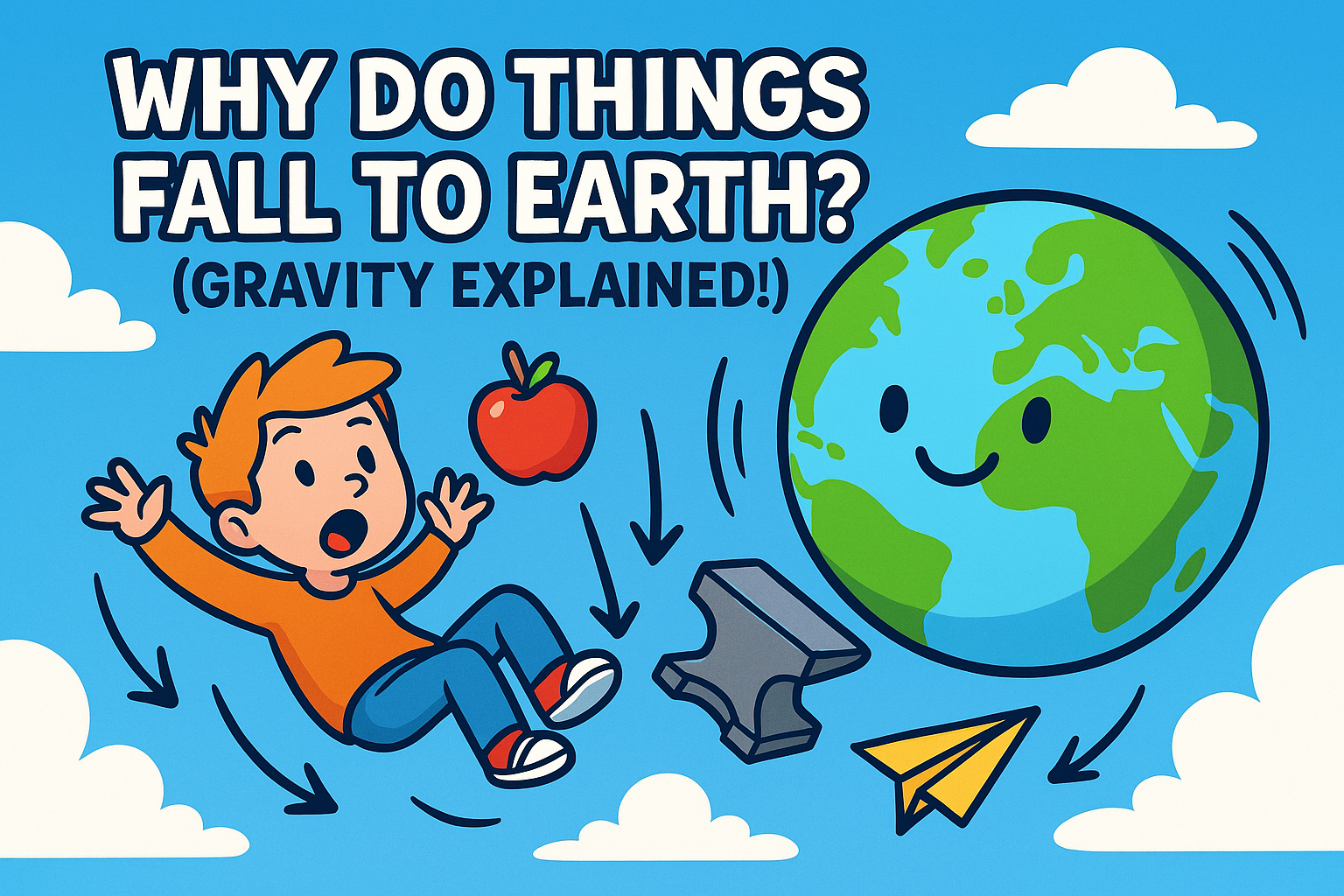
Why Do Things Fall to Earth? (Gravity Explained!)
By Alan Lloyd
This topic is part of our Info Zone collection. You can read the full topic, once logged in, here: Why Do Things Fall to Earth? (Gravity Explained!)
You’ll also find a full Lesson Plan and a handy Parent Q & A sheet, for this topic, ready to use..

What is Gravity?

Gravity is a force, but you can’t see it, touch it, or smell it! Yet, you feel it every single second of your life. It’s the reason you stay on the ground instead of floating into the sky like a balloon.

Gravity is pulling you down towards the centre of the Earth all the time. It pulls everything — apples, shoes, cars, even rivers — straight down unless something holds them up. This force was always there, but it wasn’t until people started asking, “Why do things fall to Earth?” that we began to understand it.

Gravity acts on everything, whether it’s tiny like a grain of sand or massive like a planet!


Who Discovered Gravity?

You might have heard the story about Isaac Newton and the apple. Legend has it that Newton saw an apple fall from a tree and started wondering why it happened.

Did the apple just decide it was tired of hanging around? Not exactly. Newton realised that there must be a force pulling the apple to the ground. He called it gravity.

Thanks to Newton, we now know that gravity affects not just apples but everything on Earth and even things far beyond in space. Although he didn’t actually get bonked on the head by the apple, his curiosity changed science forever.


How Does Gravity Work?

Imagine you’re holding a ball high up. When you let go, it doesn’t just hover there; it drops! That’s gravity in action. The Earth has mass, which is how much “stuff” it’s made of.

The more mass something has, the stronger its gravitational pull. Because the Earth is huge, its gravity is strong enough to pull everything towards it. The ball falls, water flows downhill, and you stay safely on the ground. Without gravity, life would be very strange, and breakfast cereal would float out of the bowl every morning!

Gravity works by pulling objects towards the centre of the planet, making sure nothing escapes easily.


Gravity Isn’t Just on Earth

Gravity doesn’t just happen on Earth. It’s everywhere in space. The Moon has gravity, but it’s weaker because the Moon is much smaller than Earth.

That’s why astronauts can jump really high on the Moon — they aren’t suddenly stronger, there’s just less gravity pulling them down. Every planet, star, and moon has gravity. Even tiny asteroids have a bit of gravity, but you probably wouldn’t feel it if you stood on one!

Gravity is like the glue of the universe, holding everything together, from moons to entire galaxies.


Why Don’t We Notice Gravity More?

Gravity is all around us, but we don’t often think about it. It’s like air — you only notice it when it’s not behaving normally, like when the wind blows your hat away. We don’t notice gravity pulling us because it’s always there, doing the same thing every second.

But if you ever jump up, you’ll quickly be reminded that gravity is in charge when you come straight back down. We only really notice it when things fall, roll downhill, or when we go on a rollercoaster and feel lighter for a moment.


Is Gravity the Same Everywhere?

Gravity changes depending on where you are. On top of a tall mountain, gravity is a tiny bit weaker because you’re slightly farther from the Earth’s centre.

If you were deep underground, gravity would be a bit stronger. Different planets also have different levels of gravity. Jupiter has much stronger gravity than Earth because it’s enormous, so you’d weigh more if you stood there.

On Mars, you’d weigh less. So, if you ever wanted to jump really high, Mars is the place to go! But don’t forget your spacesuit!


What Would Happen Without Gravity?

Imagine a world with no gravity. You’d wake up floating above your bed, your socks and toast would be drifting around the room, and even rivers would float into the sky! Life without gravity would be chaotic.

Planets wouldn’t stay together, the Moon wouldn’t orbit Earth, and the oceans would simply float away into space. Everything we know about life relies on gravity. Without it, not only would we have floating breakfasts, but there wouldn’t even be a planet to have breakfast on!


Gravity and Orbits

Have you ever wondered how the Moon stays circling the Earth or how satellites don’t just fly away? Gravity is the answer! The Moon is constantly falling towards Earth because of gravity, but it’s also moving sideways fast enough to keep missing.

That’s what an orbit is — constantly falling but always missing. Satellites do the same thing. They travel around Earth really fast, and gravity keeps pulling them towards the planet, creating a perfect loop. Without gravity, satellites would drift away into space.


Gravity Shapes the Universe

Gravity doesn’t just work on apples and astronauts — it’s the force behind galaxies, stars, and even black holes! It pulls huge clouds of gas together to form stars, then keeps planets moving around them.

Gravity is the reason stars form into galaxies, and why galaxies group into massive clusters. Without gravity, the universe would just be a scattered mess of gas and dust with nothing interesting happening. Thanks to gravity, we get stars, planets, solar systems, and, of course, life.


The Mystery of Black Holes

Black holes are gravity’s ultimate trick. They are places where gravity is so strong that not even light can escape! They form when massive stars collapse at the end of their lives.

Scientists think there is a black hole at the centre of almost every galaxy. Don’t worry though — there isn’t one close to us. Black holes may sound scary, but they actually help shape galaxies and keep them stable.

Gravity is the boss here, bending light and space itself in ways we are still trying to understand.


How Do Astronauts Deal With Less Gravity?

Astronauts who go into space have to deal with microgravity — which means there’s almost no gravity. Without gravity, their muscles and bones get weaker because they aren’t being pulled down all the time.

That’s why astronauts exercise for two hours every day on the International Space Station! They also have to strap themselves into their beds at night to stop floating around while they sleep. Imagine trying to brush your teeth while floating — it’s not as easy as it sounds!


Do Animals Feel Gravity Too?

Animals experience gravity just like humans do. Birds have to flap their wings hard to fight gravity and fly. Fish don’t feel it as much because water helps them float, but gravity still pulls them down.

Even insects have to deal with gravity, which is why some of them have sticky feet to help them walk upside down! All creatures on Earth, big or small, live with gravity every single day without even thinking about it. Gravity doesn’t play favourites — it pulls on everyone equally.


Can We Ever Escape Gravity?

Technically, yes! Rockets are designed to go so fast that they overcome Earth’s gravity. This is called reaching “escape velocity.” To leave Earth, a rocket must travel about 11 kilometres every second!

Once it escapes gravity’s strong pull, it can float through space where gravity is much weaker. But remember, gravity never fully disappears; it just gets weaker the farther you go.

Even astronauts in space are still under the influence of gravity, just not as strongly.


How Do We Measure Gravity?

Scientists measure gravity using a unit called acceleration, measured in metres per second squared (m/s²). On Earth, gravity pulls everything down at about 9.8 m/s².

That means every second, something falls faster by 9.8 metres per second! Scientists have invented clever tools like gravimeters to measure tiny changes in gravity all over the planet.

These measurements help us understand more about the Earth’s shape, oceans, and even underground rocks.


Gravity on Other Planets

Every planet has gravity, but it’s different depending on the planet’s size and mass. On Mercury, gravity is much weaker than on Earth, so you’d feel very light.

On Saturn, you’d feel heavier because of its strong gravity. Scientists use this information when planning space missions, so they know how much fuel is needed to land safely or to escape a planet’s pull.

Astronauts even practice for different gravities using special machines and underwater training to prepare for space missions.


The Future of Studying Gravity

Scientists are still learning about gravity today. Even though Isaac Newton discovered how it works, and Albert Einstein explained it even further with his theory of relativity, there are still mysteries.

For example, scientists are trying to understand something called “gravitational waves” — tiny ripples in space caused by huge events like black holes crashing into each other.

The more we study gravity, the more surprises we find. Gravity might be invisible, but it’s still full of secrets waiting to be discovered.


What Do You Remember?

  1. Who first discovered gravity and what made him think about it?

  2. Why is gravity weaker on the Moon than on Earth?

  3. What is an orbit and how does gravity make it happen?

  4. What would happen if Earth suddenly lost its gravity?

  5. How do astronauts stay healthy when there is less gravity in space?

Write your answers in the comment section below.


Related Topics

If you enjoyed learning about gravity, you might also like to find out more about space, planets, and the universe. Discover how stars are born, why black holes are so powerful, or how astronauts train for space missions. Space is full of fascinating mysteries, and gravity is just the beginning.

Learn more:
https://en.wikipedia.org/wiki/Gravity
https://en.wikipedia.org/wiki/Orbit_(celestial_mechanics)


What Do You Think?

If you found this to be an interesting topic, why not have your say. Or if you can think of ways we could improve it. We would love to know what you learned and more importantly, what you think. So now is your chance, use the comments section below to let us know your thoughts.

Leave a comment


'; // Add header content for print html += '

Lenara Learning

Get more learning resources at www.lenara.uk

'; // Insert the worksheet content html += '
' + content + '
'; html += ''; printWindow.document.write(html); printWindow.document.close(); printWindow.focus(); // Trigger printing and auto-close the popup printWindow.print(); printWindow.onafterprint = function() { printWindow.close(); }; setTimeout(function() { printWindow.close(); }, 1500); }