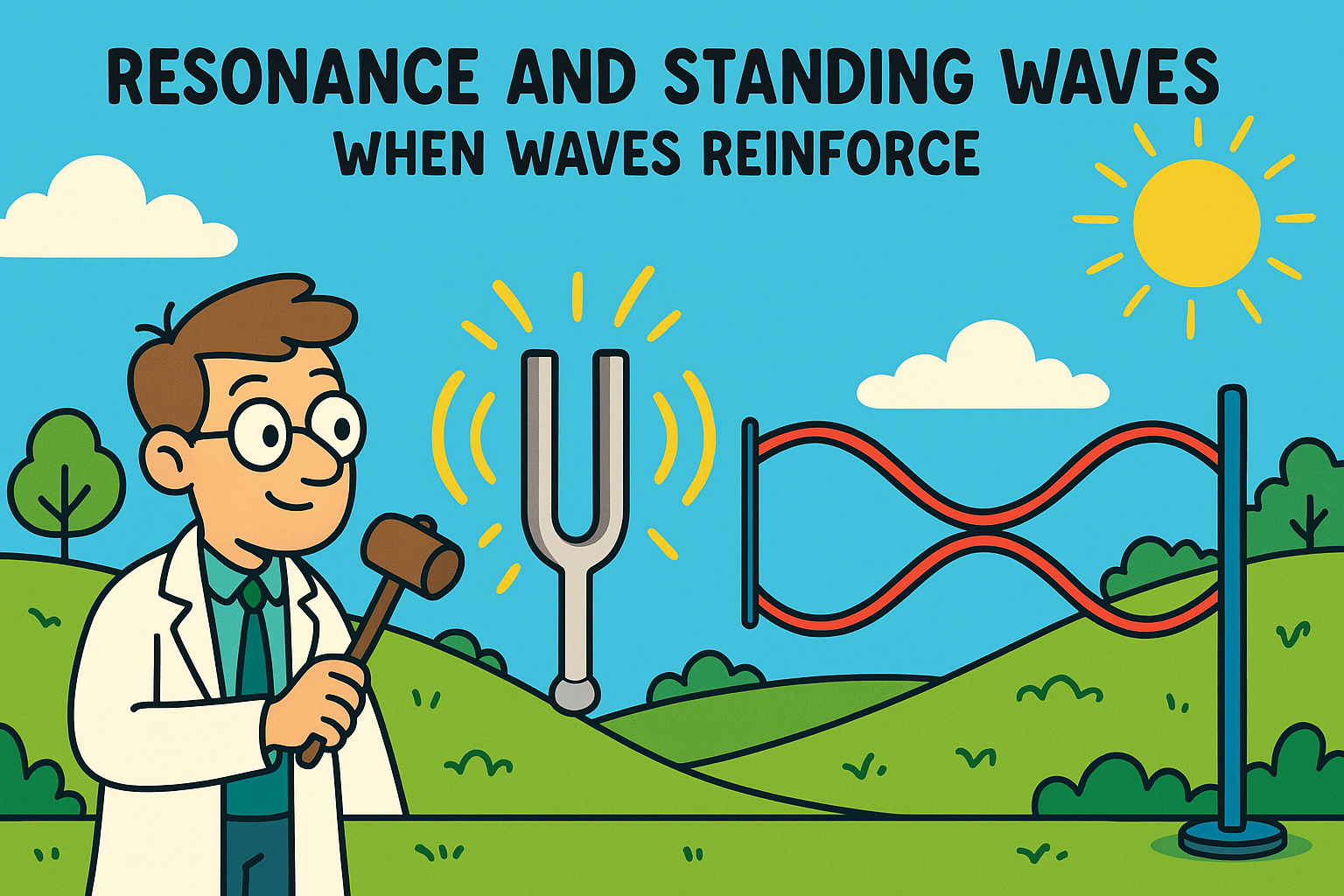
Resonance and Standing Waves: When Waves Reinforce (Q&A)
Q & A - Resonance and Standing Waves: When Waves Reinforce
Have you ever wondered why swings go higher when pushed at just the right time? Or how certain notes on a guitar seem to “ring” louder than others? This Parent Q&A sheet is here to help you explain how waves behave in everyday life through the science of resonance and standing waves.
This topic explores what happens when vibrations (tiny movements) match up perfectly and strengthen each other. You’ll discover why it matters in music, buildings, bridges—even your microwave! The answers below are written in simple, easy-to-use language to help you talk things through with your child, no matter their age or science background.
You don’t need to be an expert. I’ve made sure these explanations work at home without needing school-style lessons or fancy equipment. And if you’d like to take it further, we’ve also got a full lesson plan to go along with this Parent Q&A sheet—perfect for diving a bit deeper into the science of waves.
This topic is part of our Info Zone collection. You can read the full topic, once logged in, here: Resonance and Standing Waves: When Waves Reinforce
You’ll also find a full Lesson Plan and a handy Parent Q & A sheet, for this topic, ready to use..
| Resonance and Standing Waves: When Waves Reinforce | |
|---|---|
| Tip for Parents | Use these questions to chat with your child about what they've learned. Ask them to explain ideas in their own words and link them to things they’ve seen or heard in everyday life. |
| 1. What does resonance mean? | Resonance happens when something vibrates at its favourite (natural) frequency because something else is vibrating near it at the same speed. It makes the movement stronger. |
| 2. Why do swings go higher when pushed at the right time? | You're adding energy at just the right moment—this matches the swing’s natural frequency, which causes resonance and makes the swing go higher. |
| 3. What is a standing wave? | A standing wave is a wave that looks like it's not moving. It forms when two waves bounce back and forth and overlap, creating still spots (nodes) and moving spots (antinodes). |
| 4. Where can I see a standing wave at home? | Try shaking a skipping rope or string tied to a doorknob. If you get the timing right, the wave will stay in one place—this shows *how waves behave* when they reinforce each other. |
| 5. What is a node and an antinode? | A node is a point that stays still in a standing wave. An antinode is the part that moves the most. They're key to understanding standing wave patterns. |
| 6. How does this link to sound? | Sound travels in waves. When those waves bounce around in a tube or a room and line up just right, they create resonance and make the sound louder or clearer. |
| 7. Can resonance ever be dangerous? | Yes. If a building or bridge vibrates at its natural frequency during a storm or earthquake, resonance can cause it to shake too much—and even collapse. |
| 8. What is natural frequency? | It’s the speed at which something naturally vibrates when it's bumped, struck, or moved. Everything has one—from a glass to a skyscraper! |
| 9. Why do some glass cups break from loud singing? | If a note matches the glass’s natural frequency, the sound waves create strong resonance. If the vibration is big enough, the glass might shatter. |
| 10. What are harmonics in wave motion? | Harmonics are patterns of standing waves. The basic one is simple, but more complex ones form richer sounds. Musicians use these to tune instruments. |
| 11. Why do engineers care about *how waves behave*? | They need to design buildings and machines that won't break when exposed to certain vibrations. Understanding resonance helps them keep things safe. |
| 12. How does this connect to musical instruments? | Instruments use standing waves to make sound. A guitar string vibrates in specific patterns, and those waves create notes we hear. |
| 13. Can you see sound waves? | Not directly—but you can see their effects. Try sprinkling rice on a drum and tapping it. The rice bounces in patterns made by sound vibrations. |
| 14. Why does a longer tube make a deeper sound? | Because longer tubes create slower vibrations. This lowers the frequency, which makes the sound deeper. That’s wave behaviour in action. |
| 15. What's the link between microwaves and resonance? | Microwaves work by making water molecules vibrate at their natural frequency. This creates heat and cooks your food. |
| 16. Why does this science matter in daily life? | It helps us understand music, tech, safety, and even speech. *How waves behave* affects everything from car design to phone speakers. |
| Extra Conversation Ideas |
|