Quantum Superposition Made Easy: The Strangest Idea in Physics
Lesson Plan - Quantum Superposition Made Easy: The Strangest Idea in Physics
This lesson plan introduces the mind-bending idea of quantum superposition — the concept that tiny particles can exist in more than one state at once. You and your child will explore how this strange behaviour is not just science fiction, but a real part of quantum physics. It’s an opportunity to dive into one of the most fascinating ideas in modern science, even without needing a physics background.
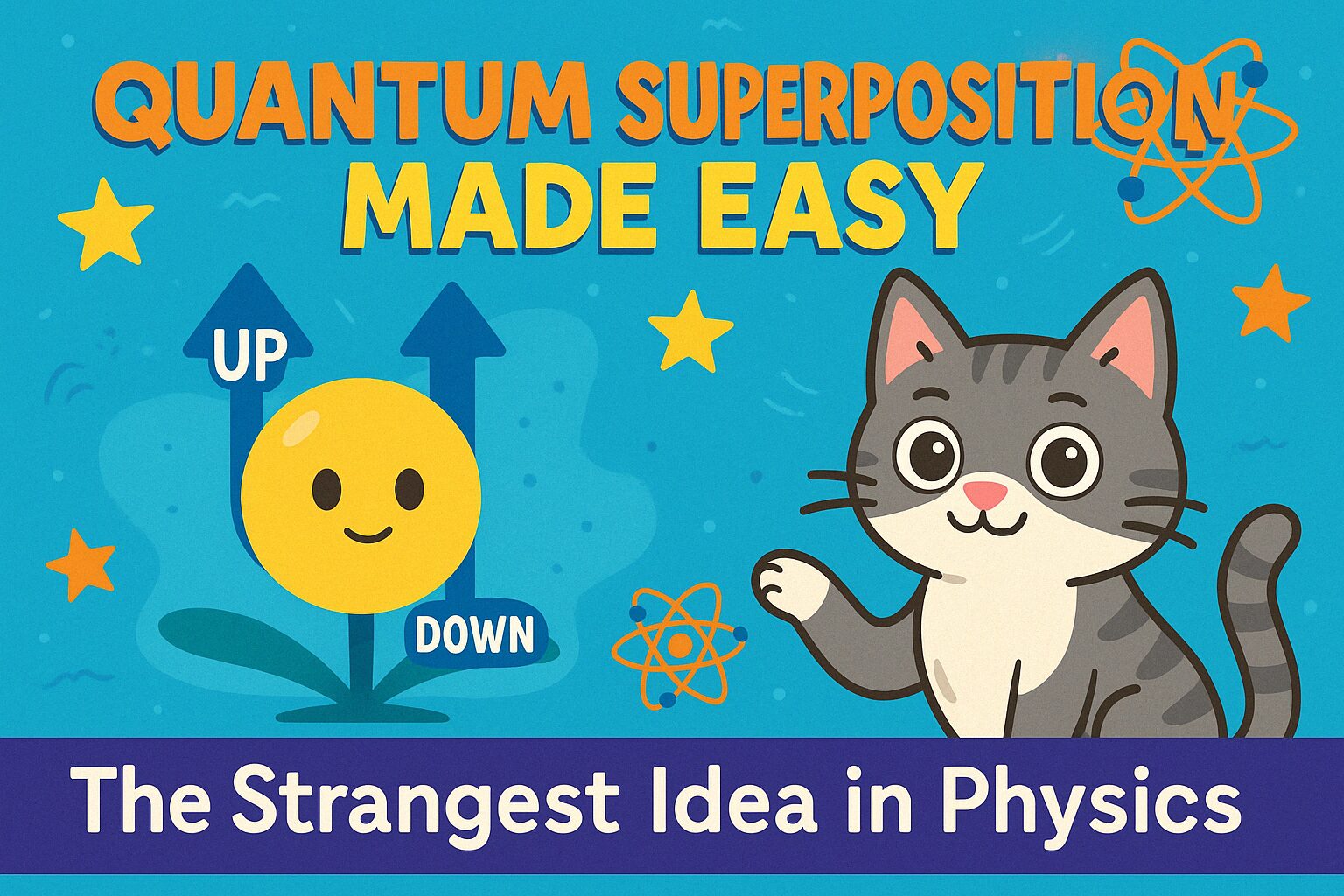
The quantum superposition lesson plan is designed for parents supporting home education, making complex science topics simple and engaging. You’ll guide your child through thought experiments like Schrödinger’s cat and practical examples from real-world research. Along the way, you’ll build critical thinking skills and spark deep curiosity about how the universe works.
We’ve broken the content down into manageable sections so you can explore it at your own pace. There’s no pressure to understand everything straight away — just a chance to learn something truly astonishing together. If you’re ready to explore the frontier of science from your kitchen table, this quantum superposition lesson plan is a great place to begin.
This topic is part of our Info Zone collection. You can read the full topic, once logged in, here: Quantum Superposition Made Easy: The Strangest Idea in Physics
You’ll also find a full Lesson Plan and a handy Parent Q & A sheet, for this topic, ready to use..
[cl_logged_in]
[br][br]
Quantum Superposition Made Easy
This lesson plan is designed to help you support your child with this topic: Quantum Superposition Made Easy: The Strangest Idea in Physics
[br][br]
Learning Objectives (What You’ll Learn Today)
- Understand what quantum superposition means in simple terms
- Explore how quantum particles behave differently from everyday objects
- Discuss the famous Schrödinger’s cat experiment
- Discover why quantum physics challenges our view of reality
[br][br]
Estimated Time
45–60 minutes depending on the pace and discussion time
[br][br]
Let’s Get Started
Ask your child: If you flipped a coin but didn’t look at it, could it be both heads and tails at the same time? Why or why not?
[br][br]
The Main Lesson
1. What Is Quantum Superposition?
Quantum superposition means that particles like electrons can exist in multiple quantum states at the same time. It’s not something we see in daily life, but it’s been proven through experiments. The idea is a big part of quantum physics, and it’s one reason the quantum world feels so strange.
This behaviour only changes when we measure or observe the particle. Before that, all possible outcomes exist at once — like being in two places at the same time. It’s not just theory either — it’s been tested using photons, electrons, and even small molecules.
Mini-Task: Ask your child to describe how this compares to flipping a coin and not looking at the result.[br][br]
2. The Schrödinger’s Cat Thought Experiment
One of the best-known ways to picture superposition is through Schrödinger’s cat. In this imagined setup, a cat in a box is linked to a quantum particle that might or might not decay. If it decays, poison is released, and the cat dies. If it doesn’t, the cat lives.
Until the box is opened, the cat is in a quantum superposition — both alive and dead. It’s a strange thought, but it helps us explore the role of observation. Once we look, the superposition ends and we get just one result.
Mini-Task: Let your child explain whether they think the cat is really both alive and dead before the box is opened.[br][br]
3. Particles or Waves?
Quantum particles don’t act like tiny marbles — they behave more like waves. In fact, they can even interfere with themselves. In a famous experiment, electrons created a pattern like waves on water when fired through two slits, even one at a time.
This happens because the electron is in a superposition — it travels through both slits at once until measured. The act of watching collapses the wave pattern. This shows how quantum superposition and observation are closely linked.
Mini-Task: Have your child draw how a wave might go through two gaps and explain why that’s different from a tennis ball.[br][br]
4. Why Observation Matters
In quantum mechanics, observing something isn’t just about looking — it’s an interaction that changes the outcome. Before we observe, a particle’s position, speed, or state is spread out. After observation, we get a single result. The rest disappear.
That means what we choose to measure shapes what we see. This is why many scientists say quantum physics isn’t just about particles — it’s also about knowledge and probability.
Mini-Task: Ask your child: What do you think happens when we don’t measure something? Can it still be real?[br][br]
5. What Makes This Useful?
Superposition isn’t just a weird idea — it’s powering new technologies. Quantum computers use it to do many calculations at once, making them faster for certain problems. These computers use qubits, which are like regular bits but can be both 0 and 1 at the same time.
Understanding how superposition works could help us build better tech in the future — from super-fast computers to secure communication systems that can’t be hacked. It all starts with knowing how particles behave in the quantum world.
Mini-Task: Ask your child to explain how a quantum computer might use superposition to work faster than a normal computer.[br][br]
Think and Discuss
- Do you think quantum particles choose what to be when we look?
- What’s the difference between how a tennis ball and an electron move?
- If you could build a quantum computer, what would you use it for?
[br][br]
Wrap-Up Summary
Quantum superposition shows us that the smallest parts of nature behave in surprising ways. It helps scientists build new technologies and rethink what we know about reality.
[br][br]
Quiz
- What does quantum superposition mean?
- Who imagined the famous cat in a box?
- True or false: A quantum particle can be in two states at once.
- What collapses a particle’s wave function?
- How does quantum computing use superposition?
- What kind of pattern does an electron make in a double-slit experiment?
- What is a qubit?
- True or false: Observation changes nothing in quantum physics.
- What’s one real use of quantum superposition?
- Why is quantum superposition considered strange?
Answers: 1. A particle can be in multiple states; 2. Erwin Schrödinger; 3. True; 4. Measurement/observation; 5. It allows calculations on many possibilities; 6. Interference pattern; 7. A quantum version of a bit; 8. False; 9. Quantum computing; 10. It doesn’t follow classical rules
Short Essay Prompt
Write a short essay, say 3 paragraphs explaining how quantum superposition is different from how things work in our everyday world. Use at least one example from the lesson plan and one new idea of your own.
[br][br]
Extra Learning
Extra Learning: Try acting out Schrödinger’s cat at home using a cardboard box, a cuddly toy, and two cards marked “alive” and “dead.” Let your child decide how they’d explain the experiment to a friend or sibling.
[br][br]
Final Reflection (What Did You Learn?)
Talk to your child about how learning this topic changed the way they think about how the universe works. What did they find most surprising or confusing?
[br][br]
[/cl_logged_in]
[cl_logged_out]
Members Only
You need to be registered and logged in to access this lesson plan and all other learning resources, games and quizzes.
[/cl_logged_out]