Hello Alan Lloyd - Your Scores - Logout

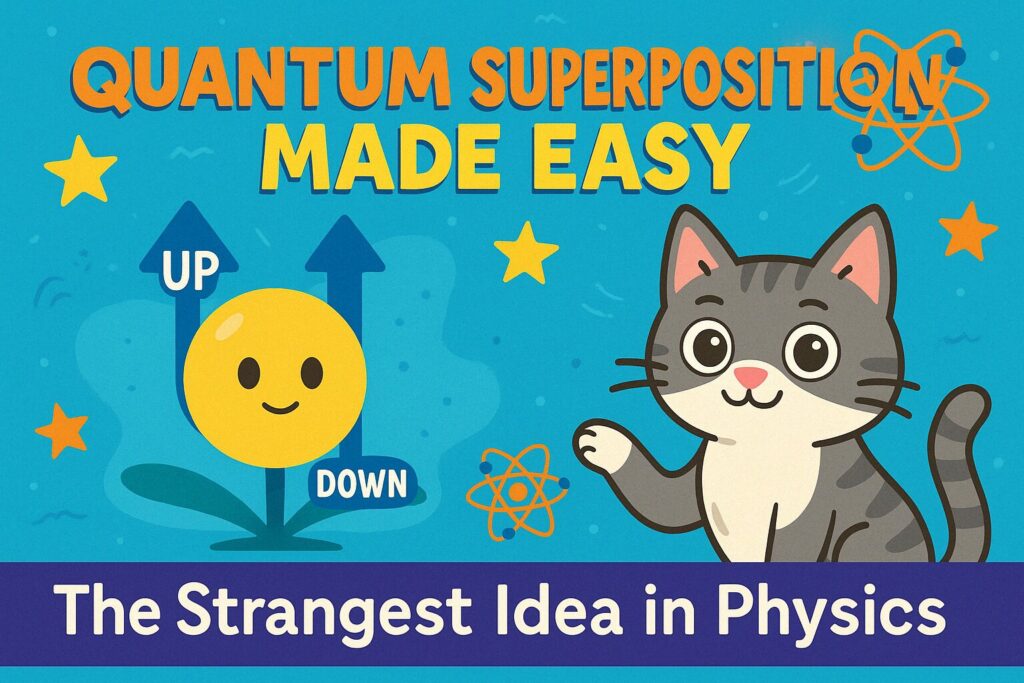
Quantum Superposition Made Easy: The Strangest Idea in Physics

Quantum Superposition Made Easy: The Strangest Idea in Physics

Have you ever wondered how something can be in two places at once? That’s exactly the kind of mind-bending idea we explore when we talk about quantum superposition. This strange but real phenomenon is part of quantum physics and helps explain how the tiniest particles in the universe behave. One of the most famous examples? The thought experiment known as Schrödinger’s cat.

Quantum Superposition Made Easy: The Strangest Idea in Physics
By Alan Lloyd

Quantum physics is full of surprises. Unlike everyday objects, quantum particles don’t have just one position or state until we measure them. Instead, they exist in a blend of possibilities. Scientists call this the superposition principle. It’s not magic — it’s just how nature works at a really small scale.

In this topic, we’ll break down the key ideas behind quantum superposition. We’ll explore what it means, how it works, and why it’s one of the strangest — yet most important — parts of modern physics. So if you’re ready to question everything you thought you knew about reality, let’s dive in.


This topic is part of our Info Zone collection. You can read the full topic, once logged in, here: Quantum Superposition Made Easy: The Strangest Idea in Physics

You’ll also find a full Lesson Plan and a handy Parent Q & A sheet, for this topic, ready to use..

What Is Quantum Superposition?

Quantum superposition is a principle in quantum mechanics where a particle exists in all its possible states at once — until we observe or measure it. That sounds wild, doesn’t it? But this isn’t science fiction. It’s based on real experiments and is one of the foundations of modern physics.

Let’s break it down. Imagine flipping a coin. Before it lands, we say it’s either heads or tails. In the quantum world, a particle is both heads *and* tails at the same time until we check. That’s superposition. It describes how quantum particles can be in multiple quantum states simultaneously.

This idea is very different from classical physics, where things have defined positions and speeds. In contrast, quantum particles behave more like waves than solid balls. They spread out, interfere, and exist in a blend of outcomes.

Superposition applies to things like electrons, photons (light particles), and even atoms. When left alone, these particles explore every possible path. Only when we measure them does the wave collapse into one outcome.

This concept leads to some of the strangest behaviours in physics, including quantum interference and tunnelling. We’ll look at those soon — but first, let’s talk about a famous cat.


Schrödinger’s Cat Explained

Schrödinger’s cat is a famous thought experiment used to explain quantum superposition. It was proposed by Austrian physicist Erwin Schrödinger in 1935. He wanted to show how odd quantum rules seem when applied to everyday objects.

Here’s the idea: Imagine a cat inside a sealed box. In that box is a radioactive atom, a Geiger counter, and a vial of poison. If the atom decays, the counter triggers and releases the poison — killing the cat. If not, the cat stays alive.

But because the atom is in a quantum superposition of decayed and not decayed, the cat is also in a superposition — both alive and dead — until someone opens the box and checks. Weird, right?

Of course, this doesn’t mean real cats can be both alive and dead. Schrödinger’s point was to highlight how strange quantum rules sound when scaled up to large objects. Still, the experiment helps us understand how particles can exist in overlapping states.

It shows that observation (or measurement) plays a huge role in determining a particle’s state. Until we look, it remains undecided — a mix of all possibilities.


How Do Quantum States Work?

So what exactly is a quantum state? It’s a way of describing everything we know about a particle — like its position, energy, and spin. But in superposition, these aren’t fixed. Instead, they’re spread out across many values at once.

Think of a quantum state like a music chord. Just as a chord is made up of multiple notes, a quantum state combines different possibilities. The particle isn’t in one note — it’s in all of them together.

When we measure the particle, we “collapse” the chord into a single note. That’s the outcome we see. But before we measure it, all outcomes exist in a blend, described mathematically by a wave function.

This wave function gives us the probability of each result. But it doesn’t predict what will happen — only how likely each outcome is. This randomness is at the heart of quantum theory.

It’s like rolling a die, except the die is in a superposition of all six numbers until you look at it. Once you check, you get a definite answer — but until then, all outcomes are real.


Wave-Particle Duality

Superposition is closely tied to wave-particle duality. This idea says that particles like electrons and photons behave both like particles and like waves. And yes, they can do both at once.

In experiments like the double-slit test, a single electron can go through two slits at the same time — creating an interference pattern like a wave. That’s superposition in action. The particle explores all paths at once.

If you try to observe which slit it goes through, the interference disappears. The particle “chooses” a path. Observation collapses the superposition and gives you just one outcome.

This behaviour is totally different from how balls or bullets behave. It’s unique to the quantum world, where everything is fuzzy and full of possibility until we look.

Wave-particle duality shows us that the universe is much stranger than it looks — and that even light and matter don’t follow classical rules.


The Role of Measurement

One of the most puzzling parts of quantum mechanics is the role of measurement. Why does simply looking at something change its state?

When we measure a quantum system, we collapse its wave function into a single outcome. Before that, it exists in a blend of states. But measurement forces it to “decide.”

No one knows exactly why this happens. Some theories suggest the measuring device interacts with the particle and forces a result. Others think our knowledge itself plays a role.

This debate has led to different interpretations of quantum theory — like the Copenhagen interpretation (which says the wave function is real) and many-worlds (which says all outcomes happen, just in separate realities).

Either way, measurement is key to turning quantum fuzziness into solid outcomes. Without it, we’d never see a clear result.


Real-World Experiments

Quantum superposition isn’t just a theory. Scientists have tested it in real experiments. In fact, it’s been observed in particles as small as electrons and as large as molecules made of thousands of atoms.

One famous experiment involved sending electrons through a double slit. Even one at a time, they created interference — proving they were in superposition.

More recently, researchers created superpositions in tiny metal strips and even viruses. The goal? To push the limits and see how far superposition can go.

These studies help us understand where quantum rules end and classical physics begins. They also help build better quantum technologies — like sensors, microscopes, and computers.

Superposition isn’t just weird — it’s useful. And it’s driving some of the most exciting tech advances in the world today.


Superposition in Quantum Computing

One of the biggest uses of quantum superposition is in quantum computing. Unlike normal bits, which are either 0 or 1, quantum bits (qubits) can be both at once.

This means quantum computers can explore many possibilities at the same time. It’s like trying every password at once instead of one at a time.

By using superposition, quantum computers can solve problems much faster than classical ones. They’re especially good at tasks like searching databases, factoring huge numbers, and simulating molecules.

Superposition gives quantum computers their power. But it also makes them tricky to build. Qubits are delicate and can lose their superposition quickly unless carefully controlled.

Still, progress is being made. Quantum computing is no longer just an idea — it’s becoming reality, thanks to superposition.


What Superposition Isn’t

Before we go further, let’s clear up a common misunderstanding. Superposition doesn’t mean particles are literally in two places at once like magic. It means they’re in a state that includes all possibilities.

It’s not that an electron splits itself. Instead, its wave function stretches across multiple locations or energies. Until we measure, we can’t say where it actually is.

Superposition isn’t teleportation or duplication. It’s about probabilities — what might happen, not what definitely has happened.

It also doesn’t apply to large objects like chairs or people. At that scale, the effects are too tiny and collapse too quickly to notice.

So while the idea sounds wild, it’s grounded in solid science. Understanding what it is — and isn’t — helps us keep things clear.


Why It Matters

Quantum superposition isn’t just a curiosity. It has real effects on the world around us. It underpins technologies like lasers, MRI machines, and atomic clocks.

It also shapes how we understand reality itself. What does it mean that something can be undecided until we look? Are we part of the system we’re observing?

These questions don’t have simple answers, but they push science forward. Superposition is at the heart of quantum theory, and quantum theory is the most accurate model we’ve ever made of nature.

From photosynthesis in plants to reactions in stars, superposition is everywhere. Learning about it helps us understand how the universe works at its deepest level.

And it reminds us that the world is full of surprises — especially when we look closely.


Exploring the Strangest Idea

Quantum superposition may be the strangest idea in physics — but it’s also one of the most powerful. It challenges our everyday thinking and opens the door to new ways of seeing the universe.

By exploring this idea, you’re stepping into a world where particles are waves, reality is fuzzy, and nothing is fixed until it’s measured. And that world is real.

Physicists continue to test and explore superposition, building experiments that stretch what we know. Every new discovery helps us unlock more of the quantum puzzle.

So if your brain feels a bit scrambled — that’s okay. You’re not alone. Even Einstein struggled with quantum theory.

Keep asking questions. Keep exploring. That’s how science works — and it’s how we discover the truth about our strange and wonderful universe.


A Final Thought

Quantum superposition might sound confusing, but it’s a key part of how the universe behaves at the tiniest levels. The more we learn about it, the more we uncover the mysteries of nature.


Quick Quiz

  • What does quantum superposition mean?
  • Why is Schrödinger’s cat both alive and dead?
  • How does measurement affect a quantum particle?
  • What is wave-particle duality?
  • Why is superposition important in quantum computing?
Write your answers in the comment section below.

Related Wikipedia Links

If you want to explore this topic further, check out these helpful pages:


What Do You Think?

Does quantum superposition change how you think about reality? What questions do you still have about this strange but real idea?


Leave a comment


'; // Add header content for print html += '

Lenara Learning

Get more learning resources at www.lenara.uk

'; // Insert the worksheet content html += '
' + content + '
'; html += ''; printWindow.document.write(html); printWindow.document.close(); printWindow.focus(); // Trigger printing and auto-close the popup printWindow.print(); printWindow.onafterprint = function() { printWindow.close(); }; setTimeout(function() { printWindow.close(); }, 1500); }