
What’s Happening in Science in 2025? Top Discoveries
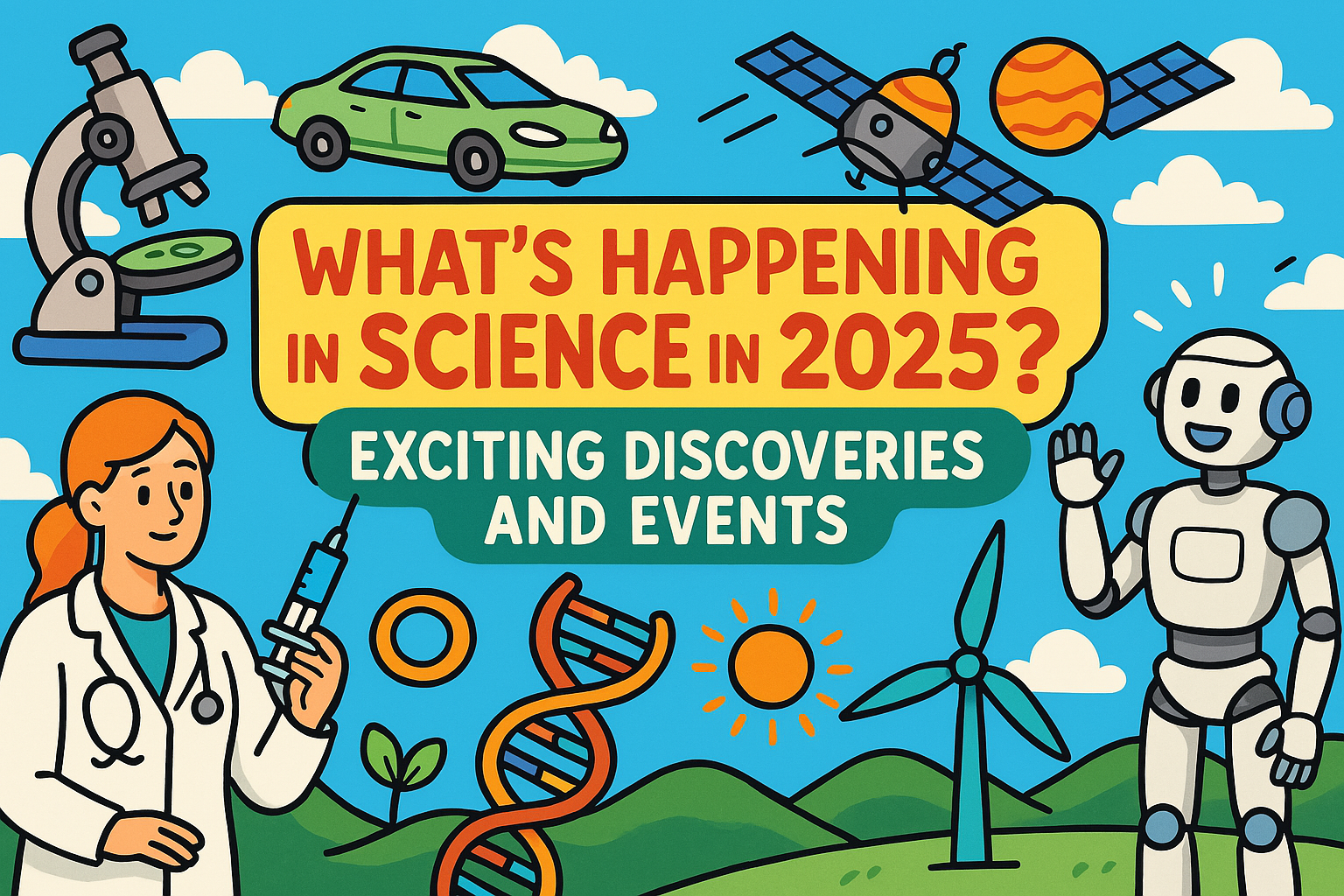
What’s Happening in Science in 2025? Exciting Discoveries and Events
What’s happening in science in 2025? A lot! This year is packed with amazing discoveries in medicine, space, the environment, and technology.
From astronauts heading to the Moon, to new vaccines and smart robots, science is changing our world faster than ever. If you’re curious about what scientists are doing right now, this article is your guide to the coolest breakthroughs of 2025.
This topic is part of our Info Zone collection. You can read the full topic, once logged in, here: What’s Happening in Science in 2025? Exciting Discoveries and Events
You’ll also find a full Lesson Plan and a handy Parent Q & A sheet, for this topic, ready to use..
What’s Happening in Science in 2025: A Year of Breakthroughs
The focus keyword appears right here because this section gives us an overview of what’s happening in science in 2025. Science is moving fast, and 2025 is shaping up to be a big year. From space missions to smart tech and health breakthroughs, scientists are pushing boundaries. Let’s take a closer look at each exciting area of discovery and what it might mean for us in the future.
What’s Happening in Vaccines and Health?
Scientists have developed new vaccines that protect against multiple variants of COVID-19 and seasonal flu in one shot. These are called “combo vaccines,” and they’re already being tested in several countries. The aim is to make yearly boosters easier and more effective. By using new mRNA technology, these vaccines can be updated quickly as new strains appear.
This approach could save lives and reduce the number of hospital visits each winter. The science behind it builds on the success of previous mRNA vaccines used during the pandemic. It’s a huge step forward in public health.
Researchers hope this tech could also be used for other viruses in the future, like RSV or even HIV.
What’s Happening in Space in 2025?
NASA’s Artemis II mission is one of the biggest space events of 2025. It’s the first crewed mission to the Moon in over 50 years. Although the astronauts won’t land just yet, they will orbit the Moon and test all systems for future lunar landings.
The spacecraft, called Orion, will carry four astronauts around the Moon and back. This journey will help us prepare for life on the Moon and, later, Mars. Artemis II is not just about exploration—it’s also about building long-term space habitats.
Science experiments on board will study how space affects the human body, especially during longer missions.
Artificial Intelligence: Friend, Not Foe
Artificial intelligence (AI) is becoming more powerful—but instead of taking jobs, it’s being used to support doctors, scientists, and teachers. In 2025, AI systems can now detect diseases in X-rays faster than some radiologists. AI is also being used to help design new medicines by predicting how different chemicals interact in the body.
In classrooms, AI tutors are supporting learning by giving instant feedback and helping students practise problem areas. Scientists say these tools should work *with* people, not replace them. The goal is to use AI to boost human creativity and decision-making.
How Science Is Fighting Climate Change
What’s happening in science in 2025 when it comes to climate? Loads! New inventions are helping to clean the air and save energy. Carbon-capture machines are now being installed in cities to suck CO₂ from the air and store it underground safely. These machines work like giant air filters.
Scientists have also improved solar panels to make them cheaper and more efficient. Some solar panels now work even on cloudy days! Other exciting developments include algae farms that turn sunlight into fuel and electric planes for short trips.
Can We Predict Earthquakes?
Researchers are making progress in predicting earthquakes. In 2025, a network of sensors and satellites is being tested that can spot early signals of shifting tectonic plates. This could give people a few minutes—or even hours—of warning before a quake hits.
These systems use deep-sea sensors, ground monitors, and AI to spot patterns. Although we can’t stop earthquakes, this science could save thousands of lives by helping people evacuate or prepare.
Building Human Organs in the Lab
In medical science, 2025 is the year lab-grown organs are getting closer to real use. Using 3D bioprinting, scientists can now build parts of kidneys and livers. These aren’t full organs yet, but they’re being tested to help people waiting for transplants.
These printed tissues are made from a patient’s own cells, so the body is less likely to reject them. The future goal is to print entire organs—heart, lungs, and more. This could completely change organ donation in the future.
Can Bacteria Eat Our Rubbish?
What if bacteria could clean up our rubbish? In 2025, scientists have developed new bacteria that can break down plastics in a matter of weeks instead of hundreds of years. These microbes are found in compost heaps and hot springs and have been modified to speed up plastic-eating power.
This discovery is being used in recycling plants to deal with things like bottles, packaging, and fishing nets. The aim is to reduce ocean and land waste using natural science.
What the James Webb Telescope Found
The James Webb Space Telescope continues to send back amazing pictures in 2025. It has spotted the oldest galaxies ever seen—some formed just 300 million years after the Big Bang! Scientists are using these images to learn how the universe began and how stars and planets formed.
Another exciting mission is the European Space Agency’s JUICE mission to Jupiter’s moons. It is exploring Ganymede, Callisto, and Europa to find signs of water—and maybe life!
Robot Helpers Are Getting Smarter
In Japan and Europe, robot helpers are now being tested in care homes. These robots can remind people to take medicine, help carry things, and even hold a conversation. They’re built to be friendly and supportive, not scary or bossy.
They use cameras and AI to recognise faces and understand voice commands. Scientists hope that these bots will support nurses and carers, especially as more people live longer lives.
Making Water Out of Thin Air
Access to clean water is still a big challenge in many parts of the world. That’s why scientists in 2025 have invented machines that pull water straight from the air—even in deserts! These devices use solar energy to trap moisture and turn it into drinkable water.
They’re already being used in remote villages and emergency zones. This technology could save lives during droughts or natural disasters, and it’s completely eco-friendly.
What Do You Remember?
- What is the name of NASA’s Moon mission in 2025?
- How are AI systems helping doctors and students?
- What do carbon-capture machines do?
- Which telescope is finding the oldest galaxies?
- How are scientists using bacteria to help the environment?
Write your answers in the comment section below.
Related Topics
If you enjoyed learning about what’s happening in science in 2025, you might also like to explore topics such as space exploration, environmental science, and robotics. These subjects help us understand how science shapes our future and what incredible things may come next.
What Do You Think?
If you found this to be an interesting topic, why not have your say. Or if you can think of ways we could improve it. We would love to know what you learned and more importantly, what you think. So now is your chance, use the comments section below to let us know your thoughts.