
Heisenberg’s Uncertainty Principle: The Limits of Knowing
Heisenberg's Uncertainty Principle: The Limits of Knowing
Have you ever tried to follow a fast-moving object with your eyes? Like a buzzing fly or a bouncing ball? Sometimes, the faster it moves, the harder it is to tell exactly where it is. Now imagine trying to track something a million times smaller than a speck of dust – like an electron! That’s where Heisenberg’s Uncertainty Principle comes in.
This scientific idea says there’s a limit to how much we can know about tiny particles. You can measure where a particle is or how fast it’s going – but not both at the same time, not exactly. It’s like nature’s way of keeping secrets! In this article, we’ll explore what this means, why it matters in quantum physics, and how it completely changed science. So if you’re ready to learn why scientists can’t always be sure – let’s dive into the world of uncertainty!
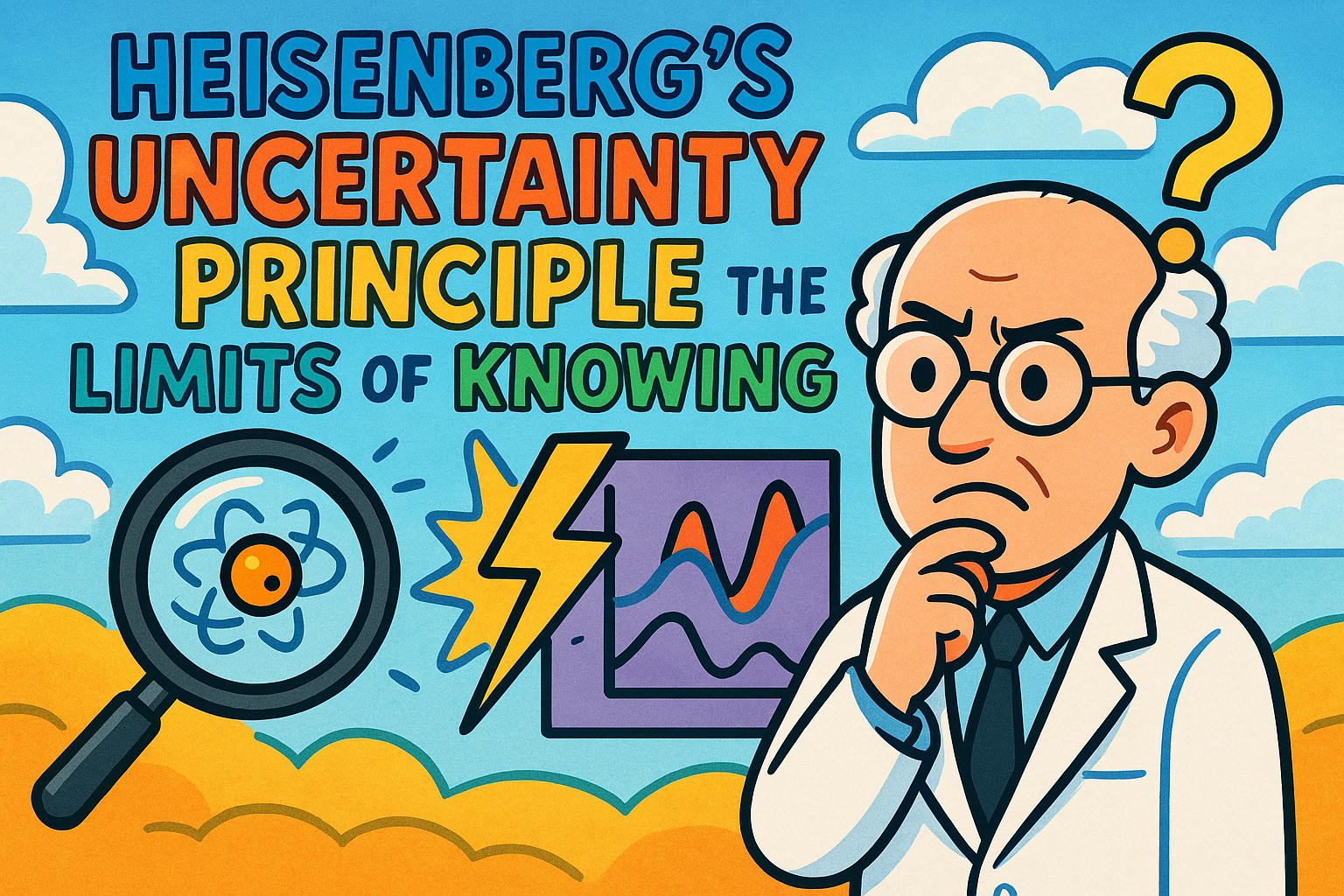
This topic is part of our Info Zone collection. You can read the full topic, once logged in, here: Heisenberg’s Uncertainty Principle: The Limits of Knowing
You’ll also find a full Lesson Plan and a handy Parent Q & A sheet, for this topic, ready to use..
What Is Heisenberg’s Uncertainty Principle?
Have you ever tried to track a firefly at night? It zips around, and just when you think you’ve found it, it moves again. That’s a bit like what scientists face when studying tiny particles like electrons. Heisenberg’s Uncertainty Principle says we can’t know both the exact position and the exact momentum of a particle at the same time.
This idea comes from a scientist named Werner Heisenberg, who came up with it in 1927. It shook up how people understood science. Before this, scientists believed everything could be measured and predicted. But this principle showed that, at the quantum level, some things are just unknowable.
The uncertainty isn’t because of bad equipment or mistakes. It’s built into nature itself. The more precisely we know a particle’s momentum, the less we know about where it is. And the more we know about its location, the fuzzier its momentum becomes.
Heisenberg’s idea isn’t just about physics – it’s about knowledge itself. It tells us there are limits to what we can know, even with perfect tools. That’s a pretty wild thought, right?
Let’s dig deeper into this weird world where particles behave like waves and certainty just isn’t possible.
Who Was Werner Heisenberg?
Werner Heisenberg was a German physicist born in 1901. He’s one of the most important scientists in the history of physics. In his twenties, he helped create quantum mechanics – the science of very, very tiny things like atoms and electrons.
Heisenberg wasn’t afraid to ask difficult questions. He noticed that the way we look at tiny particles affects what we see. That led to his famous idea: the Heisenberg Uncertainty Principle.
Heisenberg won the Nobel Prize in Physics in 1932 for his work. His ideas changed how scientists understand the universe. And they’re still part of every modern physics course today.
Fun fact – he was also part of Germany’s nuclear research program during World War II. Historians debate whether the program’s lack of progress was due to technical challenges, resource limitations, or deliberate actions by the scientists involved. The full story remains a subject of historical discussion.
So, Heisenberg wasn’t just smart – he was a game-changer in how we think about reality.
What Does “Uncertainty” Mean in Science?
In everyday life, “uncertainty” usually means you’re not sure about something. Like, “I’m uncertain if it’s going to rain.” But in quantum physics, it has a very special meaning.
Heisenberg’s uncertainty isn’t about guessing or bad data. It’s about limits built into nature. According to quantum theory, some things just can’t be known exactly at the same time – no matter how hard we try.
The most famous example? You can’t know both the position and momentum (which means mass times velocity) of a particle perfectly. This is not a problem with our measuring tools – it’s a fundamental principle of physics itself.
Think of it like a seesaw. If one side goes down (like knowing position really well), the other side (momentum) goes up in uncertainty. It’s a trade-off. You gain one, you lose the other.
This has huge effects on science, especially when we look at atoms, molecules, and light. It shows us that reality is a bit fuzzier than we used to think.
Why Can’t We Measure Everything?
Let’s say you want to find out where an electron is. To see it, you might shine light on it. But light is made of photons – tiny bits of energy. When a photon hits the electron, it transfers energy and momentum, changing the electron’s state!
This means just trying to measure the electron changes what it’s doing. The better you try to see it, the more you disturb it. It’s like trying to watch a soap bubble with a water hose – you’ll pop it before you ever get a good look.
This is related to the uncertainty principle, but it’s actually a separate concept called the observer effect. Heisenberg’s uncertainty principle is more fundamental – it would exist even with perfect, non-disturbing measurements. It’s a property of the wave nature of quantum objects themselves.
That’s weird, right? But it’s true. Scientists have tested this again and again, and Heisenberg’s idea always holds up.
The relationship between measurement disturbance and fundamental uncertainty was something Heisenberg himself initially conflated, but modern quantum mechanics makes a clearer distinction between these concepts.
How Does This Affect the Real World?
You might be thinking, “OK, but how does this affect my life?” Fair question! Most of the time, it doesn’t. The uncertainty principle mostly affects things that are really, really small.
In your daily life, you don’t notice this uncertainty. A football, a pencil, or even a grain of sand is way too big for these quantum effects to matter.
But in science, it’s a big deal. It affects how lasers work, how computers run, and even explains why atoms don’t collapse (electrons can’t be precisely located at the nucleus). Modern technology, like scanning tunnelling microscopes, semiconductor devices, and quantum cryptography, depends on quantum mechanics.
Plus, quantum uncertainty is a key part of the future – like quantum computers. These specialized machines use quantum properties to solve certain problems regular computers can’t handle efficiently.
So, while you might not see it directly, quantum uncertainty is part of many things around you.
What Are Particles Doing When We’re Not Looking?
This is one of the biggest mysteries of quantum theory. If we can’t know a particle’s exact position and momentum, then what is it doing when we’re not looking?
One interpretation says it’s in a state of multiple possibilities at once! Until you observe it, a particle exists in a superposition of states – described by a wave function that gives probabilities for different outcomes. Only when you measure it does this wave function “collapse” to a specific state.
This idea was illustrated in the famous Schrödinger’s Cat thought experiment. A cat in a box could be considered both alive and dead – until you look inside. It sounds absurd for everyday objects, but it demonstrates how counterintuitive quantum behaviour can be.
It’s important to note that there are multiple interpretations of quantum mechanics, including the Copenhagen interpretation, Many-Worlds interpretation, and others, that try to explain what’s “really” happening.
Mind-blowing, right? But that’s the nature of reality at the tiniest scale.
What Is the Uncertainty Formula?
Heisenberg didn’t just guess all this. He gave us a real formula to explain it. It looks like this:
Δx × Δp ≥ ħ/2
That’s a bit of math, so let’s break it down. Δx means “uncertainty in position.” Δp means “uncertainty in momentum.” The symbol “ħ” (h-bar) is the reduced Planck’s constant – a fundamental constant in quantum physics equal to h/2π.
This formula says the product of the two uncertainties has to be greater than or equal to ħ/2. You can’t shrink both uncertainties down to zero. It’s like trying to flatten both sides of a balloon at the same time – one side always puffs up!
This formula helps scientists understand just how “fuzzy” the quantum world can get. It’s simple, powerful, and completely changes how we study the universe.
A Final Thought
Heisenberg’s Uncertainty Principle teaches us something powerful – the universe is not always black and white. Sometimes, it’s probabilistic, wave-like, and inherently uncertain. That’s not a failure. It’s just how the world works on a tiny scale.
Instead of fearing uncertainty, scientists embrace it. They work with it, study it, and even build new inventions around it. It’s part of the mystery and magic of science!
What Do You Remember?
- What does Heisenberg’s Uncertainty Principle actually say?
- Why can’t we know a particle’s momentum and position exactly?
- What happens when we try to observe an electron?
- What is a superposition in quantum theory?
- Can you name one modern invention that uses quantum physics?
Write your answers in the comment section below
Related Wikipedia Links
Want to keep exploring quantum physics and its strange rules?
What Do You Think?
Does the idea of uncertainty make the universe more interesting or more confusing? How would you feel if you knew some things could never be known for sure? Share your thoughts in the comments!