
Double-Slit Experiment Explained: What It Reveals About Reality
Double-Slit Experiment Explained: What It Reveals About Reality
Imagine shining a torch through two small slits cut into a piece of card. You’d expect two neat lines of light on the wall behind, right? But when scientists did this with tiny particles like electrons, they got something completely unexpected. Instead of acting like little balls, the electrons created patterns like ripples in water. That strange pattern became one of the most important discoveries in science.
This is the story of the double-slit experiment explained in the simplest way possible. It’s a mystery that puzzled even the smartest minds, like Albert Einstein. Get ready to dive into the weird world of quantum physics, where particles behave like waves, and observing something might actually change what happens.
This topic is part of our Info Zone collection. You can read the full topic, once logged in, here: Double-Slit Experiment Explained: What It Reveals About Reality
You’ll also find a full Lesson Plan and a handy Parent Q & A sheet, for this topic, ready to use..
What Is the Double-Slit Experiment?
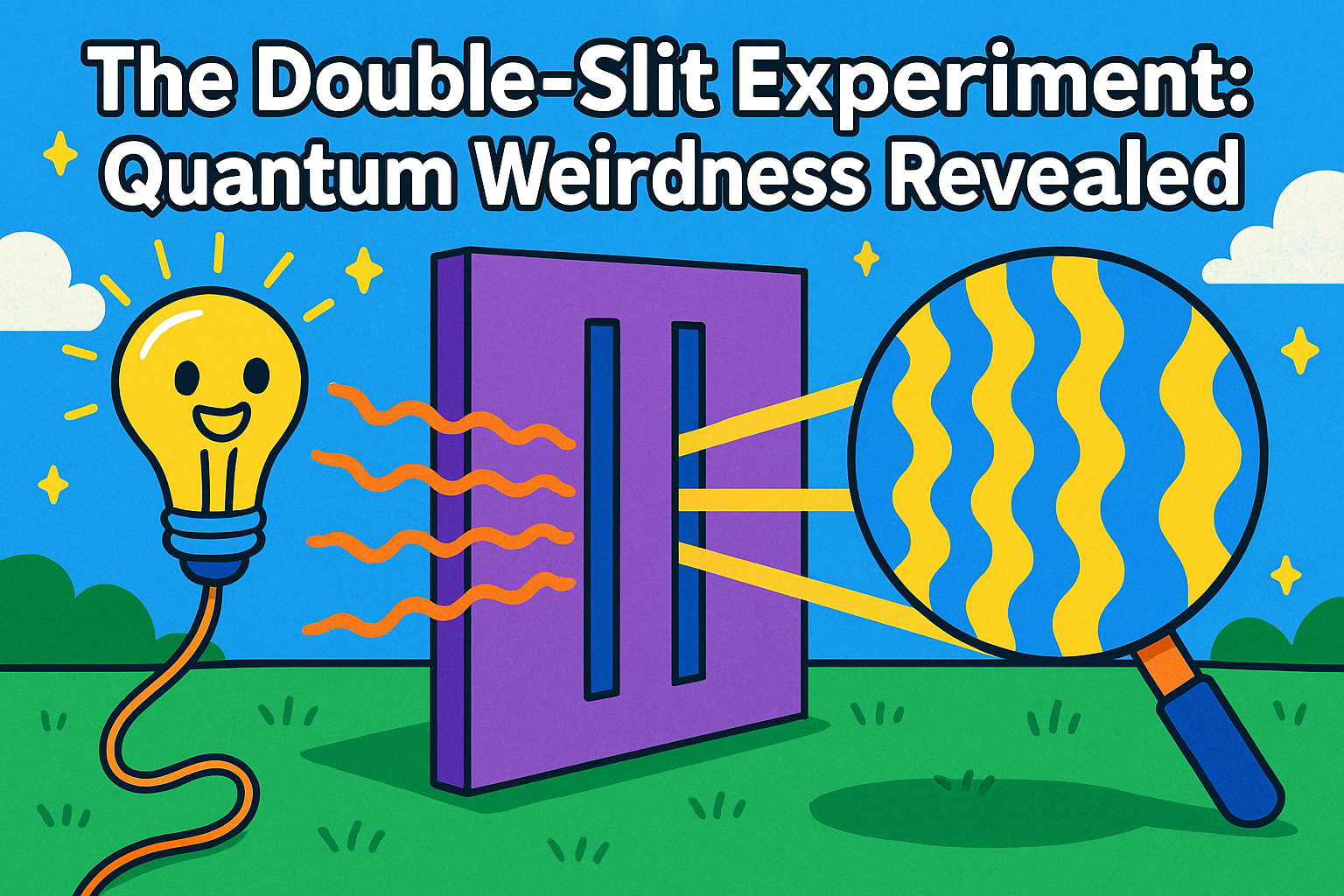
The double-slit experiment explained simply is like this: imagine a wall with two narrow openings (called slits) and a screen behind it. When scientists fire particles like electrons or even light towards the slits, they don’t just make two bright spots. Instead, they form a striped pattern, like waves interfering with each other.
Why is this strange? Because particles are meant to be solid things – they shouldn’t create patterns like waves do. This experiment showed that particles can act like waves. Even weirder, when you try to watch which slit they go through, the pattern disappears, and they behave like normal particles again!
It’s not magic, but it sure feels like it. This experiment revealed something odd: the simple act of measuring or observing changes what happens. That idea shook the world of physics and helped build the field called quantum mechanics.
We’ll break it all down, step-by-step, so it’s easy to follow. And by the end, you might be asking the same question scientists still ask: what really *is* a particle?
This experiment is more than just cool science—it opens the door to a reality that’s far stranger than fiction.
Setting Up the Experiment
To understand the double-slit experiment explained clearly, let’s start with the basics. You need a particle emitter (something that shoots tiny particles like electrons), a barrier with two slits in it, and a screen to catch whatever goes through.
If you block one slit, you get a single spot on the screen behind it. That makes sense. Now open both slits and fire particles again. You don’t get two spots. You get multiple lines, like a bar code. This is called an interference pattern. Waves create this kind of pattern, not particles.
Even stranger, if you fire one particle at a time, the same pattern still appears over time. That means each particle seems to “know” about the other slit. How can that be? It’s like the particle splits and goes through both slits at once—then recombines and creates a wave pattern.
That’s why scientists say the particle behaves like a wave until it’s observed. We’ll look at what that means next, but for now, just remember: no one expected particles to act this way.
And yes, this really works. It’s been repeated hundreds of times in real labs around the world.
Wave or Particle? Why Not Both?
In everyday life, we think things are either particles (like balls) or waves (like water ripples). The double-slit experiment explained why that idea doesn’t always work. Tiny things like electrons and photons can act like both, depending on the situation.
This is called *wave-particle duality*. It’s a fancy way of saying: “We don’t know if it’s a wave or a particle… because it’s both.” Scientists had to invent new rules—quantum rules—to deal with this.
When no one is watching, particles behave like waves. They explore all paths and create interference patterns. But the moment you try to measure where the particle goes, it “chooses” a path and the wave-like behaviour vanishes.
It’s like the universe doesn’t make up its mind until you look. Which is pretty weird, right? It makes us rethink what reality even means.
This is why quantum physics is sometimes called “spooky” or “mind-bending.” But don’t worry—we’ll keep it simple as we go.
The Role of the Observer
Here’s where things get even stranger. If you add a detector to see which slit the particle goes through, the interference pattern disappears. Just by watching, you change the result!
This idea shocked the science world. It means that observation isn’t passive. It has power. The universe behaves one way if you don’t look and a different way if you do. It’s as if the particle decides what it is based on what you want to see.
This doesn’t mean your eyes change reality, but it shows that measurement and interaction affect tiny systems. The act of observing collapses the wave into a particle. This is called *wave function collapse*, and yes, it’s real physics—not science fiction.
Think of it like a magic trick that only works when no one’s watching. When the spotlight turns on, the magic disappears.
We’ll explore what this means for big questions like free will, consciousness, and the nature of time later on.
Quantum Mechanics: Rules of the Small
To make sense of all this, scientists developed quantum mechanics. It’s the science of the very small—atoms, electrons, and other tiny particles.
Quantum mechanics accepts that particles act like waves. It uses maths called probability to predict what might happen, not what will happen. That’s a big shift from regular physics, which deals in facts and formulas.
In quantum mechanics, you can only predict the chances of where a particle might be. It’s like guessing where a bird will fly next—but with maths.
The double-slit experiment explained why we need quantum rules. Classical physics couldn’t explain the interference pattern. Only quantum thinking could do that.
And here’s the twist: quantum rules are super accurate. They’re used in things like computers, lasers, and even GPS. So even if they sound weird, they work.
A Final Thought
The double-slit experiment explained a mystery that still puzzles scientists today. It shows us that the universe doesn’t behave the way we think it should. Things can be two things at once. Observing something can change it. And reality, at its core, is full of surprises.
You don’t need to be a scientist to ask big questions. This experiment invites us all to wonder, explore, and imagine new ways of thinking.
So next time you shine a torch, just remember: light is playing by rules that are far stranger than they seem.
What Do You Remember?
- What is wave-particle duality, and why is it important?
- How does the interference pattern form in the double-slit experiment?
- What happens when a detector is added to observe the slits?
- Why do scientists say that observation changes reality?
- What is quantum mechanics, and how is it different from classical physics?
Write your answers in the comment section below.
Related Wikipedia Links
If you’d like to explore more about quantum physics and famous experiments, check out these:
What Do You Think?
Do you think reality is only real when we look at it? Can science ever fully explain these mysteries? Share your ideas below!