What Are Prime Numbers? – A Complete Guide
What Are Prime Numbers? - A Complete Guide
Prime numbers are special numbers that can only be divided exactly by 1 and themselves. They’re important in maths because they help build all other numbers. They’re used in things like coding, security, and solving puzzles. Once you understand them, you’ll spot them everywhere.
What Is a Prime Number?
A prime number is a number that has exactly two factors: one and itself. That means you can only divide it evenly by 1 and the number itself without getting a decimal or remainder. For example, 7 is a prime because nothing divides into it except 1 and 7.
On the other hand, 6 is not a prime because 2 and 3 also divide into it. The number 1 is not a prime, and neither is 0. Even the number 2 is a bit special—it’s the only even prime number. That’s because all other even numbers can be divided by 2, which adds a third factor and kicks them out of the prime club!
How Are Prime Numbers Different from Other Numbers?
Prime numbers are quite different from most numbers we use every day. Most numbers are what we call composite—they have lots of factors. For example, 12 can be divided by 1, 2, 3, 4, 6, and 12.
But a prime number is clean and simple. It doesn’t like sharing itself with other numbers. Think of prime numbers like VIPs at a party—they don’t mix with too many others! This special quality makes them very useful in maths, especially in things like encryption and computer security.
Why Is the Number 2 So Important?
The number 2 is the only even prime number. It’s like the lone wolf of the prime world. Every other even number can be divided by 2, so they’re not prime. But 2?
It breaks the mould. It’s often the first prime kids learn and a great place to start when figuring out if a number is prime. If a number is even and bigger than 2, you can safely say it’s not prime. This makes 2 a bit of a superstar when learning about primes!
How Can You Tell If a Number Is Prime?
There’s no magic wand for finding prime numbers, but there are some tricks. One way is to try dividing the number by smaller numbers. If it divides evenly by anything other than 1 and itself, it’s not prime. You don’t have to test every number—just the ones up to its square root!
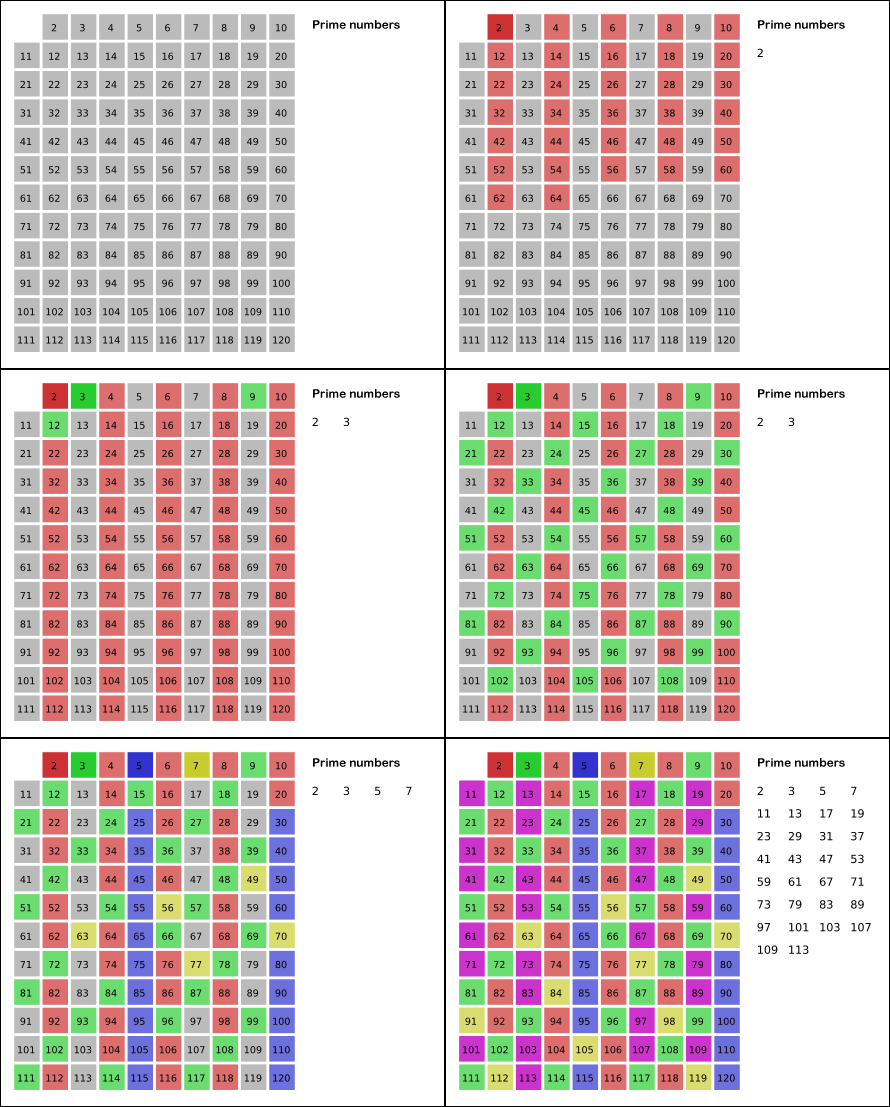
There are also fun tools like prime charts and sieve methods (like the Sieve of Eratosthenes) that help you find them. You could even write a computer program to find primes if you enjoy coding!
What Are Prime Factors?
Prime factors are prime numbers that multiply together to make another number. For example, the prime factors of 30 are 2, 3, and 5 because 2 × 3 × 5 = 30. This is called prime factorisation. Every number (except 0 and 1) can be broken down into prime numbers.
It’s like taking something apart to see what it’s really made of. This is super handy for finding the greatest common factor or the lowest common multiple when solving maths problems.
Why Do Prime Numbers Matter in Real Life?
Prime numbers aren’t just for schoolwork—they matter in the real world too. They’re used in computer security to keep your information safe when you’re online. Primes help make codes that are nearly impossible to break. They’re also used in programming, banking, and even in art and music. Who would’ve thought maths could help protect your bank card or your Instagram messages?
Are There Infinite Prime Numbers?
Yes, there are! Over 2,000 years ago, a Greek mathematician named Euclid proved that there are an infinite number of primes. That means no matter how far you go, you’ll always be able to find more. As numbers get bigger, primes become rarer, but they never stop.
People today are still discovering massive new prime numbers that are thousands or even millions of digits long!
What Is the Largest Known Prime Number?
The largest known prime number is huge—so big you couldn’t write it down on paper! It has over 24 million digits and was found using powerful computers. It’s part of a special group called Mersenne primes.
These are primes that look like 2^n – 1 (that’s 2 raised to a power, minus 1). You don’t need to remember that, but just know that mathematicians love chasing these giants!
What Is a Twin Prime?
Twin primes are pairs of prime numbers that are only two numbers apart, like 11 and 13 or 17 and 19. They’re like best friends who live next door. Mathematicians think there are infinitely many twin primes, but no one has proven it for sure. It’s one of the biggest mysteries in maths. If you like puzzles, this is the kind of problem you might solve one day!
Do Prime Numbers Follow a Pattern?
Prime numbers seem to pop up randomly at first, but mathematicians have found patterns and clues in how they appear. For example, all primes greater than 3 are either one more or one less than a multiple of 6. That’s because if a number can be divided by 2 or 3, it’s not a prime. These little clues help scientists build better ways to find primes faster.
What Is the Sieve of Eratosthenes?
This ancient method is a fun and clever way to find all the prime numbers up to a certain number. You start by writing all the numbers from 2 up to, say, 100. Then you cross out all the multiples of 2, then all the multiples of 3, then 5, and so on. The numbers that aren’t crossed out are prime! It’s like a filter that catches only the VIPs of the number world.
Can Prime Numbers Help with Fractions?
Definitely! When simplifying fractions, prime numbers come to the rescue. If you break the top and bottom of a fraction into prime factors, you can cancel out the common ones. For example, 18/24 becomes 3 × 3 / 3 × 2 × 2, and you cancel the threes. What’s left is 3/4. Prime numbers make this process quick and tidy, and it works every time.
How Do Primes Link to Multiplication and Division?
Multiplication is all about building numbers, and prime numbers are the bricks. Division helps you take numbers apart again. When you multiply prime numbers, you make new composite numbers.
When you divide, you’re trying to find out what primes went into that number. This back-and-forth is a key part of how maths works, and it shows why primes are so important.
Why Are Prime Numbers Great for Problem Solving?
Primes help you think in new ways. They’re often used in tricky brain teasers, puzzles, and even maths competitions. If you can spot a prime number or break something into primes quickly, you’ll solve problems faster. They help with logical thinking and recognising number patterns, which are great skills for school and beyond. Some puzzles even hide primes in secret codes!
Can Learning Primes Be Fun?
Yes! You can play games like “Prime or Not?” or race to spot the next prime in a number list. There are online tools and apps that let you test your prime-finding skills. You can even colour in prime numbers on a hundred-square and see amazing patterns appear. And here’s a joke that actually works: Why did 2 break up with 3? Because 2 was even and 3 was odd!
What Do You Remember?
What makes a number a prime number?
Why is 2 the only even prime number?
What is a prime factor, and how is it useful?
How does the Sieve of Eratosthenes work?
Why are prime numbers important in real life?
Write your answers in the comment section below.
Related Topics
If you enjoyed learning about prime numbers, you might want to explore more number topics like factors, multiples, and multiplication patterns. You could also dive into the world of codes and ciphers where prime numbers are superheroes. Understanding primes helps you see the maths behind the scenes in technology and puzzles.
Learn more:
What Do You Think?
If you found this to be an interesting topic, why not have your say. Or if you can think of ways we could improve it. We would love to know what you learned and more importantly, what you think. So now is your chance, use the comments section below to let us know your thoughts.