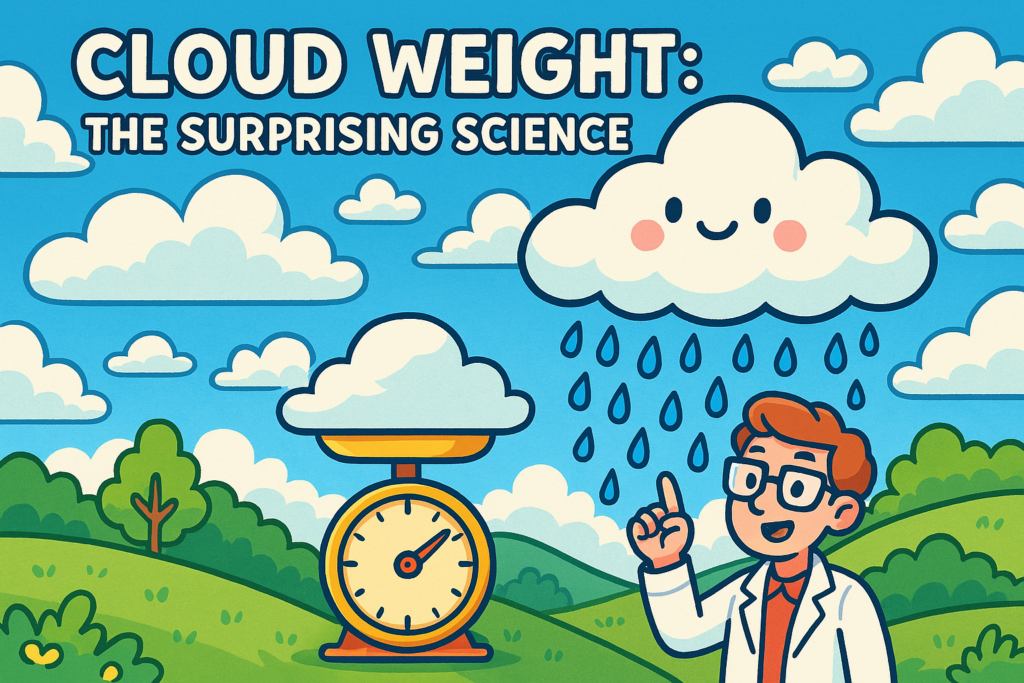
Cloud Weight: The Surprising Science (Lesson Plan)
Lesson Plan - Cloud Weight: The Surprising Science
Have you ever looked up at the sky and wondered how clouds float? They look so light and fluffy, but they can actually weigh hundreds of tonnes! This home education lesson plan breaks down that surprising fact in a way that’s simple, fun, and easy to teach – even if science isn’t usually your thing.
You’ll guide your child through ideas like mass, gravity, and why clouds don’t fall, with hands-on activities, thinking questions, and creative tasks along the way. Everything is written clearly with key words explained (like water vapour or air resistance), so you can feel confident leading the learning. It also links nicely to other science topics like the water cycle and air pressure.
The lesson plan gives structure without being strict. Whether you do it all in one go or split it across the week, it’ll get your child asking questions, making connections, and thinking like a scientist. And hopefully, next time you’re outside and someone spots a cloud, they’ll say, “That’s heavier than a truck!” — and be right.
This topic is part of our Info Zone collection. You can read the full article here: Cloud Weight: The Surprising Science
You’ll also find a full Lesson Plan and a handy Parent Q & A Sheet ready to use.
[cl_logged_in]
Overview
This home education lesson plan explores the surprising science behind cloud weight. Learners will discover how something that looks so light can actually weigh hundreds of tonnes. Through guided learning, practical tasks, and deeper thinking, children and teens will understand cloud formation, air resistance, and why clouds don’t fall from the sky. It also links directly to our full topic on cloud weight here: https://lenara.uk/science/cloud-weight-the-surprising-science
[br][br]
Learning Objectives
– Understand what clouds are made of
– Learn how scientists estimate cloud weight
– Explain why clouds float despite being heavy
– Explore how cloud weight relates to rain and storms
– Use scientific vocabulary like mass, vapour, and density
[br][br]
Estimated Time
60–90 minutes, or split across two sessions
[br][br]
Starter Activity
Ask: “How much do you think a cloud weighs?”
Then: Watch a cloud outside or in a photo and guess together. Encourage your child to explain their reasoning. Write the guesses down to revisit later.
[br][br]
Read and Learn
Read this short summary aloud or silently:
Clouds are made of tiny water droplets or ice crystals. Even though they float in the sky, they can weigh hundreds of thousands of kilograms! This happens because water has mass, and even small droplets add up. But because they’re spread out and very small, clouds don’t fall like solid objects. Instead, they hover thanks to air resistance and rising warm air.
Think about:
- How is a cloud different from steam or mist?
- Why don’t we feel the cloud’s weight when we walk outside?
- What would happen if cloud droplets were larger?
[br][br]
Guided Learning
Explain together: The water in clouds comes from oceans, rivers, and plants. It evaporates into gas (vapour), then cools and forms droplets. These gather in the sky to become clouds. The more droplets, the heavier the cloud. But they stay afloat because warm air pushes up and the droplets are tiny.
Use this example: Imagine holding one droplet — it weighs almost nothing. But now imagine holding a billion of them!
Key words to explore: mass (how much matter something has), density (how tightly packed it is), buoyancy (what makes things float)
[br][br]
Activities (with comprehension questions)
Activity 1 – Compare Weights: List common things and their weights (e.g. elephant = 6,000 kg). Compare these to a cloud’s estimated weight (500,000 kg).
Activity 2 – Build a Water Cloud: Fill a jar with water and add shaving foam on top. Gently drop food colouring onto the foam until it ‘rains’. This shows how clouds release rain when too full.
Comprehension Questions:
- What are clouds made of?
- Why do they float even though they’re heavy?
- How do scientists know a cloud’s weight?
- What causes clouds to release rain?
- Why is understanding cloud weight important?
[br][br]
Deeper Thinking
Big Question: “If something is heavy, does it always have to fall?”
Explore: Use a balloon and a rock as examples. Why does one float and the other fall? What does this tell us about how air and weight interact?
[br][br]
Creative Projects
– Draw and label a diagram showing how a cloud forms
– Make a comic strip about a water droplet’s journey from ocean to cloud to rain
– Write a short poem or story from the point of view of a droplet stuck in a heavy cloud
[br][br]
Review & Reflect
Ask your child:
- What surprised you the most?
- If you could float in a cloud, what would you see?
- How does cloud weight help us understand weather?
Revisit your cloud weight guesses from earlier. Were they close?
[br][br]
Continuation Of The Topic (Homework)
– Look up different types of clouds and their shapes (e.g. cumulus, cirrus)
– Create a chart showing cloud types and whether they usually cause rain
– Watch a weather forecast and spot references to clouds or rain – can your child explain why rain might happen?
[br][br]
[/cl_logged_in]
[cl_logged_out]
Members Only
You need to be registered and logged in to access this lesson plan and all other learning resources, games and quizzes.
[/cl_logged_out]