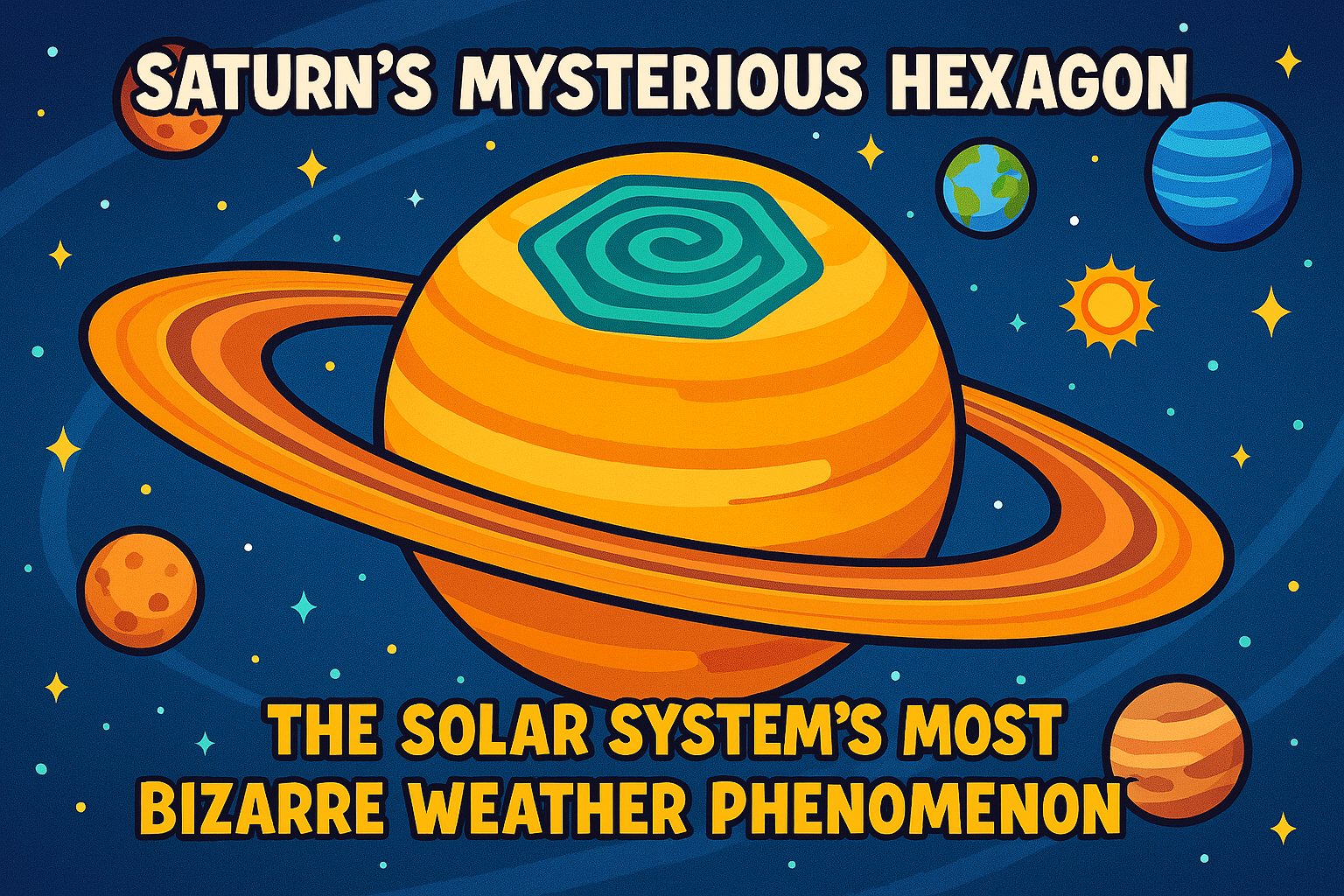
Saturn’s Mysterious Hexagon: The Solar System’s Most Bizarre Weather Phenomenon (Lesson Plan)
Lesson Plan - Saturn's Mysterious Hexagon: The Solar System's Most Bizarre Weather Phenomenon
Have you ever heard of a hexagon-shaped storm on another planet? Sounds like science fiction, right? But Saturn’s north pole really does have a strange six-sided weather pattern that scientists are still trying to fully explain. It’s called Saturn’s mysterious hexagon, and it’s one of the most fascinating discoveries in space science. This lesson gives your child a chance to explore the wonders of Saturn’s atmosphere, learn about space weather, and discover how science helps us understand planets far from Earth.
You don’t need a science degree to teach this topic. The lesson is designed for home education and uses clear language to explain complex ideas like jet streams (fast-moving air currents) and atmospheric pressure (the weight of air pushing down). There’s a mix of reading, hands-on tasks, and creative thinking, so it works for all kinds of learners—whether your child loves drawing, writing, or just asking big questions. By the end of the session, they’ll know how Saturn’s hexagon was discovered, why it’s such a puzzle, and how it compares to weather here on Earth. It’s a great way to make science feel exciting, approachable, and completely out of this world.
This topic is part of our Info Zone collection. You can read the full article here: Saturn’s Mysterious Hexagon: The Solar System’s Most Bizarre Weather Phenomenon
You’ll also find a full Lesson Plan and a handy Parent Q & A Sheet ready to use.
|
Lesson Plan Saturn's Mysterious Hexagon – The Solar System's Most Bizarre Weather Phenomenon |
|
|---|---|
| Overview | This lesson explores Saturn’s mysterious hexagon, a giant six-sided storm at the planet’s north pole. Learners will investigate how it was discovered, why it forms a hexagon, and what makes it so unusual. Includes activities for reading, writing, discussion, and creativity. Based on the article at Lenara.uk. |
| Learning Objectives |
- Identify what Saturn’s mysterious hexagon is and where it’s found - Explain how scientists discovered it and what we know so far - Compare Saturn’s storm systems with weather on Earth - Encourage critical and creative thinking through discussion and drawing |
| Estimated Time | 60–90 minutes |
| Starter Activity |
Ask: "Have you ever seen shapes in clouds? What would you think if you saw a perfect hexagon in space?" Show a picture of Saturn’s north pole (NASA’s real images). Ask your child to guess what they’re looking at. Why might it look so geometric? |
| Read and Learn |
Read the full article together or independently: Saturn’s Mysterious Hexagon: The Solar System’s Most Bizarre Weather Phenomenon Discuss these questions after reading:
|
| Activities |
Comprehension Questions:
Hands-On Science: Spin water in a bowl and drop in a few drops of food colouring. Try different speeds and directions—can you create any patterns? (Be sure to supervise.) Compare and Contrast: Create a chart comparing Saturn’s mysterious hexagon with a typical Earth hurricane. Include shape, size, wind speed, and location. |
| Deeper Thinking |
Big Question: "Why do you think the hexagon has stayed in place for so long without breaking apart?" Explore ideas about Saturn’s fast winds, its size, and the difference in atmosphere. Let your child come up with theories and test their reasoning. You could use a drawing or diagram to help them explain. |
| Creative Projects |
- Draw Saturn and its hexagon from space, including other planets and stars - Imagine you’re an astronaut looking at the hexagon from above. Write a short story or poem describing what you see and feel - Build a model of Saturn using a ball and paper rings. Use card to cut out a hexagon and attach it to the top |
| Review & Reflect |
|
| Extensions & Homework |
- Watch a short documentary or animation about Saturn’s atmosphere (BBC Bitesize or YouTube kids science channels) - Research other strange weather phenomena on planets (like Jupiter’s Great Red Spot) - Write a letter to NASA suggesting a future mission to study the hexagon up close |
[cl_logged_out]
Members Only
You need to be registered and logged in to access this lesson plan and all other learning resources, games and quizzes.
[/cl_logged_out]