Hello Alan Lloyd - Your Scores - Logout

Are You an NPC? Simulation Theory Fact or Fiction

Are You an NPC? Simulation Theory Fact or Fiction

Have you ever felt like life was just… too weird? Like things were repeating or people around you were acting like characters in a video game? You’re not alone! Some scientists and philosophers think we might actually be living in a computer simulation.

That’s right—just like a game, with code running everything. This idea is called the simulation theory, and it asks a big question: is the world around us really real? In this article, we’ll explore what NPCs are, how simulation theory works, and whether any of it could be true.
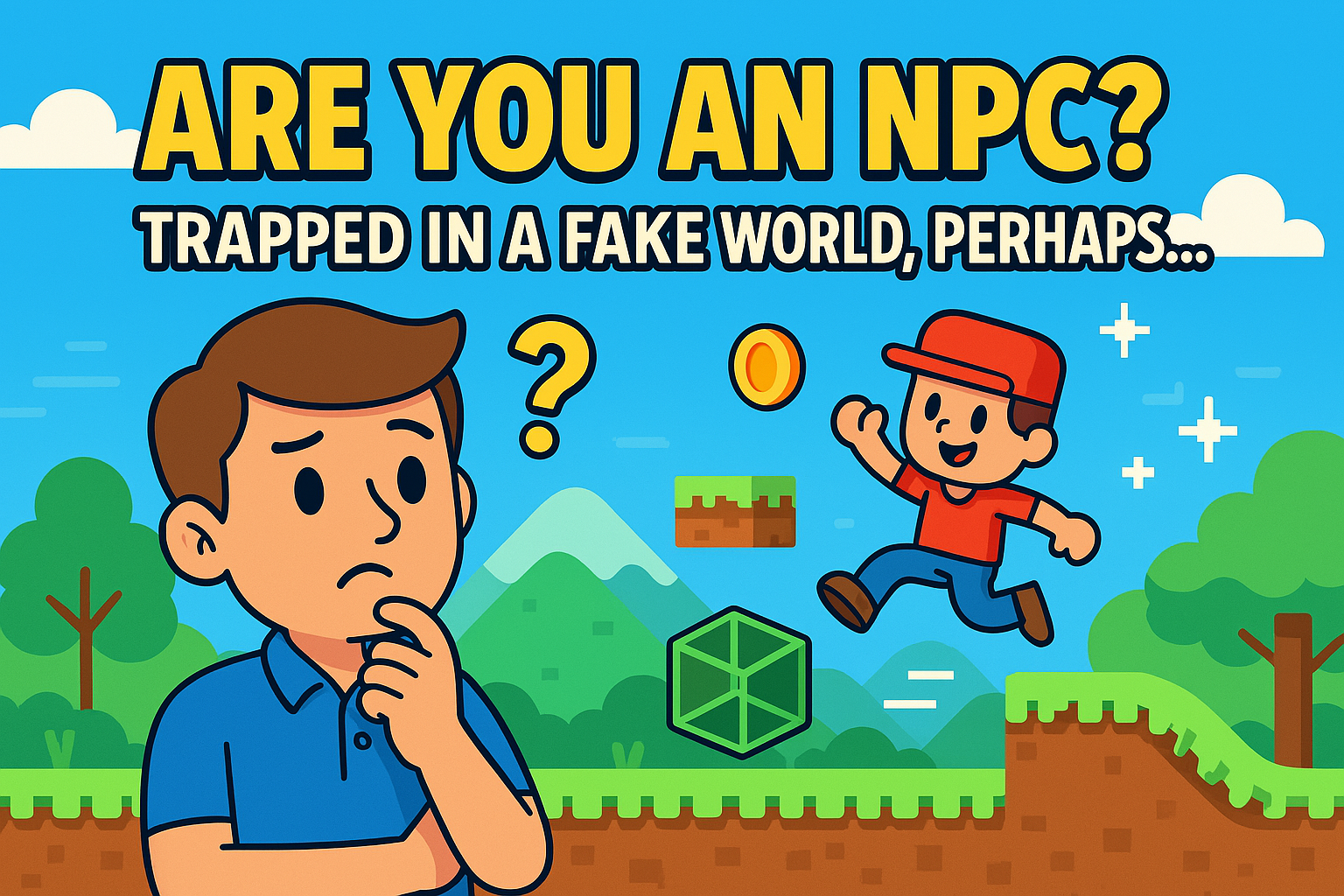
Are You an NPC? Trapped in a Fake World, Perhaps…
By Alan Lloyd


This topic is part of our Info Zone collection. You can read the full topic, once logged in, here: Are You an NPC? Simulation Theory Fact or Fiction

You’ll also find a full Lesson Plan and a handy Parent Q & A sheet, for this topic, ready to use..

What is an NPC and Why Are People Talking About It?

NPC stands for “Non-Player Character.” It’s a term used in video games to describe characters you can’t control. They follow set patterns, repeat the same lines, and don’t think for themselves. You might hear someone jokingly say, “That guy’s such an NPC,” meaning they seem to just go along with life without thinking.

People on social media and in science conversations have started wondering: what if *we* are NPCs? What if some people—or all people—are just part of a bigger simulation, like background characters in someone else’s story?

This may sound like science fiction, but it’s an idea being taken seriously by some very smart people, including scientists, computer experts, and philosophers.


What is Simulation Theory?

Simulation theory suggests that everything we see, hear, and feel might be part of a super-advanced computer program. This would mean the universe, Earth, even you and me, are just digital creations. It’s like being inside a giant version of The Sims or Minecraft!

The idea became popular thanks to a philosopher named Nick Bostrom, who wrote a paper in 2003 explaining how it could be possible. He said if humans ever create super-powerful computers that can simulate life, they might run millions of virtual worlds—and we might be inside one without knowing it.

Even famous people like Elon Musk have said they think it’s more likely that we’re in a simulation than not. But don’t panic—it’s still just a theory.


Could We Really Be Digital People?

Let’s think about video games. In a game, characters move, talk, and follow rules that the game’s code controls. Now imagine a game so detailed that the characters *think* they’re real. They see the world, have memories, and make choices.

Some people think our brains could be like that too—part of a program that gives us thoughts, feelings, and choices, even if everything is running on code.

However, scientists say there’s no proof of this yet. We don’t have any way to detect if our world is being controlled or simulated. It’s still just a big “what if?”


How Would a Simulation Even Work?

For a simulation like this to exist, you’d need an extremely powerful computer—way beyond anything we have now. It would have to process the behaviour of billions of people, weather, gravity, animals, and even galaxies.

One theory suggests the simulation could focus only on what we observe. In games, parts of the world don’t load until you look at them. Maybe our world does the same. Scientists have actually found tiny patterns in nature that *look* like computer code, though this doesn’t prove anything yet.

Still, it’s a fascinating idea. Could everything we experience just be pixels and programming?


Does Physics Give Us Any Clues?

Believe it or not, some physics theories sound a bit like computer programming. Quantum physics— the science of tiny particles—shows us that things only happen when they’re observed. This is called the observer effect.

It’s as if the universe waits for us to notice it before deciding what to do. That’s a little like how games don’t show the full world until you’re there.

Another idea is that our universe has limits, like the speed of light, and that could be like a simulation’s “rules.” But again, these are just interesting ideas, not proof.


Are There Glitches in Real Life?

Some people think strange coincidences or repeating patterns are “glitches in the matrix.” That’s a phrase from the film *The Matrix*, where people live inside a fake world without knowing it.

Examples might include déjà vu (the feeling you’ve lived something before), seeing numbers like 11:11 repeatedly, or noticing things that seem to change for no reason. While fun to think about, these are usually just our brains noticing patterns or playing tricks on us.

Science calls these “cognitive biases,” and they happen because our brains try to make sense of the world by finding meaning in things—even when it’s not really there.


Why Would Anyone Create a Simulation?

If we are in a simulation, who made it—and why? There are many guesses:

  • To study how life and humans develop
  • To replay history or test ideas
  • As entertainment for advanced beings
  • Or maybe we’re in a school experiment—like an ant farm for aliens!

It’s impossible to know for sure. If someone did create our world, they’re far more advanced than us.


Can We Escape the Simulation?

If this is a simulation, is there a way out? That’s a popular idea in films and books. In *The Matrix*, the main character takes a red pill to wake up from the fake world.

In real life, though, we have no such pill. There’s no way to leave if we don’t know we’re inside. Some scientists have tried to find clues, like weird cosmic rays or repeating numbers, but nothing has proven anything yet.

So for now, if we are in a simulation, we’re stuck here. But hey—it’s a pretty cool one!


Does It Even Matter If It’s Real?

Here’s the big question: if life feels real to you, does it matter if it’s a simulation? You still have feelings, dreams, friends, and choices. Whether real or virtual, your experiences still matter.

Many philosophers say what counts is how we live, not whether it’s “real.” Even in a simulation, kindness, learning, and doing good things can have meaning.

So instead of worrying, focus on living your best life—code or no code!


What Do Scientists Say?

Most scientists agree that simulation theory is interesting, but there’s no solid evidence yet. It’s more of a philosophical idea than a scientific fact.

Still, some are trying to test it. In 2017, a group at Oxford University said it’s almost impossible that we’re in a simulation. Others say we may never know.

Until there’s proof, it remains a theory—fun to think about, but not something to panic over.


Who Actually Believes in Simulation Theory?

It might surprise you to know that some very famous and smart people believe there’s a real chance we’re living in a simulation.

Elon Musk, the founder of Tesla and SpaceX, once said in an interview: “There’s a one in billions chance that this is base reality.” He explained that video games have become so realistic so quickly, that future games could be completely lifelike. If that happens, he argues, it’s far more likely we’re in one of those future simulations than in the original world.

Neil deGrasse Tyson, a well-known astrophysicist, has also weighed in. He said, “I think the likelihood may be very high… we might be in a simulation.” He added that if a species could become advanced enough to simulate a universe, they probably would—just like we make games now.

Even philosopher Nick Bostrom, who made the theory famous, believes that either advanced simulations will exist—or we’re already inside one. His 2003 paper laid out the logic: if it’s possible to create conscious beings inside simulations, and if people want to do it, then it’s likely it has already happened.

That doesn’t mean it’s proven—but it shows that simulation theory isn’t just some internet rumour. Some of the world’s top minds are seriously thinking about it.


So, Are You an NPC?

Unless someone’s controlling your every move, probably not! You have thoughts, emotions, and can make choices. That’s what makes you a player, not a background character.

Still, it’s a good reminder to think for yourself. Don’t just follow the crowd. Be curious. Ask questions. Challenge ideas. That’s how you know you’re truly awake—no matter what kind of world you live in.


What Do You Remember?

  • What does NPC stand for?
  • What is simulation theory?
  • How does physics hint at a possible simulation?
  • What are some reasons someone might create a simulation?
  • Do scientists think the theory is proven?

Write your answers in the comment section below.


Related Topics

If you enjoyed exploring simulation theory, you might be curious about other big questions, too. Learn more about how computers think, the nature of reality, or explore other mysteries of science and the mind. These topics will help you understand the strange and amazing world we live in—even if it turns out to be virtual!


What Do You Think?

If you found this to be an interesting topic, why not have your say. Or if you can think of ways we could improve it. We would love to know what you learned and more importantly, what you think. So now is your chance, use the comments section below to let us know your thoughts.


Leave a comment