The End of Everything: How the Universe Might Die (Lesson Plan)

Lesson Plan - The End of Everything: How the Universe Might Die

Understanding how the universe might end is a powerful way to explore the biggest scientific questions we can ask. This end of universe lesson plan gives you an easy way to guide your child through ideas like cosmic expansion, dark energy, black holes, and the far future of space itself. Theories like the Big Rip, Big Crunch, and Heat Death can sound complex, but this lesson plan breaks them down into friendly, step-by-step sections.

The End of Everything: How the Universe Might Die
By Alan Lloyd

It’s designed for parents without any science background. You’ll find clear goals, thought-provoking questions, and mini-tasks that build understanding layer by layer. Your child will develop critical thinking skills while learning how scientists use real evidence to make predictions about the death of the universe. There’s no need to know any physics ahead of time—everything is explained in simple, accurate language.

By the end, your child will be able to talk about the different ways the universe could end, understand what dark energy might do, and explore some of the strangest ideas in modern science. This end of universe lesson plan makes big ideas manageable and helps spark curiosity about space, time, and our place in it.


This topic is part of our Info Zone collection. You can read the full topic, once logged in, here: The End of Everything: How the Universe Might Die

You’ll also find a full Lesson Plan and a handy Parent Q & A sheet, for this topic, ready to use..

[cl_logged_in]

The End of Everything: How the Universe Might Die

This lesson plan is designed to help you support your child with this topic: The End of Everything: How the Universe Might Die

[br][br]

Learning Objectives (What You’ll Learn Today)

  • Understand the three main scientific theories about how the universe might end
  • Explore key concepts like dark energy, entropy, and black holes
  • Learn how science uses observation and data to predict cosmic events
  • Practise critical thinking and asking big scientific questions

[br][br]

Estimated Time

60–90 minutes

[br][br]

Let’s Get Started

Ask your child: What do you think will happen to the universe in the far future? Will it last forever, or could it end?

[br][br]

The Main Lesson

1. What Is the Universe?

The universe is everything—space, time, matter, and energy. It includes planets, stars, galaxies, and even empty space. Scientists believe it started with the Big Bang about 13.8 billion years ago, and it’s been expanding ever since.

Understanding the universe means looking at the biggest and oldest things in existence. It also means thinking about what might happen in the far, far future—billions or even trillions of years from now.[br]

Mini-Task: Ask your child to list everything they think exists in the universe. Include things they can’t see like black holes or energy.

[br][br]

2. Three Ways the Universe Might End

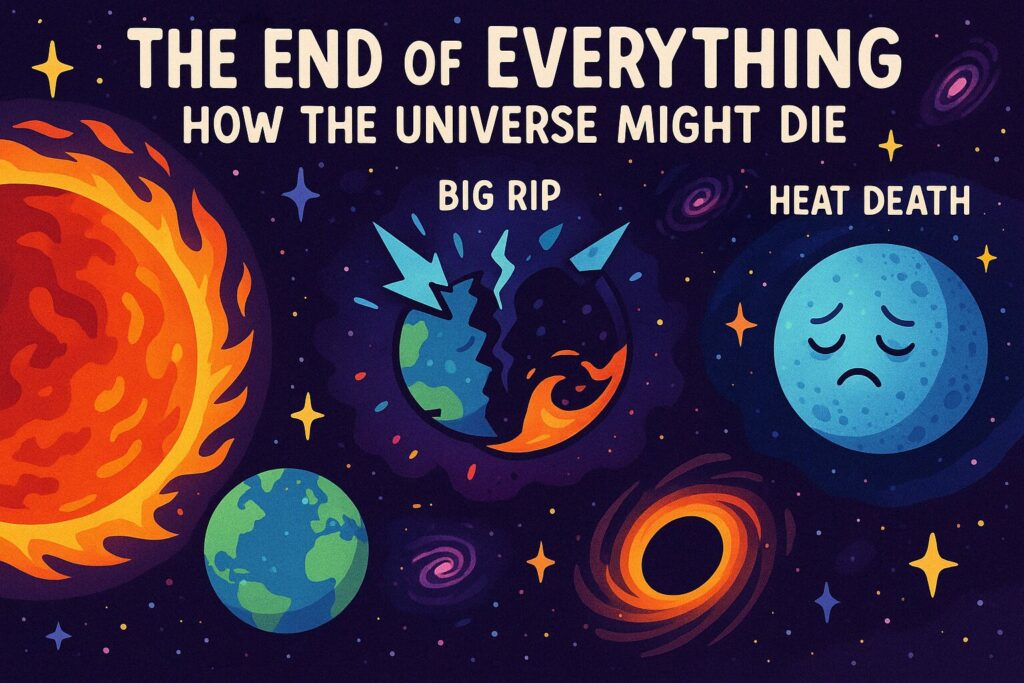
Scientists have suggested three main endings: the Big Rip, the Big Crunch, and Heat Death. Each one depends on how gravity and dark energy behave over time.

The Big Rip means the universe tears apart. The Big Crunch is a collapse of everything back into one point. Heat Death is a slow fade where everything freezes. These ideas help us explore the possible death of the universe using science and logic.[br]

Mini-Task: Draw three boxes and label them “Rip,” “Crunch,” and “Freeze.” Add a short description or sketch for each theory.

[br][br]

3. What Is Dark Energy?

Dark energy is a mysterious force that makes the universe expand faster over time. We don’t know exactly what it is, but it makes up most of the universe.

If dark energy keeps growing, it could cause the Big Rip. If it weakens, gravity might pull everything back in for a Big Crunch. If it stays steady, we may see Heat Death. This shows how powerful dark energy is when it comes to how the universe ends.[br]

Mini-Task: Ask your child to explain what they think dark energy is in their own words, even if it’s a guess!

[br][br]

4. Black Holes and Cosmic Time

Black holes are regions of space where gravity is so strong that nothing can escape. Over time, even black holes might disappear due to something called Hawking radiation.

In the very distant future—far beyond anything we can imagine—black holes could be the last things left. After they vanish, the universe may be completely empty. This is part of the Heat Death idea and shows how long cosmic time really is.[br]

Mini-Task: Imagine a timeline from the Big Bang to the death of the universe. Ask your child to mark where we are now and where black holes vanish.

[br][br]

5. Could the Universe Reboot?

Some scientists think the universe might start again after it ends. In a Big Crunch, a new Big Bang might follow. In a multiverse, other universes might pop into existence even if ours ends.

These ideas are still being explored, but they show how science keeps asking new questions—even about the end of everything. Thinking about the universe collapse can lead to new discoveries about how reality works.

Mini-Task: What do you think would happen if the universe started over? Ask your child to describe their idea of a “new” universe.

[br][br]

Think and Discuss

  • Why do scientists think the universe is expanding?
  • Which of the three endings sounds the most likely to you? Why?
  • If the universe ends, do you think something else could come after?

[br][br]

Wrap-Up Summary

The universe might end in several different ways, depending on how energy and gravity behave over time. By looking at the death of the universe, we can better understand how it began and how science tries to explain everything—even the unknown.

[br][br]

Quiz

  1. What are the three main theories for how the universe might end?
  2. True or False: Dark energy slows down the universe’s expansion.
  3. What is a black hole?
  4. Which theory describes the universe slowly freezing over time?
  5. What is Hawking radiation?
  6. True or False: The universe has stopped expanding.
  7. What could happen after a Big Crunch?
  8. Which force pulls things together in space?
  9. What does dark energy do?
  10. True or False: Scientists know exactly how the universe will end.

[br][br]

Answers

  1. Big Rip, Big Crunch, Heat Death
  2. False
  3. A place with strong gravity where not even light can escape
  4. Heat Death
  5. Energy lost by black holes over time
  6. False
  7. Another Big Bang or new universe
  8. Gravity
  9. It makes the universe expand faster
  10. False

[br][br]

Short Essay Prompt

Write a short essay explaining the difference between the Big Rip and Heat Death. Include what causes each one and what the universe would look like in the end.

[br][br]

Extra Learning

Research the James Webb Space Telescope. How does it help scientists learn about the early universe—and possibly how it might end?

[br][br]

Final Reflection (What Did You Learn?)

Ask your child: What did you learn today that surprised you the most? Which theory about how the universe ends do you think makes the most sense?

[br][br]
[/cl_logged_in]

[cl_logged_out]

Members Only

You need to be registered and logged in to access this lesson plan and all other learning resources, games and quizzes.

[/cl_logged_out]

Leave a comment