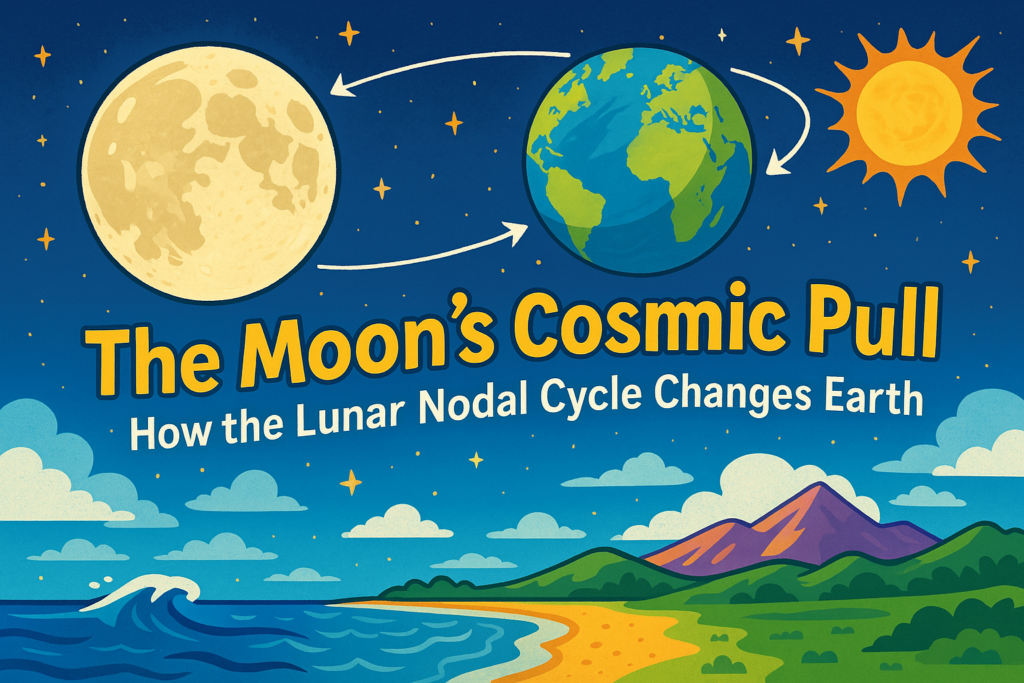
The Moon’s Cosmic Pull: How the Lunar Nodal Cycle Changes Earth (Lesson Plan)

Lunar Nodal Cycle: How the Moon’s Cosmic Pull Changes Earth

The lesson plan for The Moon’s Cosmic Pull: How the Lunar Nodal Cycle Changes Earth is designed to help parents and carers guide learners through this fascinating space science topic. It provides a complete structure for exploring how the Moon’s orbit affects Earth’s tides, climate, animal life, and even the planet’s tilt.

The plan includes clear learning objectives, discussion ideas, creative tasks, comprehension questions, and deeper thinking prompts to encourage curiosity and critical thinking. Parents will find ready-made activities suitable for a range of ages and abilities, along with suggestions for adapting tasks to suit their learner’s interests.

This resource is ideal for families using Elective Home Education and offers flexibility to allow parents to deliver the lesson in a way that works best for their child, whether as a one-off study session or as part of a larger project on space, weather, or Earth science.


This topic is part of our Info Zone collection. You can read the full article here: The Moon’s Cosmic Pull: How the Lunar Nodal Cycle Changes Earth

You’ll also find a full Lesson Plan and a handy Parent Q & A Sheet ready to use.

[cl_logged_in]
Lesson Plan
The Moon’s Cosmic Pull – How the Lunar Nodal Cycle Changes Earth
OverviewThis lesson explores the fascinating relationship between the Moon and Earth. Learners will investigate the lunar nodal cycle, its effects on tides, climate, animal behaviour, and Earth's natural rhythms. The lesson is fully adaptable for Elective Home Education and encourages curious thinking about the natural world.
Learning Objectives - Understand what the lunar nodal cycle is and how it works
- Explore how the Moon’s pull affects tides, weather, and Earth's tilt
- Investigate the impact on animals and climate
- Make connections between space science and everyday life
Estimated Time45–75 minutes
Starter Activity Discuss: “What do you think would happen if the Moon suddenly disappeared?”
Look at pictures of the Moon and tides. Can learners explain what they already know about tides?
Optional: Use a bowl of water and a ball to model how the Moon pulls water to make tides.
Read and Learn Read the article together or individually:

The Moon’s Cosmic Pull: How the Lunar Nodal Cycle Changes Earth

After reading, discuss:

  • What is the lunar nodal cycle, and why is it important?
  • How does the lunar nodal cycle change tides over time?
  • What surprised you most about how the Moon affects Earth?
  • How do animals rely on the Moon's effects to survive?
Activities Comprehension Questions:

  1. What causes the lunar nodal cycle?
  2. How long does one complete cycle take?
  3. Why are tides sometimes higher during certain years?
  4. How might this cycle influence the weather?
  5. What could happen if this cycle were ignored when planning coastal cities?

Creative Drawing:

Draw a diagram showing the Earth, Moon, and how the lunar nodal cycle might tilt the Moon's orbit. Label key parts: the nodes, Earth, Moon, and tidal bulges.

Role-play:

Pretend you are a scientist explaining the lunar nodal cycle to a class of younger children. Practise giving a simple and clear explanation.
Deeper Thinking Big Question: “If the Moon affects our tides and weather, do you think it could affect life on land more than we realise?”
Discuss or write down possible ideas. Encourage learners to think about animals, plants, and even people.
Creative Projects - Create a fact poster about the lunar nodal cycle to display at home
- Make a mini-booklet explaining how the Moon influences Earth
- Invent a fictional world where the Moon is much bigger. How would life there be different?
Review & Reflect Ask the learner:

  • What is one new thing you learned today?
  • What would you like to know more about?
  • How could knowing about the lunar nodal cycle help people who live near the sea?
Extensions & Homework - Research another space cycle, such as Milankovitch cycles
- Write a short story about an explorer discovering the secret of the lunar nodal cycle
- Track the Moon's position and local tides for a week — record your results
[/cl_logged_in]

[cl_logged_out]

Members Only

You need to be registered and logged in to access this lesson plan and all other learning resources, games and quizzes.

[/cl_logged_out]