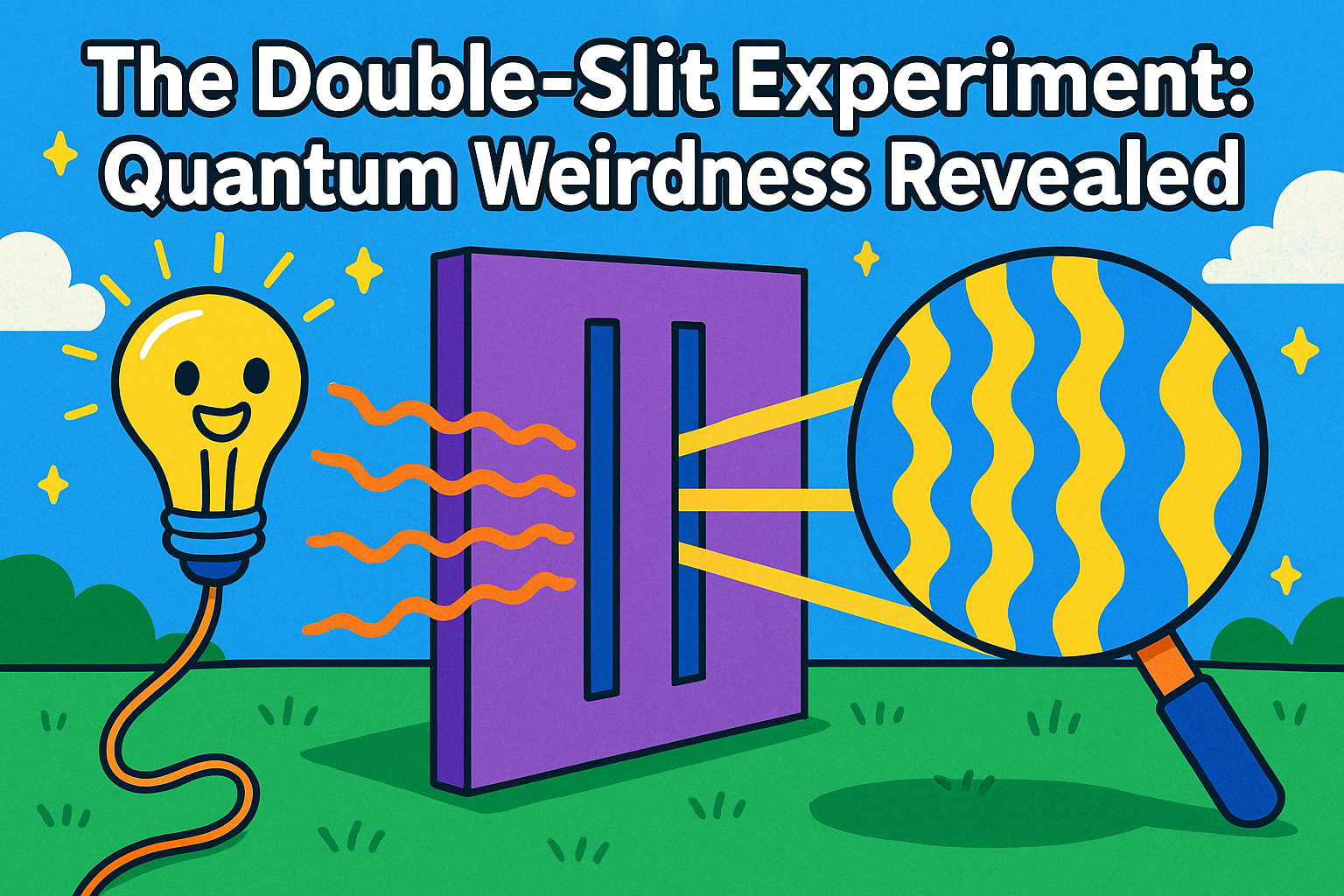
Quantum Interference Lesson Plan: Teaching the Double-Slit Test
Lesson Plan - Quantum Interference Lesson Plan: Teaching the Double-Slit Test
If you’re feeling unsure about how to explain quantum physics at home—don’t worry, you’re not alone! This lesson plan takes one of the most famous science experiments ever—the double-slit experiment—and breaks it down into easy-to-understand parts for learners aged 8 to 16. The double-slit experiment shows us that tiny particles, like electrons, can behave like waves and that just observing something can actually change what happens. It sounds strange, but that’s what makes it so fascinating.
This guide walks you through everything step by step. There’s a mix of reading, discussion, simple hands-on activities, and creative tasks to keep things varied. You’ll also get questions to check understanding, spark curiosity, and encourage deeper thinking. You don’t need a science degree to teach this! I’ve included clear explanations of tricky terms (like “wave-particle duality”) so you can feel confident leading the lesson, even if quantum physics sounds intimidating.
Whether your child loves science or just asks lots of “how” and “why” questions, this lesson will give you both a glimpse into the weird and wonderful world of quantum mechanics. Just follow along, enjoy the journey—and get ready to rethink what reality really means!
This topic is part of our Info Zone collection. You can read the full article here: Double-Slit Experiment Explained: What It Reveals About Reality
You’ll also find a full Lesson Plan and a handy Parent Q & A Sheet ready to use.
|
Lesson Plan The Double-Slit Experiment – Quantum Weirdness Revealed | |
|---|---|
| Overview | This lesson explores the famous double-slit experiment and how it reveals the strange behaviour of particles in quantum physics. Learners will discover how light and matter can act like both particles and waves, and how observation itself can change outcomes. Designed to support your teaching at home, this lesson makes complex ideas clear and engaging. |
| Learning Objectives |
- Understand the setup and findings of the double-slit experiment - Learn the meaning of wave-particle duality and quantum interference - Explore how observation affects results in quantum experiments - Develop curiosity about how science explains reality |
| Estimated Time | 60–90 minutes |
| Starter Activity |
Ask: “If you shine a torch through two holes, what pattern will appear on the wall?” Predict together and draw it. Then say: “What if I told you tiny particles behave like waves—and that watching them might change what they do?” Watch a short intro video on quantum interference (optional). |
| Read and Learn |
Visit and read our full topic: The Double-Slit Experiment: What It Reveals About Reality. Then discuss the following:
|
| Activities | Comprehension Questions:
Hands-On Activity: Use a torch, card with slits, and a white surface to simulate the light version (basic visual only). Talk about how light spreads and interferes. Compare and Contrast: Use balls, water ripples, and light to compare particles and waves. Create a simple table listing differences and similarities. |
| Deeper Thinking | Big Question: "If watching something can change it, what does that say about reality?" Explore: Could this mean that our minds or choices matter in shaping the world? |
| Creative Projects |
- Write a sci-fi story where reality changes when someone is observed - Draw what you imagine quantum waves look like - Design a comic strip showing particles trying to “hide” their wave behaviour |
| Review & Reflect | Ask your learner:
|
| Extensions & Homework |
- Research another quantum experiment (like Schrödinger’s cat) - Watch a documentary or science video on quantum physics - Create a glossary of quantum terms like interference, wave, particle, observation, duality |
[cl_logged_out]
Members Only
You need to be registered and logged in to access this lesson plan and all other learning resources, games and quizzes.
[/cl_logged_out]