Finding Rules for Number Sequences
If a sequence continued for a thousand terms, could its thousandth term be identified without writing out the other 999? Open Full Article...

Home schooling resources for children and parents.
Explore Maths | Lenara Learning
Maths develops accuracy, reasoning and confidence with patterns, quantities and relationships. This Maths category focuses on number, algebra, geometry, statistics, probability and problem-solving strategies used in everyday life and further study. The online lessons are written for curious children and teenagers, with clear explanations that introduce important ideas without assuming specialist knowledge.
Learners can build subject vocabulary, examine useful examples and connect maths to wider questions across school subjects and everyday life. Each lesson aims to explain not only what happens, but how we know and why the topic matters.
The category encourages learners to ask questions, compare evidence and recognise where an answer depends on context, interpretation or further investigation. Difficult concepts are broken into manageable steps so that learners can develop understanding rather than simply memorising facts.
Whether the subject is being studied as part of home education or home schooling, used for revision or explored through personal interest, these lessons support independent thinking and confident discussion. New material can be added as the collection develops.
Browse the lessons below to start learning.
If a sequence continued for a thousand terms, could its thousandth term be identified without writing out the other 999? Open Full Article...
Why can points that look almost identical belong to different graphs? Open Full Article...

How can 3(x + 4) and 3x + 12 look different yet represent the same value? Open Full Article...

If two sides have the same value, what does the equals sign actually tell us? Open Full Article...

A number is hidden in the statement □ + 3 = 8, yet the relationship is already clear. Open Full Article...

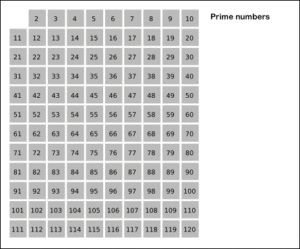
Why is 7 prime, while a larger number such as 8 is not? The answer depends not on the size of a number but on the exact structure of its factors. Open Full Article...
Times tables become clearer when each answer is understood as the total from equal groups. Open Full Article...

Why is three-eighths smaller than three-fifths, even though both fractions have the same numerator? Open Full Article...

How can a scoreboard show 0 while still displaying a real numerical result? Open Full Article...

How can an answer be exact when no digits are written down? Open Full Article...
