
Home Education Laws in England, Wales and Scotland
Home education is legal across England, Wales and Scotland, but the rules are not exactly the same in each country. This guide explains the current law, how to withdraw a child from school, what local authorities can ask for, and what the new 2026 legislation may change.
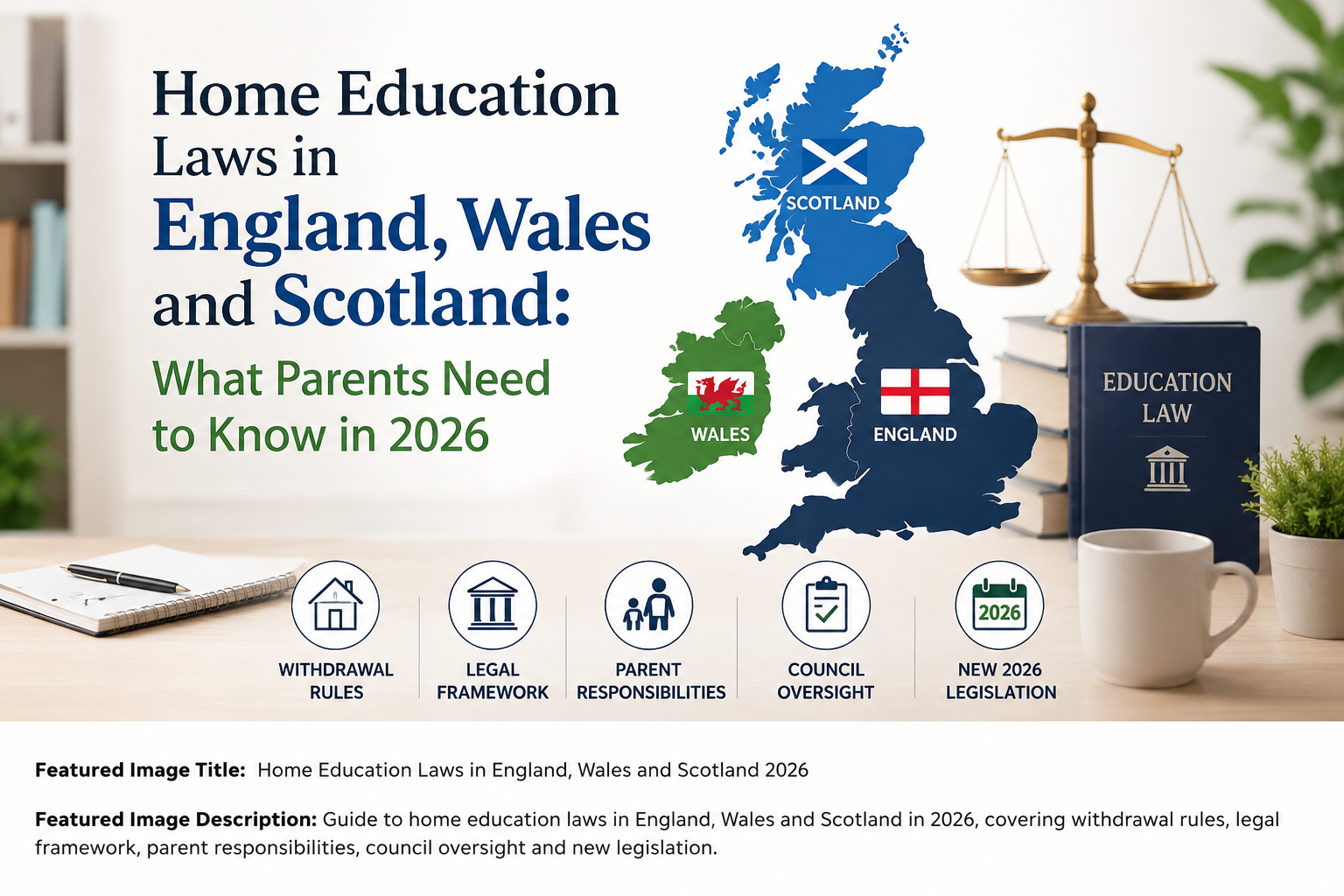
Home education is legal in England, Wales and Scotland, but the rules are not exactly the same in each country.
This guide explains your responsibilities as a parent, how to withdraw a child from school, what local authorities can ask for and how the Children’s Wellbeing and Schools Act 2026 may affect home-educating families.
The general information comes first. You can then find separate, clearly marked sections for England, Wales and Scotland.
Please note: This article provides general information about home education law. It is not a substitute for legal advice about your family’s individual circumstances.
Home Education Laws at a Glance
| Question |
England |
Wales |
Scotland |
|---|---|---|---|
| Is home education legal? | Yes | Yes | Yes |
| Is council permission normally required? | No, when leaving an ordinary mainstream school | No, when leaving an ordinary mainstream school | Usually yes, when leaving a public school |
| Must you follow the national curriculum? | No | No | No |
| Can the local authority make enquiries? | Yes | Yes | Yes, where it needs to establish that suitable education is being provided |
| Are new Children Not in School registers planned? | Yes | Yes | No |
Jump to Your Country
Is Home Education Legal in the UK?
Yes. Parents may educate their child at home instead of sending them to school, provided they arrange a suitable education.
This is commonly called elective home education, or EHE. The word “elective” means that the parent has chosen to take responsibility for the child’s education.
Education is compulsory, but attending school is not always compulsory.
Home education does not need to copy a school timetable or classroom. Families may use structured lessons, projects, practical activities, online resources, books, tutors, educational visits and child-led learning.
The main legal question is whether the child is receiving a suitable education, not whether their education looks like school.
What Is Compulsory School Age?
The detailed rules about when compulsory school age begins and ends differ slightly between the three countries.
In general, the legal duty to provide education applies once a child reaches compulsory school age. Parents of younger children may still educate them at home, but the compulsory education rules do not yet apply in the same way.
Parents should check the rules for their country, particularly when a child is approaching school age or the end of compulsory education.
What Counts as a Suitable Home Education?
There is no single approved home-education curriculum, timetable or teaching method.
A suitable education should normally:
- take account of the child’s age, ability and aptitude
- address any special educational or additional learning needs
- allow the child to learn and make progress
- prepare the child for adult life
- help the child participate in their community and wider society
- avoid unnecessarily limiting the child’s future opportunities
- provide regular and genuine learning
- be appropriate to the child’s individual circumstances
The education does not have to cover every subject taught in school. However, parents should consider how their child will develop important skills such as reading, writing, communication, mathematics, digital skills, independent learning and practical life skills.
Do Home-Educated Children Need to Follow a Curriculum?
Home-educating parents are not normally required to follow:
- the National Curriculum in England
- the Curriculum for Wales
- Scotland’s Curriculum for Excellence
Parents can choose the subjects, resources, timetable and teaching methods that suit their child.
The freedom to choose a different curriculum does not remove the duty to provide a suitable education.
Tests, GCSEs and Qualifications
Home-educated children are not automatically required to take school-based tests.
Parents may arrange GCSEs, International GCSEs or other qualifications privately. This usually means finding an examination centre that accepts private candidates.
Families may have to pay:
- examination entry fees
- administration charges
- fees for practical assessments or coursework
- travel costs
- the cost of textbooks, courses or tuition
Not every examination centre accepts private candidates or offers every subject. Parents planning formal qualifications should investigate examination arrangements well in advance.
Who Pays for Home Education?
Parents who choose elective home education normally take financial responsibility for their child’s education.
This can include books, computers, internet access, subscriptions, tutors, educational visits and examination costs.
Some local authorities provide limited support, resources or help with examinations, but this varies. Parents should not assume that funding will be available.
Important distinction: Elective home education is different from education arranged by a local authority because a child is ill, excluded or unable to attend school. Where the authority is responsible for arranging education, the parent should not simply be expected to fund everything themselves.
Socialisation and Home Education
Socialisation does not have to take place in school.
Home-educated children may meet other people through:
- sports and activity clubs
- home-education groups
- community groups
- volunteering
- libraries and museums
- family activities
- friendships and social events
- online learning communities
Parents should consider whether their child has suitable opportunities to develop relationships, communication skills and independence.
Can a Home-Educated Child Return to School?
Yes. Home education does not have to be permanent.
Parents can apply for a school place through the normal admissions process. However, the child’s previous school or preferred school may not have a place available.
The child may be offered a place at another suitable school. The receiving school will also make decisions about year-group placement, subject choices and examination entry.
Before You Remove a Child From School
Before withdrawing a child, consider:
- Why you are considering home education.
- Whether problems at school could be resolved.
- What your child thinks about the decision.
- How you will provide regular education.
- What resources and support you will need.
- How you will arrange qualifications.
- What social opportunities will be available.
- How any special or additional needs will be supported.
- What records of learning and progress you will keep.
- How you would manage if your circumstances changed.
Check Before Withdrawing
Do not assume that the usual withdrawal process applies if:
- your child attends a special school
- a School Attendance Order is in force
- your child has an Education, Health and Care plan
- your child has an Individual Development Plan
- your child attends a Scottish public school
- children’s social care is involved
- your child is subject to particular safeguarding arrangements
A school should not pressure a parent into removing a child simply because of attendance problems, behaviour, special educational needs or unmet support requirements.
The Children’s Wellbeing and Schools Act 2026
The Children’s Wellbeing and Schools Act 2026 received Royal Assent on 29 April 2026. Royal Assent means that the bill completed the parliamentary process and became an Act of Parliament.
The Act contains measures covering schools, safeguarding, children’s social care and children who are not registered at school.
One of the main changes affecting home education is the introduction of local authority Children Not in School registers in England and Wales.
These registers are intended to help local authorities identify children who are not registered at school and understand what education they are receiving.
The Act may also require parents and certain education providers to supply specified information. It also changes parts of the School Attendance Order process and introduces additional safeguards for some vulnerable children.
Has Every Part of the Act Started?
No. An Act becoming law does not necessarily mean that every section starts operating immediately.
Some provisions require commencement regulations. These are legal instructions that specify when a section of an Act begins to operate.
Detailed regulations and statutory guidance may also be required before councils can operate the new system fully.
The new Act does not ban home education. Parents will still be able to educate their children at home, provided they meet their legal responsibilities.
The Children Not in School provisions apply to England and Wales. They do not create the same registration system in Scotland.
What Parents Should Do Now
- follow the current law in your country
- check the correct withdrawal process before removing a child
- keep copies of withdrawal letters and official correspondence
- keep reasonable records of your child’s education
- respond constructively to legitimate local authority enquiries
- check whether special rules apply to your child
- watch for official announcements about the 2026 Act
- be cautious about social-media posts claiming that every new rule already applies
Home Education Law in England
The Legal Duty in England
Section 7 of the Education Act 1996 requires parents to make sure that a child of compulsory school age receives an efficient, full-time education suitable to:
- their age
- their ability
- their aptitude
- any special educational needs they may have
This education can be provided through regular attendance at school or otherwise.
The law does not set a fixed number of daily teaching hours for home education. “Full-time” does not mean that parents must copy ordinary school hours.
How to Withdraw a Child in England
When a child attends an ordinary mainstream school, a parent can normally write to the headteacher and state that the child is being withdrawn to receive education at home.
For a complete withdrawal, the school should normally remove the child’s name from its admission register.
England Withdrawal Checklist
- Check whether the child attends a mainstream or special school.
- Check whether a School Attendance Order is in force.
- Write clearly to the headteacher.
- State that the child will receive education otherwise than at school.
- Keep a dated copy of the letter.
- Ask the school to confirm removal from the admission register.
When Is Permission Required in England?
Different rules may apply when:
- the child attends a special school under arrangements made by the local authority
- the child is subject to a School Attendance Order
In these circumstances, local authority consent may be required before the child can be removed from the school roll.
A child attending a mainstream school does not normally require council permission simply because they have an Education, Health and Care plan. However, the local authority will continue to have responsibilities connected with that plan.
What Can the Council Ask For in England?
A local authority may make enquiries when it needs to establish whether a child is receiving suitable education.
The council may ask for:
- a written description of the education
- examples of work
- information about resources and activities
- evidence of progress
- a meeting with the parent or child
- a home visit
There is not currently a general automatic right for a council officer to enter a family home solely because a child is home educated.
Parents may demonstrate the education through written information, samples of work, discussions or a meeting at another location.
However, refusing to provide any meaningful information may make it difficult to show that suitable education is being provided.
School Attendance Orders in England
A School Attendance Order is a formal legal process that may be used when a local authority believes that a child is not receiving suitable education.
The parent will normally be given an opportunity to show that suitable education is being provided.
If the authority remains unsatisfied, the order may name a school that the child must attend. Ignoring a valid School Attendance Order can lead to prosecution.
Flexi-Schooling in England
Flexi-schooling means that a child attends school for part of the week and receives education elsewhere for the remainder.
Parents may request flexi-schooling, but there is no automatic right to it. The headteacher can agree or refuse the arrangement.
A flexi-schooled child remains registered at the school.
How the 2026 Act Affects England
The Children’s Wellbeing and Schools Act 2026 provides for local authorities in England to maintain Children Not in School registers.
Parents and certain education providers may be required to provide specified information once the relevant provisions are operating.
The Act also introduces additional safeguards affecting the withdrawal of some vulnerable children and changes parts of the School Attendance Order process.
The practical requirements will depend on the commencement of the relevant provisions and the regulations and guidance supporting them.
Home Education Law in Wales
The Legal Duty in Wales
The main parental duty in Wales also comes from section 7 of the Education Act 1996.
Parents must provide an efficient, full-time education suitable to the child’s:
- age
- ability
- aptitude
- additional learning needs
Education is compulsory, but school attendance is not the only lawful way to provide it.
How to Withdraw a Child in Wales
When a child attends an ordinary mainstream school, a parent can normally write to the headteacher and request that the child is removed from the school roll for home education.
Local authority permission is not generally required for withdrawal from an ordinary mainstream school.
Wales Withdrawal Checklist
- Check whether the child attends a mainstream or special school.
- Check whether a School Attendance Order applies.
- Write clearly to the headteacher.
- State that the child will receive education at home.
- Keep a dated copy of the letter.
- Ask for written confirmation that the school roll has been updated.
When Is Permission Required in Wales?
Additional restrictions may apply where:
- the child attends a special school under local authority arrangements
- a School Attendance Order is in force
- another specific legal arrangement applies
Parents should check the position before removing the child from the school roll.
What Can the Council Ask For in Wales?
Welsh local authorities have responsibilities to identify children who may not be receiving suitable education.
A council may ask for:
- written information
- examples of learning
- information about progress
- a conversation with the parent
- contact with the child
- a meeting or home visit
Parents should be given a reasonable opportunity to demonstrate that the education is suitable.
Parents do not normally have to accept a home visit simply because they are home educating. However, refusing all meaningful communication or evidence may make it harder to establish that suitable education is being provided.
Additional Learning Needs in Wales
Wales uses the term additional learning needs, usually shortened to ALN.
A home-educated child may still be entitled to a decision about whether they have additional learning needs and whether an Individual Development Plan is required.
Responsibility for provision can depend on:
- the child’s circumstances
- whether an Individual Development Plan already exists
- what provision was in place before home education began
- whether the child remains registered at a school
Parents considering withdrawal because a child’s needs are not being met should ask the school and local authority to explain what support would continue after the child leaves the school roll.
How the 2026 Act Affects Wales
The Children Not in School provisions of the Children’s Wellbeing and Schools Act 2026 apply to Wales as well as England.
Local authorities will be required to maintain registers containing information about children who are not registered at school.
Parents and carers may be required to provide specified information once the relevant provisions are operating.
The measures increase local authority oversight but do not remove the right to choose elective home education.
The exact procedures will depend on commencement arrangements, regulations and Welsh guidance.
Home Education Law in Scotland
The Legal Duty in Scotland
Scotland has its own education legislation.
Section 30 of the Education (Scotland) Act 1980 requires parents to provide an efficient education suitable to the child’s:
- age
- ability
- aptitude
This can be done by sending the child to school or by other means.
Permission to Withdraw a Child in Scotland
This is one of the most important differences between Scotland and England or Wales.
When a child has been attending a Scottish public school, the parent normally needs the local education authority’s consent before withdrawing the child.
The authority must not unreasonably withhold consent.
Scotland Withdrawal Checklist
- Check whether the child attends a public or independent school.
- Contact the local education authority.
- Make a written request for consent to withdraw.
- Explain the proposed educational arrangements.
- Keep copies of the request and supporting information.
- Wait for consent before assuming the child has left the school roll.
When Is Consent Not Normally Required in Scotland?
Consent is generally not required where:
- the child has never attended a public school
- the child has never attended a public school in that authority’s area
- the child is leaving an independent school
- the child has finished primary school but has not started secondary school
- the school has closed
- the child is not yet of school age
Consent relates to withdrawal from the public-school roll rather than permission to home educate in principle.
Parents do not have to be qualified teachers or provide a particular philosophical reason for choosing home education.
What Happens While Consent Is Considered?
Parents should not assume that submitting a request immediately removes the child from the school roll.
Until consent has been given, the child will normally remain registered at the school.
Parents should obtain clear written information from the school or local authority about attendance while the request is being considered.
What Can the Council Ask For in Scotland?
Scottish local authorities can seek information where they need to establish that an efficient and suitable education is being provided.
Information may be provided through:
- a conversation
- a written report
- samples of work
- photographs
- electronic learning records
- a video or telephone discussion
- a meeting at an agreed location
The council does not have an automatic right to enter the family home as part of routine contact.
Refusing a home visit is not, by itself, proof that the education is unsuitable. However, parents should normally provide another reasonable way for the authority to understand the education being provided.
Additional Support Needs in Scotland
Scotland uses the term additional support needs.
Parents should discuss existing support arrangements with the school and education authority before withdrawing a child.
The support that remains available may depend on the child’s needs, the existing arrangements and the responsibilities of the local authority.
Does the 2026 Act Apply in Scotland?
The Children Not in School register provisions of the Children’s Wellbeing and Schools Act 2026 do not apply in Scotland.
Scotland continues to operate under its own education legislation and Scottish Government guidance.
Parents in Scotland should follow Scottish withdrawal procedures rather than guidance written specifically for England or Wales.
Official Home Education Guidance
Home education law and government guidance can change. Parents should check the official information for their country before withdrawing a child from school.
- Elective home education guidance for England
- Elective home education guidance for Wales
- Home education guidance for Scotland
- Children’s Wellbeing and Schools Act 2026
Information checked and updated on 4 August 2026.